
Year 3 Learning from Home Week 7 Term 3
Week Beginning - 31 August 2020

Please remember to:
- set up a timetable for the day that works for everyone in your family
- date your work
- write in your neatest handwriting
- try to complete one task from each section per day
- write in a sharp grey lead pencil
This week, there will be two tasks which we would like you to photograph.
These will then need to be sent to your classroom teacher via the Sentral Parent Portal.
They will be used to provide feedback during Learning from Home.
These tasks are highlighted like this.
Webex Meetings Schedule
Reading Goals will be reviewed in the Webex Check-In sessions this week.
Webex Essential sessions are as follows:
Monday: Learning from Home and wellbeing check in (Introducing)
Tuesday: Inquiry - Planning our Personal Inquiry + Sharing our Essential Questions (Introducing)
Wednesday: Science - Planning our experiment (Introducing)
Thursday: Writing - How to use paragraphs (Teaching)
Friday: Sharing a task of your choice from this week and Student Award (Reviewing)
Wellbeing
- In your gratitude journal this week, we would like you to write about a taste that you are grateful for.
For example, Mrs Lienert loves the zingy taste of a lemon meringue pie because it is the perfect balance between sweetness and bitterness.
Learning Intention:
We are learning to identify people we can trust
Task:
- Last week we looked at different types of problems and reflected on how they affect us.
Sometimes some problems are too big to solve on our own.
This is why it is important to know who we can turn to for help.
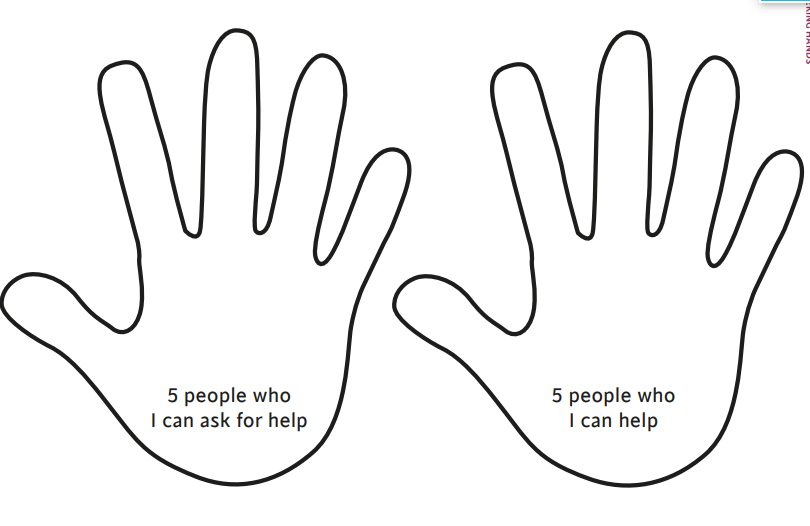
On one of the hands below, write the names of 5 people that you can help.
On the other hand write the names of 5 different people you can go to when you need help.
This could include a parent, teacher, friend, sibling, grandparent or cousin.
Reading
Learning Intention:
We are learning to make text to self connections
Tasks:
- Remember to complete your reading log each day, for ANY reading you do.
Click here to log in to Bug Club and read through the texts that have been assigned to you.
The books you read through Bug Club replace the home reading program for Term 3.
Don’t forget to complete the quizzes as you read.
If you don’t complete all the quizzes then the book won’t be saved as ‘read’.
(20 minutes) - Read a just right book of your choice independently for at least 20 minutes a day.
Don’t forget to use the resources that are available to you, such as Story Box Library and EPIC!
This would be a fantastic time to practise your SMART reading goal.
(20 minutes) - In order to make meaning of what we read, we make text to self connections.
Text to self connections are when we connect the events or story line in a text to our own personal experiences.
For example:
In the book ‘Charlie and the Chocolate Factory’ I connect to the main character, Charlie, wanting to win the Golden ticket.
This makes me think of how nice it can feel to win something.

Watch ‘Greetings from Sandy Beach’ and then make text to self connections using the graphic organiser below. An example is included.
(30 minutes)
Text to self-connections
This also happened to me when …..
For example:
The little brother throws up in the car.
When I went to the beach my sister threw up all over the back seat.
Writing
Learning Intentions:
We are using a picture stimulus to write a story
We are learning to use paragraphs in our writing
We are learning to structure a procedural text
Tasks:
- Choose a picture and write a word splash using the 5 senses. Complete this task in your Learning from Home book.
Once you have finished, write a story using some of the adjectives from your word splash.
Make sure you have corrected capital letters, punctuation and spelling with a coloured pencil.
(30 - 40 minutes)
- Paragraphs help to structure text.
Every new paragraph starts on a new line. We start a new paragraph to signal that the person, place, time or topic of the sentences has changed.

Make sure that you have used paragraphs in your story.
Click here to view the C.O.P.S editing strategy that can help you with your writing.
Click here to learn more about procedural texts.
(15 Minutes) - Click here to rewrite or cut and paste a procedural text in the correct order.
Highlight the action verbs in each step.
(20 minutes)
Maths
Learning Intention:
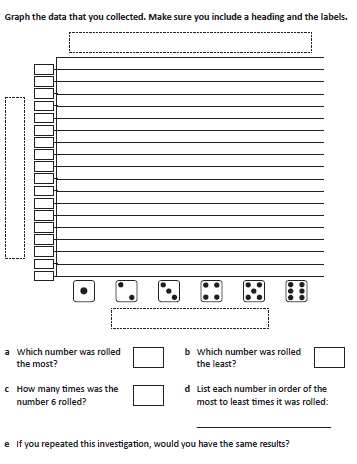
We are learning to graph data
Tasks: 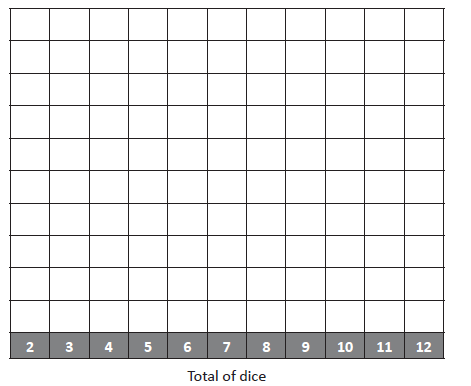
- Fluency Game
To play this fluency game you will need 2 dice and the game board (to the right).
The aim of this game is to be the first player to colour any six squares in a column.
Player 1 rolls both dice and adds the numbers and then shades the square in the correct column.
Player 2 repeats these steps.
The players take turns rolling and recording the totals in their own colour.
The winner is the player who has 6 spaces coloured, anywhere one column.
Which column was filled the fastest?
Why do you think that is?
(15 minutes)
Dice Investigation
- We usually roll a dice when we are playing a board game.
Do you have a lucky number?
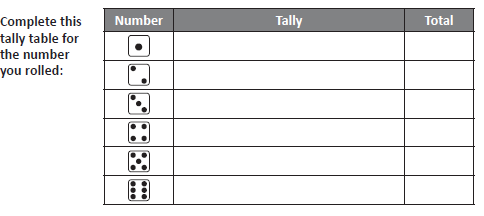
Often 6 is the luckiest number in board games, but does it come up any more or less often than the other numbers?
Let’s investigate.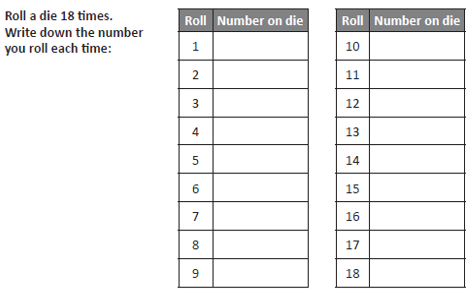
(60 minutes)
P.E./Movement breaks:
Learning Intentions:
We are learning to practise a range of PE skills, such as punting and underarm roll
We are learning how to measure our heart rate
The aim of this choice board is to let you choose what you would like to do!
It is designed for you to have fun, develop your fitness and skills and encourage you to be happy and healthy.
Task:
For each day, you need to complete one of the following activity boxes.
When you complete all the activity boxes, you can have a go at some of the activities again.
Please click here to use the ‘Equipment Replacement list’ to help you create a range of sports equipment at home using household items.
Fitness/Sports Choice Board
|
Scavenger Hunt:
Find all the common household items in the link here. When you find each item, check it off your list and have a go at doing the matching exercise.
Challenge: Time yourself and see how quickly you can complete the |
12-Minute Challenge:
In this activity we are looking at what happens to our body when we participate in sustained activity that requires our heart to work fairly hard. Before we start this activity, we are going to learn how to measure our heart rate. Click here
What to do: Select an activity that you can maintain for 12 minutes that you know will increase your heart rate. For example: running, doing step ups , star jumps, skipping or any other similar type of activity.
Use a timer on a watch, iPad, iPhone or another device to keep track of the 12 minutes – setting an alarm is a good idea. Try to push yourself to keep working at the same intensity for the whole 12 minutes – you will start to feel tired but don’t give up!
Questions: Optional – Send your answers to the questions below including your heart rate measured after the 12-minutes exercise to either Mr M or Mrs Yue-Lamb via the Sentral Parent Portal.
|
GoNoodle Fun:
Work your way through the following activities. Feel free to repeat your favourite ones.
Release Your Warrior - Click here
Moosemallow Dash - Click here 100 FAST: Jumping Jacks - Click here High Velocity - Click here
|
|
Punting a Football:
Create a punting activity, for example:
|
Tabata:
Tabata is a form of high intensity interval training that consists of eight or more sets of fast paced exercises performed for 20 seconds with a brief rest of 10 seconds. The purpose of training in this way is to build our muscular endurance.
Muscular endurance refers to the ability of the same muscle or muscle group to be used for an extended period of time without undue fatigue. The higher your level of muscular endurance, the fitter you are.
What to do: See how many rounds of Tabata you can complete. How many rounds of Tabata can you complete each day? Click here for your Tabata workout!
Questions: Optional – Send your answers to the questions below to either Mr M or Mrs Yue-Lamb via the Sentral Parent Portal.
|
For this activity you need to create a points system for hitting certain targets
You must use an underarm roll to knock down or hit your targets. The distance away from the target can be as far or as close as you would like it to be.
Once you are more confident with your underarm roll, challenge yourself and have a starting point further away.
If you like, send a video of yourself practising the underarm roll to either Mr M or Mrs Yue-Lamb via the
Click here to download your activity. |
Inquiry
Learning Intentions:
We are learning to create an ‘Essential Question’ to guide our Inquiry Presentation
We are learning to plan our Inquiry Presentation research
We are learning how to research our Inquiry Presentation
Task: This task will be introduced during Tuesday's Webex Essential meeting.
Please come to the session with your Essential Question ready to share.
- Throughout Learning from Home this term, we have been exploring different aspects of Australian history and culture, ranging from Art, Shelter, Language and Food through the video series found on ClickView.
We have explored these areas through the perspective of the Indigenous communities in Australia and through the early British colonies.
At the end of each week, we set you the task of creating a list of questions and wonderings based on the information found in these videos.
These were facts that you found interesting or wanted to know more about.
Maybe you want to learn more about the types of food different indigenous communities eat?
Perhaps you are interested in the types of shelters the early British settlers built?
This week, we are going to take all of those questions and wonderings and use them to help you create an Essential Question - that is one question that you are interested in finding out more about.
These are questions you can’t answer with yes or no.
What is an Essential Question?
An Essential Question is one that you are going to research the answer to.
You are going to find further information about this area of interest and present your findings to the class.
This question can be about anything you have learnt these past four weeks.
Some examples of Essential Questions include:
- What was life like for early British settlements?
- How did indigenous communities hunt for food?
- How did the Indigenous Australians react to British settlement?
- What is the importance of Aboriginal art to their communities?
- Why were British convicts sent to Australia?
As you can see from the above examples, these questions cannot be answered with a simple yes or no.
They are questions that require some explanation, which can be explained in your presentation.
Choosing your Essential Question
Your first goal this week is to look through the wonderings and questions you created and choose one Essential Question from the past four weeks.
Make sure it is an area you are interested in and cannot be answered with yes or no.
Click here to access your very own Personal Inquiry booklet.
Complete page 2 of the booklet, which asks you to write out your Essential Question and how you will present it (PowerPoint, poster etc.).
Then, complete page 3 of the Personal Inquiry booklet which asks you to write down any information you already know about your Essential Question.
(60 minutes)
Success Criteria
- I can use wonderings and questions I have written.
- I can create an Essential Question.
- I can record my prior knowledge about my Essential Question.
Please take a photo of the first 2 pages of your Personal Inquiry booklet and upload it to the Sentral Parent Portal by Friday 4 September
Science
Learning Intention:
We are learning to investigate what makes shadows change size
Tasks:
‘I, Mr Palmer-Leeraar, predict that the shadow of an object will get smaller the farther away it is from a light source.’
- You must now make an experiment to test my prediction and either prove it correct or incorrect.
Over the next three weeks you will be designing, carrying out and writing up an experiment to find if shadows get smaller when they are farther away from a light source.
This week, you will need to plan what you will do, that is all - DO NOT carry out the experiment!
Think about how you will test if shadows get bigger or smaller.
Write a list of the different equipment you will need, such as a torch, a tape measure (ruler) and an object to shine the light at.
Some of you may choose to extend this by thinking about the type of object - is it transparent, translucent or opaque?
Finally, you will need a Method.
This is a set of instructions or steps on how to complete your experiment.
A top tip is to imagine you’re writing this for someone younger who doesn’t know what you are doing - it needs to be really clear and easy to follow.
(60 minutes)
Success Criteria- I can write a method for an experiment.
- I can write a list of equipment for an experiment.
Please take a photo of your Experiment Plan and upload it onto the Sentral Parent Portal by Wednesday 2 September.
Click here for the other Specialist options.
© Copyright Laburnum Primary School