
Year 2 Learning from Home Week 6
Week beginning – 18 May 2020
Each day, choose some different tasks from each learning area. Complete all tasks by the end of the week.
Remember to write the date in your lined book or scrapbook for each task.
Please note that any tasks with an Epic book or video will be located in your mailbox each week.
Your teachers would love to see how much you have been reading. If you would like to share your reading log with us, ask your parents to take a photo and send it to us through the parent portal.
Reading
Learning Intentions:
We are increasing our reading stamina.
We are learning about and asking quick and deep-thinking questions.
We are using quick and deep-thinking questions to improve our comprehension.
We are identifying problems and resolution/solutions as features of a fiction text.
Tasks:
- Read your Just Right Book (JRB) independently every day.
Try to increase the amount of time you read each day.
A JRB can be your take home book, a book in your Epic mailbox, or a book of your choice.
It is okay to read the same book over again.
Remember to record the book in your reading log (lined book).
(20-30 minutes) - Good readers ask different types of questions when they read. Some questions you ask are answered in the text and some are not. There are two types of questions:

In your lined book, write the heading Quick Questions at the top of a new page.
Write the heading Deep-Thinking Questions half way down your page.
Click here to log in and listen to The Dress-Up Box on Story Box Library.
Look at the questions below.
Choose at least two quick questions and two deep-thinking questions to answer.
Quick Questions:
In which street did the Frolleys live?
Who were the Frolleys' best friends?
What was the children’s favourite game?
Where did they creep?
Deep-Thinking Questions:
Why do you think the Frolleys moved?
I wonder what they saw when they looked through the periscope?
Why do you think there were ants in the new house?
I wonder who lived in the new house before the Frolleys moved in?
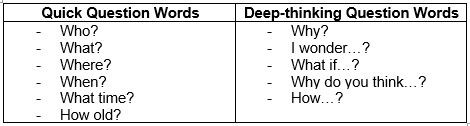
(30minutes) - Do you remember the difference between a quick question (answer is found in the text) and a deep-thinking question (answer comes from our thinking)?
Look at the table below. It gives you examples of some ways to start quick and deep-thinking questions.
Click here to listen to ‘I need my Monster’ on Epic!
After reading, ask yourself one quick and one deep-thinking question about the book.
Record the question in your scrapbook and then answer each question.
Look at the example below to help you set it out in your book.
(30 minutes)

-
Reread the table with quick and deep-thinking question words (from the previous task).
Read a just right book of your choice.
Ask yourself one quick and one deep-thinking question about the book.
Record and answer the questions in your scrapbook.
(30 minutes) -
Fiction texts always have characters, settings, problems and a resolution/solution.
These are the features of a fiction text. Choose a fiction JRB you have read this week.
Tell someone about the problems and resolution/solution.
Write about these in your lined book. For example;In the story, The Cow Tripped Over the Moon, the cow just couldn’t seem to make it over the moon. He tried different ways but nothing seemed to work. He was about to give up. However, his friends encouraged him and he kept trying. Finally, on moon attempt number 8, he managed to jump over the moon and back to Earth. He was very proud of his efforts.
(30 minutes)
Phonological Awareness
Learning Intention:
We are taking away the first sound from words to make new words (sound manipulation).
Task:
- Sometimes we can say a word and then take away the first sound to make a new word. This is called ‘sound manipulation’. For example, if we say ‘sold’ and then take away /s/, it leaves the word ‘old’.
Read these examples aloud:
snap take away /s/ leaves nap
flake take away /f/ leaves lake
race take away /r/ leaves ace
cup take away /c/ leaves up
that take away /th/ leaves at
bone take away /b/ leaves own (Parents - we are focusing on the word's sound, not spelling)
Look at the following words and say each aloud. Take away the first sound and say the new word.
Hint- pay attention to the sound and not the spelling of the word!
send
drain
seat
clay
bread
ball
lamb
bye
pear
think
(20 minutes)
Writing
Learning Intentions:
We are identifying nouns and pronouns.
We are talking about a third person narrative.
We are using a template to plan a third person narrative.
We are writing a third person narrative.
Tasks:
- Good writers use a variety of words to make their writing interesting.
Instead of repeating a noun (naming words), they sometimes use pronouns in place of a noun.
Using different pronouns helps our writing to be more interesting.
Look at the example below.
Peter went for a walk. Peter stopped when Peter arrived at the bookshop. Peter went inside, took off Peter’s coat and Peter sat down in Peter’s favourite chair.
The author has used the noun ‘Peter’ too much and the writing sounds repetitive. The Year 2 teachers have changed the sentences and replaced Peter with some pronouns.
Peter went for a walk. He stopped when he arrived at the bookshop. Peter went inside, took off his coat and sat down in his favourite chair.
Writers use both nouns and pronouns to make their writing sound better.
Look at the table below to see some examples of nouns and pronouns.
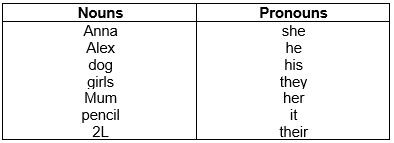
In a space in your lined book, fold your page in half.
Write the heading Nouns on one side and Pronouns on the other side.
Look through Just Right Books to find examples of nouns and pronouns an author has used.
Record these under the correct headings.
There is an example of how an author has used nouns and pronouns below.
(30 minutes)

-
Remember, a narrative is a story that contains characters, setting, problems, resolution/solution and ending.
A third person narrative is a story written from another person’s point of view, as if a person is observing the story.
Third person narratives use pronouns such as ‘he’, ‘she’, ‘they’ or ‘it’.Click here to log in and listen to Little Cat and the Big Red Bus on Story Box Library. It is an example of a third person narrative.
Look at the table below to see some of the different pronouns used in first person narratives and third person narratives.

Look through your just right books.
Think about whether they are written in the first person (I, me) or third person (they, her, him).
Show someone at home an example of a third person narrative and point out the pronouns.
(30 minutes) -
Click here to watch Taking Flight on Literacy Shed.
You will be rewriting the story in the third person and innovating on the story.
This means changing one or more elements, for example:Changing the adventures
Renaming the characters
Using a different type of transport.
Use the planning template below to plan your third person narrative. Draw or write in each box, describing your characters, setting, problems, resolution/solution and ending. You may use the same title, Taking Flight, or come up with a new title.
(20-30 minutes)

-
Use your planning template to write your third person narrative in your lined book.
Remember to use a sizzling start to begin your story.
Once you have written your sizzling start, continue writing the rest of your third person narrative.
Remember to innovate (change at least one thing) on the story Taking Flight.
It may help you to watch the video again.
(40-50 minutes)
Handwriting
Learning Intention:
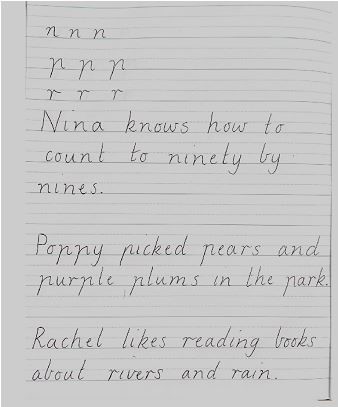
We are forming the clockwise letters n, p and r.
Task:
- Look at the handwriting example below.
Copy and continue the handwriting into your lined book.
Remember to use correct posture and pencil grip.
You could also create your own sentences using words with n, p and r.
(20 minutes)
Spelling
Learning Intention:
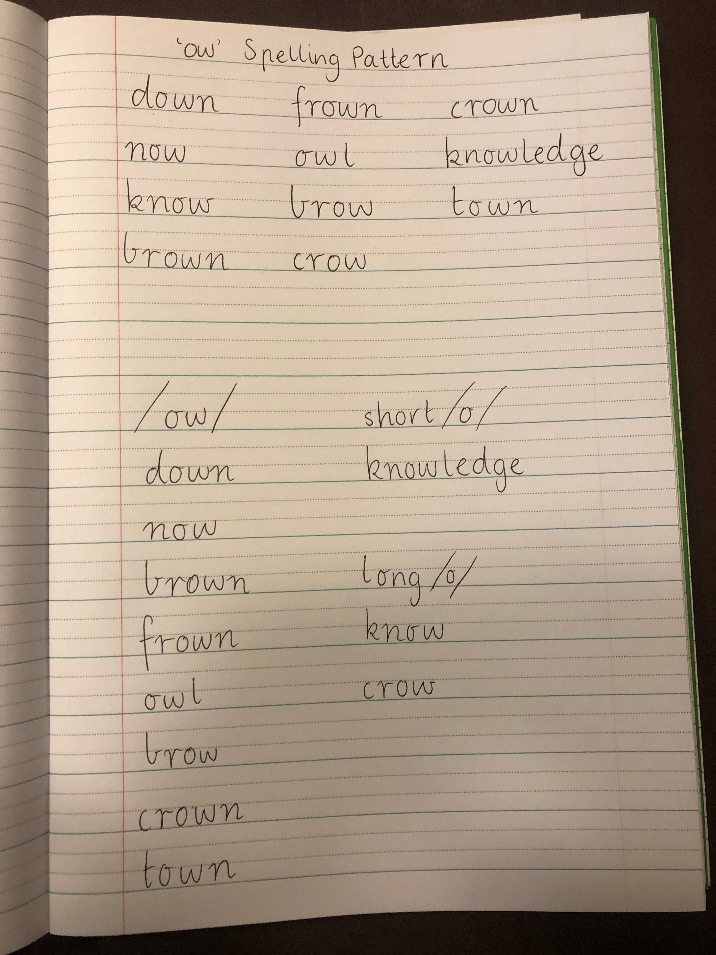
We are learning to find words with the ‘ow’ spelling pattern (this is a vowel diagraph).
Task:
- A spelling pattern is a group of letters that we see.
Look at the book covers below.
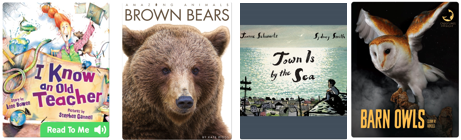
Can you identify the words with the ‘ow’ spelling pattern?
In your lined book write the title ‘ow’ spelling pattern.
List as many words with the ‘ow’ spelling pattern that you know or can find by searching through books.
Group the words according to the sounds the ‘ow’ spelling pattern represents.
Look at the example below.
Write down one thing you notice about words that have the ‘ow’ spelling pattern.
(20-30 minutes)
Maths
Learning Intentions:
We are developing our place value fluency by matching numbers to their expanded form.
We are placing 2 and 3-digit numbers on a number line.
We are using the language of chance to place events on a probability (likelihood of something happening) scale.
Tasks:
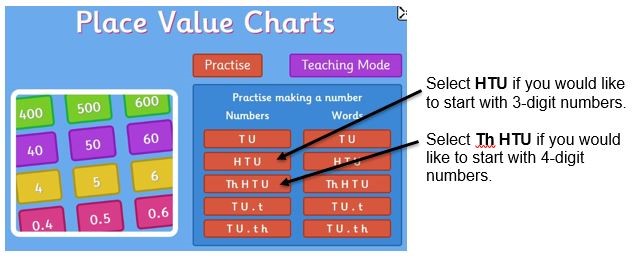
- Fluency task- Click here to access Place Value Charts on FUSE.
(10-15 minutes each day)
- A number line can start at any number. Look at the number lines below.
Copy the number lines into your scrapbook and fill in the missing numbers in another colour.
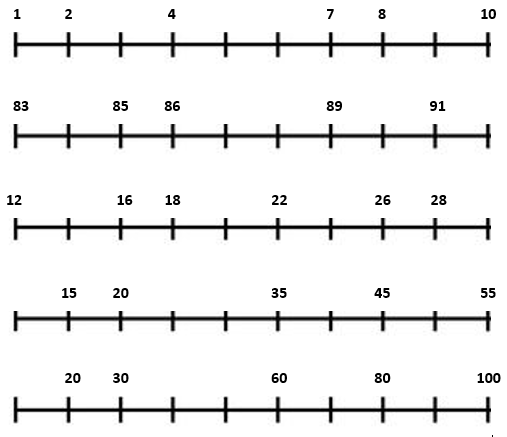
Draw a few of your own number lines with some numbers missing.
Use just right numbers in your number lines. These may be 2, 3 or 4-digit numbers.
Ask someone at home to fill in the missing numbers. Check they are correct.
(30 minutes) - Copy the number line below 5 times in your scrapbook. Each number line needs to be divided into 10 equal parts. You will be placing two numbers on each number line. Use a ruler to help you.

Write 0 at the beginning of each number line.
Decide whether you will use 2 or 3-digit numbers on your number line.
If you are using 2-digit numbers, write 100 at the end of each number line.
If you are using 3-digit numbers, write 1000 at the end of each number line.
Roll a dice twice to make a 2-digit number or three times to make a 3-digit number.
Write this number in the correct place on your number line.
Roll the dice again to make another number and place this on the same number line.
Does this number come before or after your first number?
See example below.
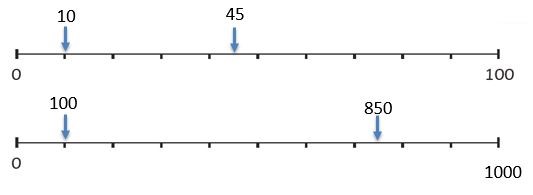
After you have placed two numbers on your number line, move onto the next number line.
(30-40 minutes) - Click here to read All About Probability on Epic!
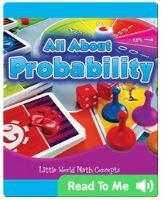
We can predict the likelihood of an event happening using the language of chance. For example;
Impossible - a dinosaur will walk into your bedroom (this has never happened)
Unlikely - It will hail today (this happens but not very often)
Likely - You will watch television tomorrow (this happens often but maybe not every day)
Certain - The sun will set tonight (this happens every day)
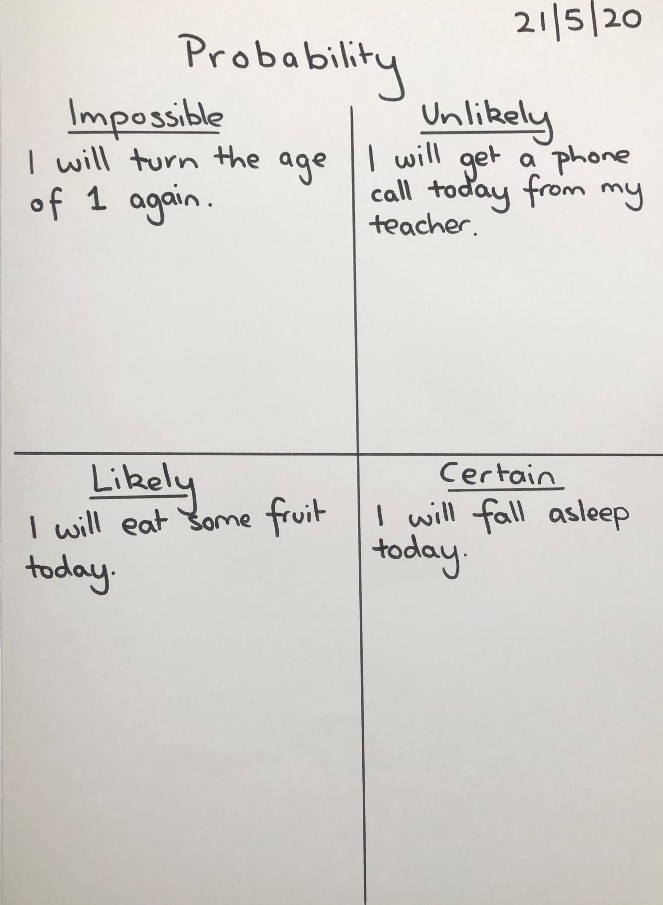
Divide a page in your scrapbook into four sections. Write the heading Probability at the top of the page.
In each box, write one of the following- Impossible, Unlikely, Likely, Certain.
Draw or write examples in each box.
Look at the example below.
(30 minutes)
- We use a probability scale to show the likelihood of something happening.

Look at the probability scale. Read the statements below and show someone where you would place them on the probability scale. Tell the person why you chose to put it there.
For example, I will play the piano today- this is impossible because I don’t have a piano at my house.
- I will read a book today.
- I will drive a car tomorrow.
- Snow will fall in Melbourne today.
- My dog will climb a tree.
- I will see an elephant walk past my bedroom window.
- I will eat ice-cream today.
Can you think of some other statements you could ask a family member?
(30 minutes)
Inquiry
Learning Intentions:
We are creating a bird’s eye view map of our bedroom.
Tasks:
- Click here to read Maps are Flat, Globes are Round on Epic!
You are going to be drawing and labelling a bird’s eye view map of your bedroom (as if you were looking at it from above).
You need to think about the shape of your room and everything that you see.
Look at the example below.
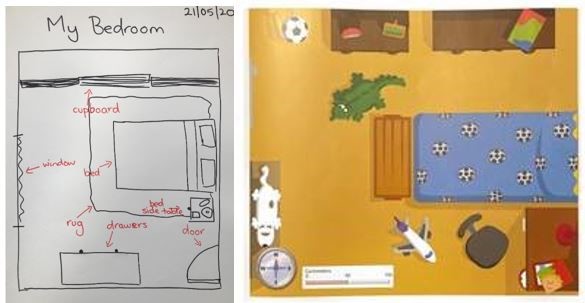
Walk around your bedroom and write a list of what you see, for example, bed, drawers, cupboards or toy box.
In your scrapbook, write the heading My Bedroom.
Draw an outline of the shape of your bedroom.
Draw the largest furniture first, for example your bed. Remember to include where your doors and windows are in your room.
Draw any other features in your bedroom, for example, toy box or cushions.
Label and decorate your map.
Science
Learning Intentions:
We are learning why we have rain gauges.
Tasks:
- How much rain is really falling when you watch heavy rain through the window of your home?
What about on other days when it is just light rain?
A rain gauge collects water and lets us discover how much it has, or has not rained.
We can make our own rain gauge and discuss what we find.
How to make a Rain Gauge
What you'll need:
A plastic (soft drink) bottle
Some stones or pebbles
Tape
Permanent marker (felt pen)
A ruler
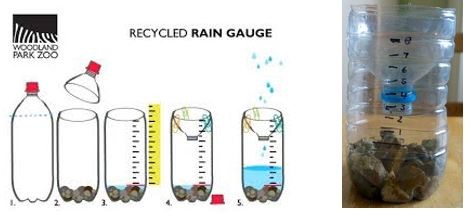
Steps:
- Ask an adult to cut around the top of the bottle (see the picture above).
- Place some stones in the bottom of the bottle.
Turn the top upside down and tape it inside the bottle to make a funnel. - Use a ruler and marker pen to mark centimetres from the top of the stones to the top of the bottle.
This will tell us how many centimetres it has rained. - Pour water into the bottle until it just covers the stones.
Congratulations, you have finished your rain gauge. - For the next seven days, you will be checking your rain gauge daily and recording how much rain has fallen.
Do not empty the rain gauge until the end of the seven days. - Put your rain gauge outside where it can collect water when it starts to rain.
A suggestion is to place it in the middle of a garden, balcony or back yard away from any trees or buildings.
After it has stopped raining, check to see how many centimetres of rain is in your rain gauge and record this in your book. - Look at the picture below for an example of how to record your rain gauge data.

We will be using the data you collected in Week 7.
Wellbeing
Resilience, Rights and Respectful Relationships ‘Positive Coping’
Learning Intention:
To identify how cooperative behaviour can help to solve problems.
Tasks:
When Learning from Home, we need to cooperate and try hard to get along with everyone in our house.
We might have to cooperate with family members for things such as:
- Sharing a device
- Getting help from a family member when they have time
- Sharing a learning space
- Sharing toys
Write the heading Cooperating with my Family
Draw a line down the middle of your page.
On the left write the heading Problems
On the right write the heading Solutions
Write any problems you have faced when learning from home (you can use the examples above).
Write how you and your family have resolved any problems.
See example below.
Click here for the Specialist options.
Self-reflection: In your book, write about your favourite task from this week and tell us why you enjoyed it.
© Copyright Laburnum Primary School