
Year 6 Learning from Home Week 3
Week beginning - 27 April 2020
This week we will again be focussing on: ORGANISATIONAL SKILLS.
- Ensure each task is completed in your HOME LEARNING book, unless otherwise instructed.
- You must include a TITLE and DATE before beginning any new tasks, not using a new page for each new task.
- Ensure your setting out and handwriting are NEAT and CLEAR.
- Use the times provided as a guide to how long to spend on each task.
- Read through all of the tasks, then use your Organisational Timetable as a guide to self-manage these, including necessary breaks.
- Remember to complete your self-reflection at the end of the week.
These tasks need to be completed this week:
You need to include 30 minutes a day in your Organisational Timetable for MOVEMENT breaks. See ‘Specialists’ link towards the end to access ideas from P.E.
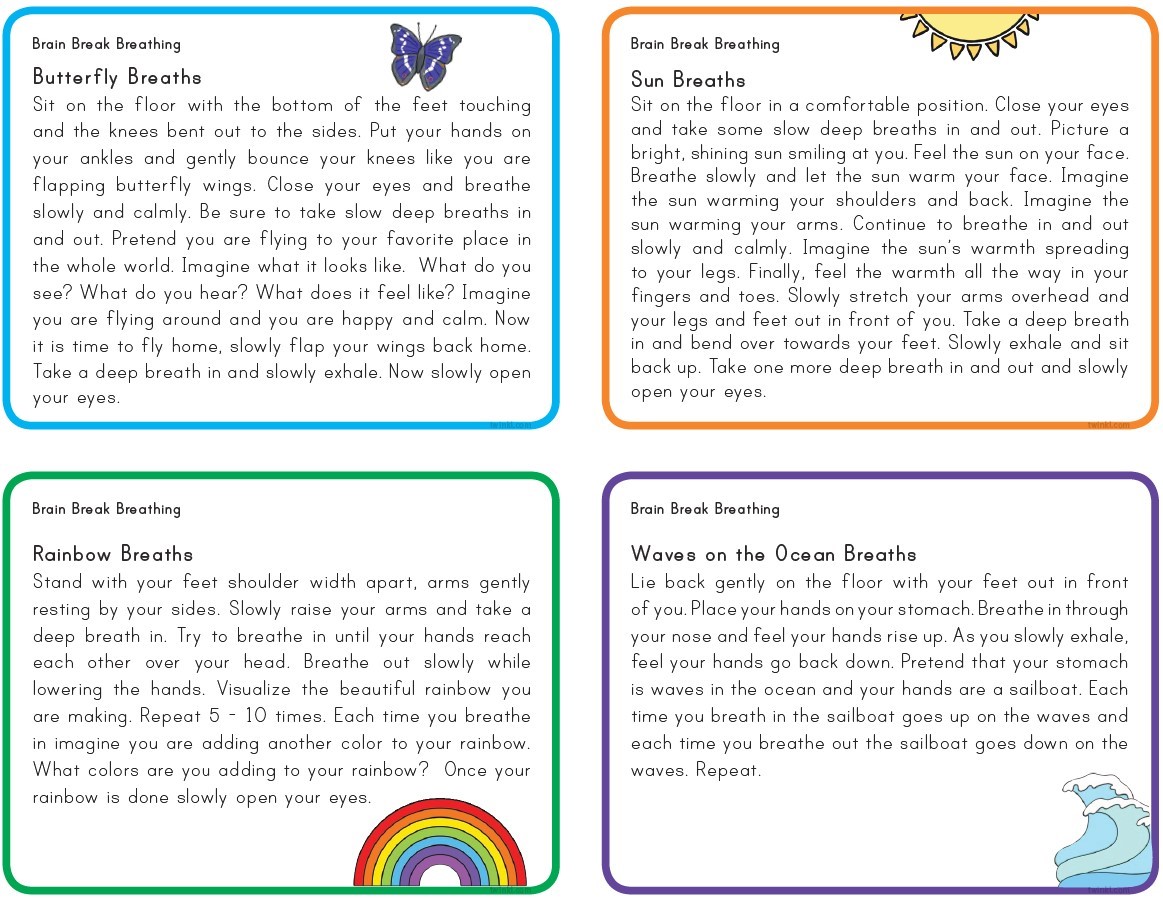
You need to include 30 minutes a day in your Organisational Timetable for WELLBEING/MINDFULNESS breaks. You may choose to listen to some relaxing music, meditate or try one of the following activities:
Reading
Learning Intentions:
To summarise the texts we are reading.
To compare the features and content of texts.
Tasks:
- Daily Independent Reading with Tracks of your Thinking: Continue with your own independent reading. This could include texts selected from Epic, books, magazines, newspapers etc. you have at home, or other online library sources. Remember to detail what you are reading in your Reading Log and leave tracks of your thinking. For example, questions, wonderings, predictions, inferences, connections or visualisations. (You should be reading for at least 30 minutes a day, plus tracks of your thinking)
- ANZAC Day Reflection: This week we are looking at what ANZAC day means to us. You are going to read some picture story books about ANZAC day. To access these books you will need to visit Storybox Library here. Now you should see a selection of 8 picture story books. Follow the instructions below to complete this task. (log-in details have been emailed to your parents)
Select and read any three of the books about ANZAC day.
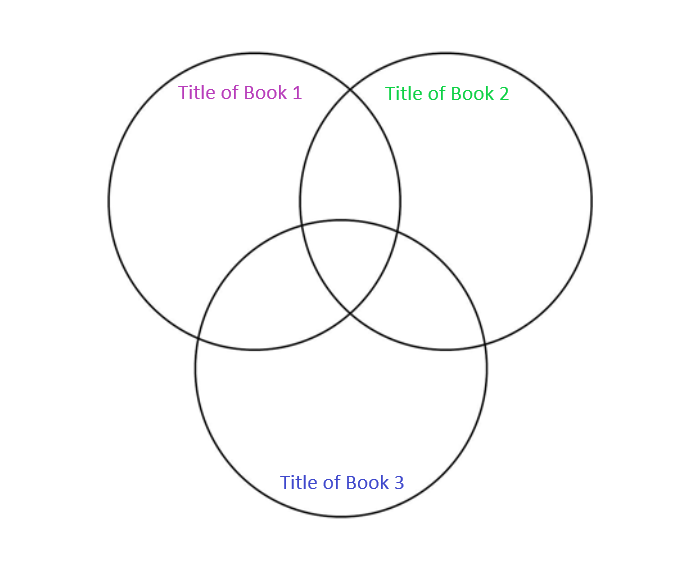
Draw a Venn diagram in your home learning book. (see below)
Helpful hint: Find a circular item, such as a Milo tin or similar cylindrical shape, to use as a tool to trace your circles.
Label each of the circles with the title of each book.
Find aspects of the books that are similar and/or unique and record this in your Venn diagram.
For example, pictures on the front, emotions experienced by the characters, emotions you feel while reading, language used, facts shared, setting.
(This task should take about 60 minutes to complete)
- Recording a Summary of your Reading: Read your current Just Right book for 30 minutes and write a summary of what you have read in your home learning book. (This task should take about 45 minutes to complete)
(As a reminder from last week)
The purpose of summarising what we read is to help us make sense of the important details within the text.
It can also help us to remember the main points of what we have read.
It is a record of what we have read in our own words. We can use a summary to help support other reading strategies, such as predicting.
When summarising a fiction text, we can use the ‘who, wanted to, but, so, then’ method.

Writing
Learning Intentions:
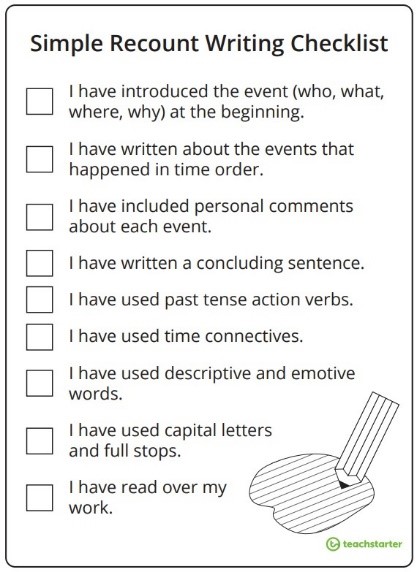
To self-edit my recount, using the provided checklist.
Tasks:
- Editing Recent Writing (your new character): Your task is to edit the FINAL piece of your writing from last week. Use the editing checklist provided to assist you with this task. Make any edits to your work in red pen.
**Optional: What else can you look for when editing?
e.g. Up-levelling words (alternative words that mean the same, but create greater impact. For example, ‘the icecream was tasty’ sounds better when written as ‘the icecream was moreish’), using interesting punctuation, is your message clear for the reader?
(This task should take about 20 minutes to complete)
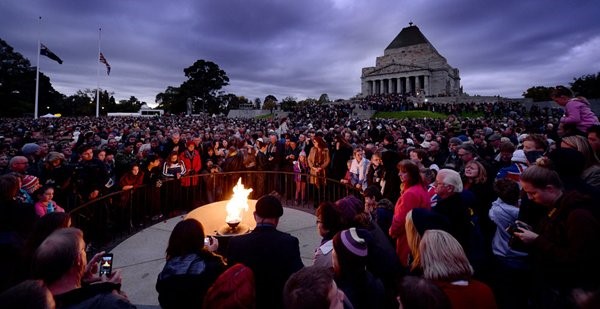
- Using my Senses: Look at the four ANZAC DAY images provided below. Now brainstorm all of the words that come to your mind. Think about your senses (like we did in Term 1). What does it look like? Sound like? Feel like? Smell like? Taste like? (This task should take about 10 minutes to complete)
- Commemorating ANZAC Day: Using words you brainstormed in task 2 to assist, write a related ANZAC day piece that allows your audience to visualise and sense the true meaning of ANZAC day. This can be any text type that you would like to use. (This task should take about 30 minutes to complete)



- Editing ANZAC writing: From your piece of writing, find 5 words that could be improved or ‘up-levelled’.
Below your writing, write these 5 words down. Write a synonym for each word that is more engaging, interesting, or descriptive to the audience. For example, change ‘small’ to ‘insignificant’. Now go back to your writing and edit your draft to include these words. (This task should take about 10 minutes to complete)
Spelling
Learning Intentions:
To identify suffixes.
To understand that suffixes can change the meaning and tense of words.
Definitions:
A suffix is a letter or group of letters attached to the end of a base word to change its meaning or tense.
For example ‘ed’, ‘ful’, ‘y’, ‘ly’, ‘ing’.
A base word or root word cannot be broken down. It gives a word its basic meaning.
For example, ‘act’ (see below).
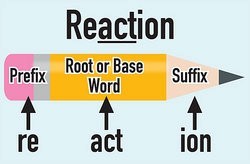
Tasks:
- Word Sort: Below is a list of adjectives (see ‘fabulous adjectives’ below this task). Read all the words from each column aloud. Look carefully for any unusual spelling patterns and reread any you have difficulties reading the first time.
In your home learning book, rule a table with two columns and label each column with titles ‘Base Words’ and ‘Suffixes’
(see example table provided).
Now choose, then record any 20 words from the adjectives list that are base words in the LEFT column and any 20 with suffixes in the RIGHT column.
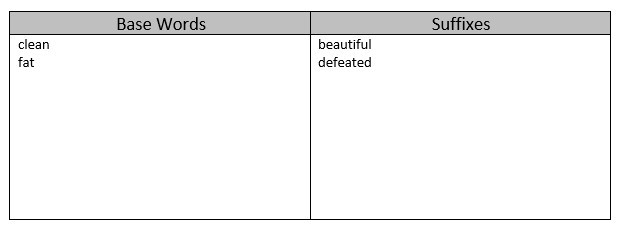
(This task should take about 30 minutes to complete)
- Adding to your Word Sort: At the bottom of the table you created in task 1, add 10 more base words and 10 more words with suffixes of your choice. Write these words in a different colour to what you used in task 1 to identify them. You could find suitable words by skimming through books, looking around your house or brainstorming. (This task should take about 15 minutes to complete)
- Looking at Suffixes: Choose 3-5 words from the column of base words. Add a range of different suffixes to the end of these words and record how it changes the word and perhaps it’s meaning. For example, if the base word is wonder, it can be changed to wonderful, wondering, wondered, wonders. What do you notice about how the word changes?
Be careful of some words in the list. For example, tiny – the baseword is tiny.
(This task should take about 20 minutes to complete)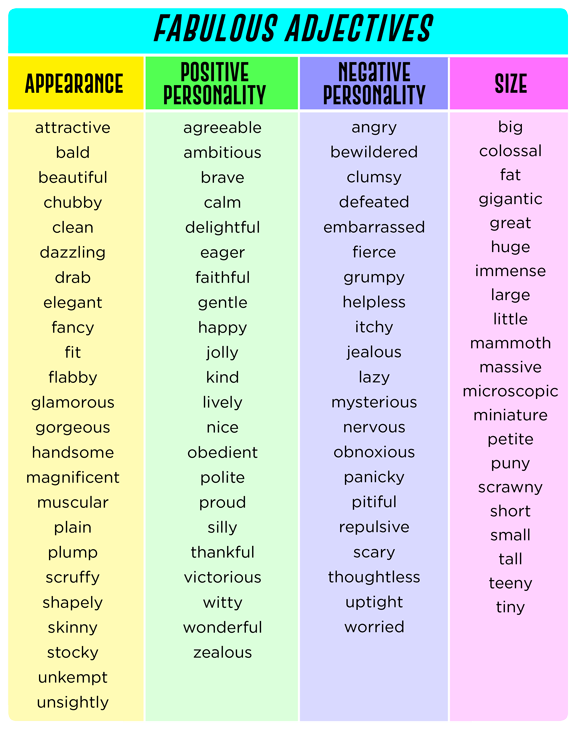
MathsLearning Intention:
To build automatic response of the four processes.
To develop concepts in Number and Algebra.
Tasks: - Sunset Maths: Each day this week, begin your Maths work with 5 minutes of ‘Sunset Maths’. This helps you to build your number fluency skills. Log into ‘Essential Assessment’ and select the ‘game controller’ icon to access Sunset Maths.
(This task should take 5 minutes to complete each day)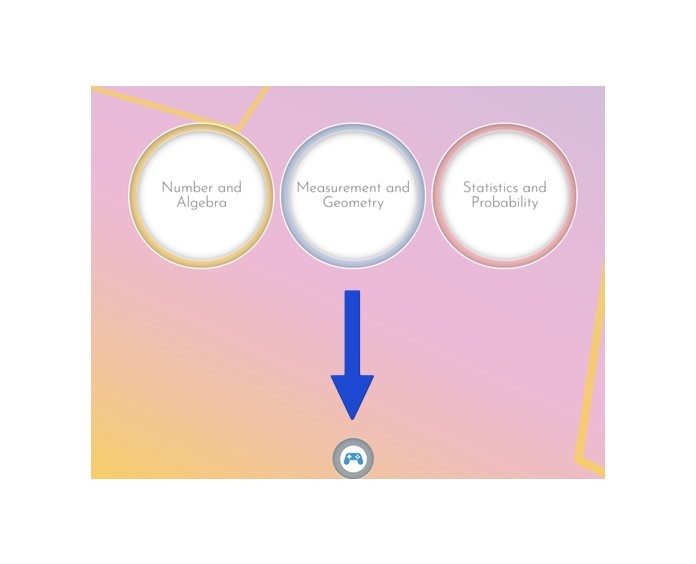
- My Numeracy: Log into Essential Assessment.
Select Number andAlgebra.
Select General All.
Select My Numeracy.
You should now see your Learning Goals.Continue the goals that you were working on in Number and Algebra.
If you have finished those and feel confident you can choose new goals to work on.
Spend 10 minutes each day working on these skills in My Numeracy.
(This task should take 10 minutes to complete each day)
*If you have finished achieving your learning goals, spend 10 minutes to try and solve any of the following problems:
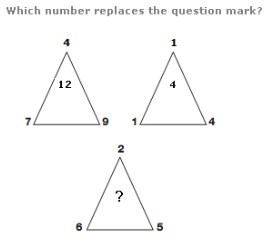
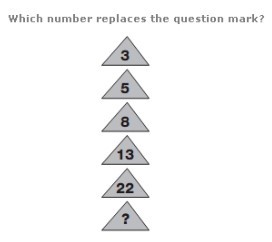
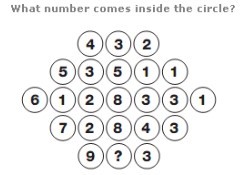
When finished, check your answers with the correct solutions and explanations
at the end of this week’s ‘Learning from Home’ tasks.
Learning Intention:
To use a tool to measure the dimensions of an area. (Measurement and Geometry)
To find the area and perimeter.
To find the volume of a space (level 3).
Tasks:
- Estimate and Find Perimeter and Area: Choose from the following interactive activities to explore the concepts of perimeter and area. The levels get progressively harder. Choose one task that is just right for you.
Helful hint: When accessing the interactive task, you need to click on the ‘view’ tab to begin.
(Spend up to 20 minutes throughout the week on your interactive task)
Interactive tasks:
Level 1- Area Counting with Coco – Click here
Level 2 – Area and Perimeter – Click here
Level 3 - What’s in a cube? – Click Here
**Optional: You may like to go back and revisit any of these interactive sites when you have finished the other tasks.
- Estimate and Find Perimeter, Area and Volume: Choose ONE of the following activities to explore the concepts of perimeter and area. You will need to use a formal unit of measurement tool to assist you, such as a tape measure or a ruler. Again, the levels get progressively harder. Choose one task that is just right for you. Record your responses in your home learning book. (This task should take about 40 minutes to complete)
Level 1- Estimate, then find the perimeter and area of a room in your house.
Level 2 – Estimate, then find the perimeter and area of your block of land, or two rooms of your house.
If measuring two rooms, see if you can calculate the combined perimeter and area of both.
Level 3 – Estimate, then find the volume of each room in your house.
Record your results in both cm2 (square centimetres) and m2 (square metres). Can you work out the total volume of your house?
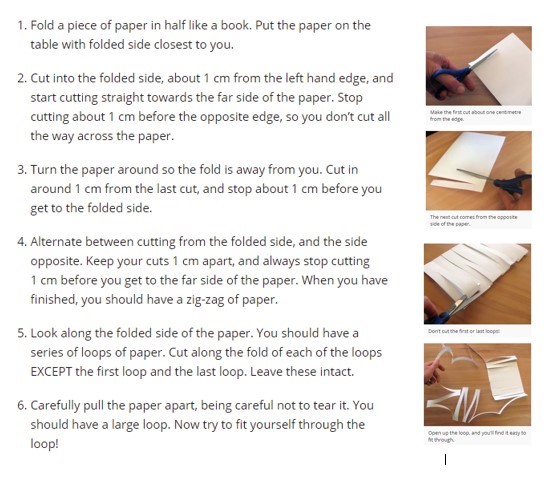
- Changing Perimeter: Did you know that you can climb through a hole in a sheet of A4 paper? How do you think this is possible? Using paper and scissors, have a go! (This task should take about 10 minutes to complete)
Now that you have spent some time trying to squeeze through, check out the solution at the end of this week’s Learning from Home tasks to see how it can be done. Follow these instructions to complete the challenge.
Record, using your choice of writing and/or diagrams, how the area and/or perimeter changed?
If you are able to print a photo of your efforts, feel free to paste it in.
(This task should take about 30 minutes to complete)
**Extra Challenge: Can this work with paper smaller than A4? If so, what was the area of it?
Wellbeing: Resilience, Rights and Respectful Relationships ‘Positive Coping’
Learning Intention:
To explain the differences between positive and negative coping strategies.
We all have many different coping strategies to help us deal with the stress and challenges in our lives.
A coping strategy is something we do to help us feel better, or to keep going (persist) when things get tough.
Task:
- Positive Coping: Think of 3-5 activities you use as positive coping strategies, which fit into the following categories. You can present these ideas in a creative way. For example, a poster or video.
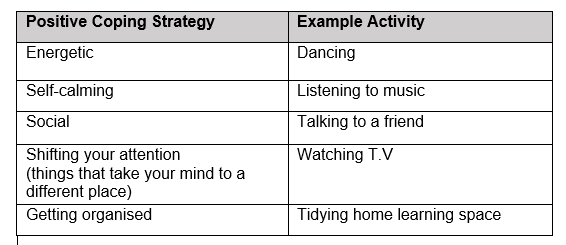
In your home learning book select one category and explain how your ideas support you in a positive way.
(This task should take about 30 minutes to complete) -
Others’ Positive Coping Strategies: Talk to someone else about positive coping strategies that they use. Record their ideas, using a thought bubble, in your home learning book.
(This task should take about 15 minutes to complete)
*Interesting Fact: Negative coping strategies tend to make things worse for ourselves or others.
We need to reduce or cut these out of our coping strategy choices. For example, taking it out on others or being aggressive doesn’t help at all. (So Dr Dray says be kind to your parents and siblings!)
Inquiry
Learning Intention:
To describe differences in climate
This term we will focus on the geographic reasons for people living in different places on the planet. This week we are investigating the different climates found in Australia. Click here for information to assist you in the tasks below (hint: scroll down when the link opens).
Tasks:
- Australia’s Climate: Look at these descriptions of Australian climates (below). In which climate zone do you live? In your home learning book, write a description of the climate of your local area. What are the climate zones of all seven of the state/territory capitals?
(This task should take about 30 minutes to complete) - Climate Map: Create a colour coded map of Australia that shows the climate zones across the country. You may draw it or create in on a digital device.
(This task should take about 30 minutes to complete)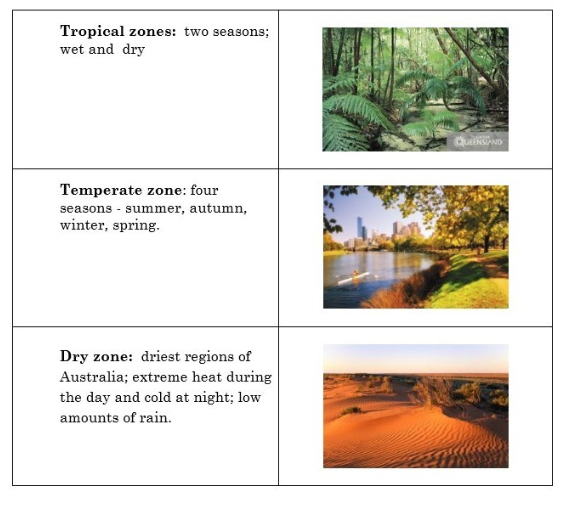
Science
Learning Intention:
To explore the impact earthquakes have on the land and its people.
Tasks:Researching Earthquake Measurements:
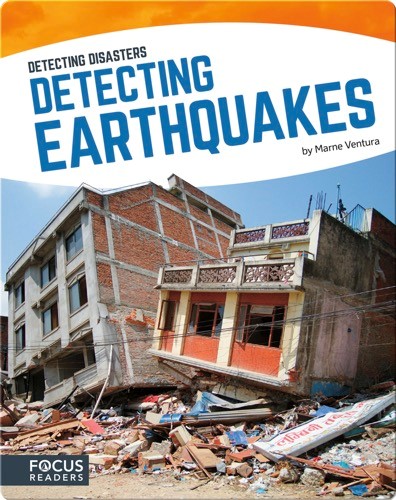
Read Chapter 3, pages 19-24, and then answer the questions below in your home learning book.
Your teacher has assigned you a text called ‘Detecting Earthquakes’ in Epic Library.
How do scientists know an earthquake has occurred?
Why do scientists need to measure earthquakes?
(This task should take about 20 minutes to complete)
Making a Seismometer:
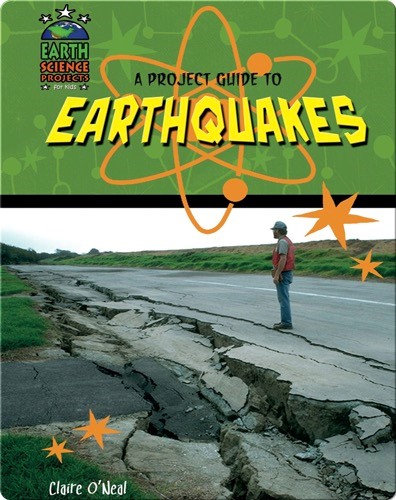
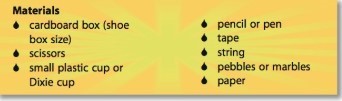
Read ‘A Project Guide to Earthquakes’ pages 23-26, again in Epic Library. Follow the instructions and make a seismometer to measure vibrations.
*If you don’t have the exact materials required, use what you can find at home as best you can.
When finished, If you are able to take a picture, paste this in your home learning book.
In your home learning book, explain how your seismometer works and how scientists would use one to measure an earthquake. (This task should take about 40 minutes to complete)
Click here for the Specialists
Self-Reflection:
Questions you may like to consider:
- You have now had three weeks of learning from home. How are you feeling?
- What are you looking forward to when we come back to school?
- What has been a surprise for you about learning from home?
- What have you learnt about yourself as a learner whilst working from home?
- Who are you grateful for this week?
(This task should take about 20 minutes to complete)
**Problem Solving Solutions:
Problem 1: The answer is 9.
Explanation – The number at the centre of each triangle equals the sim of the lower two numbers, minus the top number
Problem 2: The answer is 39.
Explanation – Working from top to bottom, double each number and subtract 1, then 2, then 3 etc.
Problem 3: The answer is 6.
Explanation – Looking at the diagram in rows, the central circle equals half the sum of the numbers in the other circles to the left and right of the centre.
**Changing Perimeter Solution:
© Copyright Laburnum Primary School