
Year 1 Tuesday Wednesday Thursday
Week Beginning 16 August
Tuesday 17, Wednesday 18 and Thursday 19 August
Below is an EXAMPLE of a weekly timetable that could be used to help plan out weekly learning tasks. Although this is a five day timetable, please plan your week around the days your family uses for Learning from Home.
Please remember to include your Webex and Specialists@Webex sessions as well!
| Monday | Tuesday | Wednesday | Thursday | Friday | |
| Session 1 | Independent Reading and Reading Task | Independent Reading and Reading Task | Independent Reading and Reading Task | Independent Reading and Reading Task | Independent Reading and Reading Task |
| Break | |||||
| Session 2 | Writing Task | Handwriting | Writing Task | Handwriting | Writing Task |
| Brain break | |||||
| Session 3 |
Spanish (Online Session) |
No Art today |
Library & Music (Online Sessions) |
P.E. (Online Session) |
Inquiry |
| Lunch | |||||
|
Session 4 |
Maths Task | Maths Task | Maths Task | Maths Task |
Science |
Webex Essential Schedule
Below is a list of what we plan to do in our Webex Essential sessions:
Webex Tuesday: No Webex today due to Student Free Day
Webex Wednesday: Looking out your Window (teaching)
Webex Thursday: Making Predictions during Reading (teaching)
Wellbeing
Resilience, Rights and Respectful Relationships - 'Help Seeking'
Learning Intention:
We are learning some of the features that make a good friend so that we can describe what makes us a good friend
Task:
What do you think makes a good friend? Watch ‘Noni the Pony Rescues a Joey’.
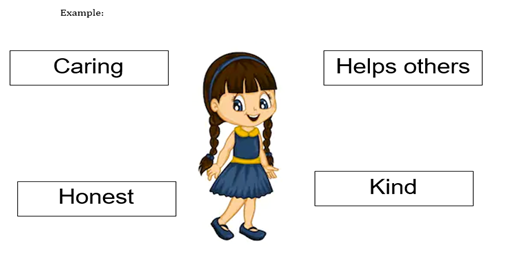
After watching the story, draw a picture of yourself in your workbook.
Around the picture write some ideas of what makes you a good friend and what good friends do.
Reading
Learning Intention:
We are learning to identify and create words that rhyme so we build our knowledge of word families
Task:
This week for phonological awareness we are going to identify and create words that rhyme.
When a word rhymes, it has the same end sound as another word. For example, plan and scan rhyme because they have the same sound /an/ at the end.
In the table below, read the words aloud and work out which ones rhyme.
Challenge: think of another word to rhyme with these two words.
Tip: you might go through the alphabet and change the first letter of the words to find out if this makes a new word or not. An example has been completed for you.
|
Words |
Which two words rhyme? |
New rhyming word |
|
scan - map - plan |
scan - plan |
man
|
|
cat - cot - hot |
|
|
|
chin - ban - bin |
|
|
|
tan - tin - can |
|
|
|
bat - sat - sit |
|
|
|
bet - let - lot |
||
|
jar - jet - star |
||
|
can - ring - king |
||
|
rug - snug - sing |
||
|
spin - long - strong |
(30 minutes)
Learning Intention:
We are learning to use the author’s clues and our schema so we can orally make predictions before reading a free choice book
Task:
Select a book you have not read that you have at home or from one of the online resources, such as Epic!, Story Box Library, Sunshine Online or Bug Club.
Look at the front cover and use the author’s clues (title, picture, blurb) and your schema (the things you know in your brain) to make a prediction (good guess) about the book.
Use the sentence stem below to help you:
A prediction I make about the book _______ (book title) written by _______ (author) is ________ (prediction). I think this because ________ (reason and clues used).
(40 minutes)
Learning Intention:
We are learning to use the author’s clues and our schema so we can orally make predictions during reading
Task: Making Predictions during Reading - Webex Essential Thursday
Good readers make predictions before, during and after reading. We are focusing on making predictions during reading today.
Good readers pause and think about the text while they are reading. They check if their predictions are correct, or adjust their predictions if needed.
Log onto Storybox Library and listen to the story 'Anemone Is Not The Enemy’ read by Mel Buttle.
Pause the story at 2 minutes 53 seconds (it will look like the image below).

Can you make your own prediction using the sentence stem below?
Now I predict that in the story Anemone Is Not the Enemy _____________ (what will happen?) because ______________.
(40 minutes)
Learning Intention:
We are learning to keep a log of our reading so that we can track our reading progress
Task:
Everyday when you read, record the title, the date and the pages you have read in your yellow reading log
(5 minutes)
Writing/Spelling
Learning Intention:
We are learning to exercise our hands and fingers so we strengthen our muscles and improve our fine motor skills
Task:
Last week we introduced you to some activities you could do at home to strengthen the muscles in your hands and fingers.
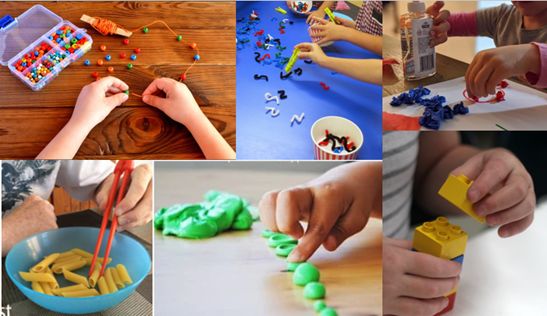
It is really important to exercise the muscles in our hands and fingers when we are young, so we develop good fine motor skills. This helps us with our handwriting and cutting when using scissors. We call this finger gym.
We practise this at school and think it is important for you to practise at home too!
We would like you to choose some other activities to practise this week.
Here are some suggestions for activities you can try:
-Build and pull apart lego creations
-Make a playdough creation
-Scrunch up little pieces of paper into balls to make a piece of art
-Use two fingers to hold a clothes peg to pick up small objects
-Beading to make a bracelet or a necklace
-Picking up pasta shells with chopsticks.
Select at least one of these activities to try.
(10 minutes per day)
Learning Intention:
We are learning to create a labelled diagram to describe what we see outside our window so we can expand our vocabulary and make our writing more interesting and descriptive
Task: Looking out your Window - Webex Essential Wednesday
After reading and discussing the book ‘Windows’ in Wednesday’s Webex Essential session (we will play this story as a class). Look outside a window or a door at your house. What do you see?
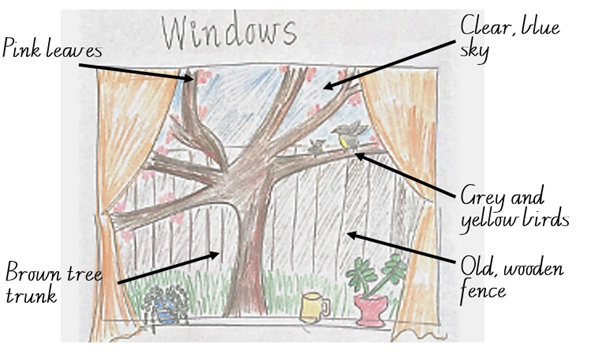
Draw and label a diagram of what you see. Include as much detail as possible, for example, a tall green tree, a fluffy white dog.
An example has been done for you below.
(40 minutes)
Learning Intention:
We are learning to include interesting adjectives and verbs in our sentences so that they are descriptive
Task:
Review the labelled diagram you created yesterday of the view outside your window. We are going to use the labelled diagram to write some descriptive sentences.
A descriptive sentence might include lots of adjectives or verbs.
An adjective is a describing word and a verb is a doing word.
Write at least 3 descriptive sentences about your picture (you may write more if you want to!).
Underline or colour the adjectives in one colour, and the verbs in a different colour.
We have underlined and coloured the verbs for you in blue and the adjectives in orange in the following sentence
Outside my window I see two grey and yellow birds sitting on the old tree branch.
(40 minutes)
Maths
Learning Intention
We are learning to read, write and order 2-digit numbers so that we build our understanding of place value
Task:
For this task, you will need to find a deck of cards in your house and remove all of the picture cards
(king, queen, jack and joker - ace will be number 1 and 10 will represent 0).
If you do not have a deck of cards at home, be creative and use Uno cards or make your own out of scrap paper (label these from 0 - 9).
Shuffle the cards and put them in a pile upside down in front of you.
Flip over the first 2 cards and write down the number that they make. For example, if I pick up a 7 and a 10, I have made the number 70. Repeat this process 4 more times. You will have made 5 different numbers.
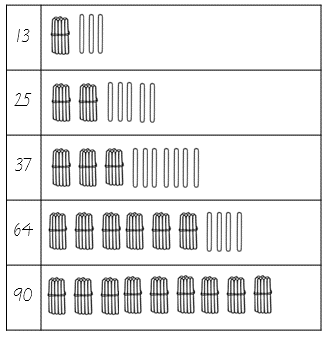
Using your knowledge of the number system or your number chart to help you, write the numbers in order from smallest to largest, going down the page in your book. Next to each number draw the bundles and loose ones to match.
An example has been completed for you below. The numbers the cards made were: 64, 25, 13, 90, 37
(40 minutes)
Learning Intention:
We are learning the meaning of the words mass, heavy and light so we can compare the weight of objects
Task:
This week we are looking at ‘Mass’. There are some special words we need to know when we are measuring mass.
Mass is how heavy or light something is.
Heavy is when something has more mass.
Light is when something has less mass.
Click here to log onto ClickView (you will find the details stapled into the front of one of your take home books).
Watch the video Mass.
Use the maths vocabulary heavy and light to finish the following sentences. You can copy the sentences or draw a picture of each object and write the word heavy or light underneath.
A feather is light.
- An elephant is __________.
- A TV is ___________.
- A piece of paper is _________.
- A car is _________.
- A fridge is ________.
-A flower is _______.
Create a free choice sentence about something heavy or light in your home.
(30 minutes)
Learning Intention:
We are learning to use hefting so we can decide if something is heavy or light
Task:
Hefting is where you use your hands like a scale to compare the mass of two different objects.
One object will feel heavier and one will feel lighter, or if their mass is equal, they may feel the same.
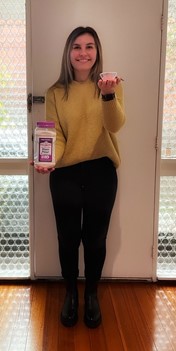
Below is a picture of Miss Loucas hefting flour and muffin cases. You can see the flour is heavier than the muffin cases.
Find at least 3 heavy things and 3 light things in your house.
Draw the table below and fill in the table using these items. We have filled in some for you.
|
House items |
Heavy |
Light |
| A teabag |  |
|
| A chair | |
|
Write and draw your items from lightest to heaviest in your workbook.
(40 minutes)
Science
Learning Intention:
We are learning to find sources of light and sound around our house so we are aware of items that produce light and sound.
Task:
In your learning from home book, divide a page into 2 columns.
Write Sound at the top of one column and Light at the top of the other.
You will be going on a light and sound hunt around your house.
Draw and label different objects that make sound and light under the correct heading.
Are there any objects that make both sound and light?
| Sound |
Light |
|
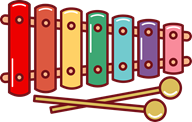
xylophone
|
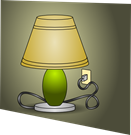
lamp
|
|
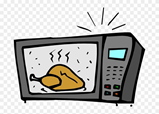
microwave
|
|
© Copyright Laburnum Primary School