
Year 5 Learning from Home Week 8 Term 3
Week beginning - 7 September 2020
Smile, take time to laugh and enjoy learning this week!
It’s Week 8 and we only have two weeks left of Term 3!
This week we will be looking at the funny side of life through Limericks and Humour Fiction.
We will also be exploring the genres of Adventure, Science fiction, and Fantasy.
The Year 5 Team is certain that one of these types of fiction will excite you this week!
Mrs Dedes gets excited reading Historical Fiction and Adventure.
Mr Rodgers’s favourite genres are Science Fiction and Fantasy.
Mr Arnott loves Historical Non-fiction and Science Fiction books.
Mr Marikar really likes reading Historical Non-fiction and Adventure books.
Mrs Richards enjoys reading Mystery and Adventure novels and Miss Cook is fond of reading Science Fiction.
To kick-start your week with some humour and a smile is a Roald Dahl quote, from his book The Twits.

Webex Schedule
Below is a list of the work you will need to complete and bring along to our Webex session:
Monday: Learning from Home plan (Reviewing)
Tuesday: Mathematics ‘Factors and Multiples’ (Teaching)
Wednesday: Writing ‘Limericks’ (Teaching)
Thursday: Science ‘States of Matter Presentations’ (Reviewing)
Friday: Science ‘States of Matter Presentations’ (Reviewing)
Self-Reflection (Reviewing)
Wellbeing
SEEKING HELP - REHEARSING HELP SEEKING CONVERSATIONS: (30 minutes)
Learning Intention:
We are identifying sources of help and rehearsing help-seeking conversations
Task:
Choose from the scenarios below and draw a comic where you ask for help to solve the problem.
You will keep this piece of work to add to and upload in Week 9.
Think about:
- Who will you ask?
- What will you ask for?
- What language will you use?
- What will you say once you have received assistance?
ROLE PLAY SCENARIOS:
1 You see a friend take a pen out of another classmate’s pencil case.
2 You get separated from your family at the New Year’s Eve fireworks festival in the city.
3 This Maths problem is really hard. You were away sick when the explanation was given.
4 Two good friends keep fighting and making up and you find it annoying.
5 You were playing with your sister’s iPod, dropped it and the screen broke.
6 One of your classmates is always asking for some of your lunch because he says that he forgets to bring his.
You think that maybe his family is having money problems. You tried to ask him about this but he denies it.
7 Your friend has started going to the sick bay a lot with headaches.
She told you in secret that she is feeling very upset because her parents are fighting and she thinks they are
going to split up.
This has been stopping her from sleeping properly at night.
She asked you to promise not to tell anyone.
8 You are walking your little brother home from school when he starts having an asthma attack.
These visuals may help you to prepare your comic:

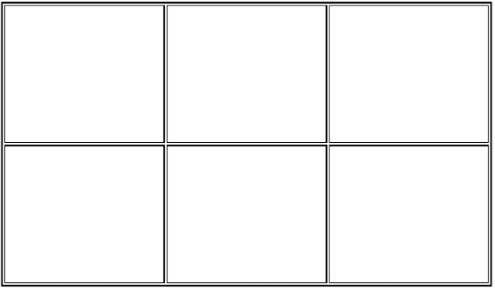
Click here to view some templates you may wish to print and use.
Reading
Continue to read every day and record your reading to share with your teacher.
You have been set texts to read in Bug Club, and you can access many more books in Epic!
Now that we have Google Classroom up and running, we would like to use it to track your weekly reading.
On Friday, upload your weekly reading log on Google Classroom.
Record the reading you do each day, including the title, author, source (Epic!, Bug Club, etc.) and the number of pages that you read in each book.
FICTION GENRES - HUMOUR: (40 minutes)
Learning Intention:
We are analysing the features of humour fiction as a genre
The purpose of Humour Fiction is to amuse the reader.
The author may do this subtly or make it really obvious. They cause the audience to laugh and feel happy.
Task:
Go to Epic! and look for the books assigned to the ‘Humour’ library collection.
Read through one or more titles.
From your reading of humour fiction texts, can you give any examples of each of the following features:
- Audience
- Purpose
- Setting
- Character
- Style
- Story-line
FICTION GENRES - ADVENTURE: (40 minutes)
Learning Intention:
We are analysing the features of adventure fiction as a genre
Adventure Fiction presents danger, or gives the reader a sense of excitement.
Common subjects are pirates, treasure hunters and explorers.
Task:
Go to Epic! and look for the books assigned to the ‘Adventure Fiction’ library collection.
Read through one or more titles.
From your reading of adventure fiction texts, can you give any examples of each of the following features:
- Audience
- Purpose
- Setting
- Character
- Style
- Story-line
FICTION GENRES - SCIENCE FICTION: (40 minutes)
Learning Intention:
We are analysing the features of science fiction as a genre
Science Fiction explores imagined future scientific or technological advances and major social or environmental changes. They frequently portray space or time travel and life on other planets.
Task:
Go to Epic! and look for the books assigned to the ‘Science Fiction’ library collection.
Read through one or more titles.
From your reading of science fiction texts, can you give any examples of each of the following features:
- Audience
- Purpose
- Setting
- Character
- Style
- Story-line
FICTION GENRES - FANTASY: (40 minutes)
Learning Intention:
We are analysing the features of fantasy fiction as a genre
Fantasy Fiction is often inspired by real world myth and folklore.
It involves magic, fantastical places and mythical creatures.
Task:
Go to Epic! and look for the books assigned to the ‘Fantasy Fiction’ library collection.
Read through one or more titles.
From your reading of fantasy fiction texts, can you give any examples of each of the following features:
- Audience
- Purpose
- Setting
- Character
- Style
- Story-line
Upload your analysis of one genre fiction to Google Classroom by Friday 1pm.
Success Criteria:
I identified the features of a fiction genre
I gave examples for the features of a chosen fiction genre
Writing
WRITING FOR INQUIRY: (40 minutes)
Learning Intention:
We are demonstrating our understanding of Australian history
Task:
You will need extra time to complete the final Inquiry project.
Refer to this week’s inquiry lesson below and use some of your writing time to complete the task.
LIMERICKS:
You will choose your best Limerick from this week to upload to Google Classroom by Friday 1pm.
Success Criteria:
I wrote a limerick that follows the correct rhyming structure
I wrote a limerick that follows the correct rhythm
I wrote a limerick that contains humour
LIMERICKS – RHYMING STRUCTURE: (40 minutes)
Learning Intention:We are learning the rhyming pattern of limericks

Limericks are five lines long.
They are usually funny and silly and have a distinctive rhythm.
The rhyming structure is AABBA, or in other words:
Lines 1, 2, and 5 rhyme with one another.
Lines 3 and 4 rhyme with each other.
For example:
There once was a very bright kid.
Was awesome in all that he did
He learned every trick
To write a limerick
And the teacher sure did flip her lid
Task:
Write a limerick on the topic of your choice, making sure you get the rhyming structure correct.
LIMERICKS - RHYTHM: (40 minutes)
This lesson will be taught during Webex Essential on Wednesday
Learning Intention:
We are learning how to write a limerick with the correct rhythm
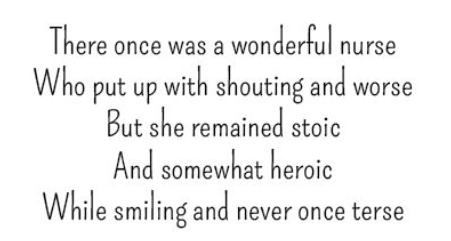
Now that you have attempted to write a rhyming limerick, you need to incorporate the RHYTHM.
Limericks are supposed to have a rhythm, or beat, where certain syllables are stressed.
Line 1, 2 and 5 have 3 beats, lines 3 and 4 have 2 beats.
In the limerick below, the stressed syllables are capitalised.
(You do not need to capitalise full words in your poem, but it shows you how the beat sounds when you read aloud.)
There ONCE was a WONderful STAR
Who THOUGHT she would GO very FAR
UnTIL she fell DOWN
And LOOKed like a CLOWN
She KNEW she would NEVer go FAR.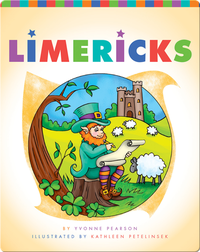
Read page 14 and 15
of this book
on Epic!
for another example.
Task:
Write a limerick on the topic of your choice following the correct rhyming pattern and rhythm.
LIMERICKS - HUMOUR: (40 minutes)
Learning Intention:
We are learning how to include humour when writing a limerick
Limericks are supposed to be humorous.
They will usually have a set-up that describes a character, and then have a punchline.
The punchline is where something amusing is described, often a downfall or something unfortunate.
For example:
There was an Old Man with a beard,
Who said, “It is just as I feared! —
Two Owls and a Hen,
Four Larks and a Wren,
Have all built their nests in my beard.”
Task:
Write a humorous limerick that involves a setup and punchline.
Remember to follow the correct rhyming and rhythm patterns.
Spelling
SPELLING PATTERNS INVOLVING H: (30 minutes)
Learning Intention:
We are changing the sound of letters by adding the letter ‘h’ to make a new spelling pattern
Task:
The letter ‘h’ changes the sound of many letters, for example - ‘sh’, ‘th’, ‘ph’, ‘ch’.
Create a poem of your choice of style (e.g. colour, haiku, cinquain, limerick, rhyming) where every single line contains a word containing a ‘sh’, ‘th’, ‘ph’, or ‘ch’ spelling pattern.
Mathematics - Factors and Multiples
FLUENCY - MULTIPLES OF TEN (Complete daily before Maths)
Task:
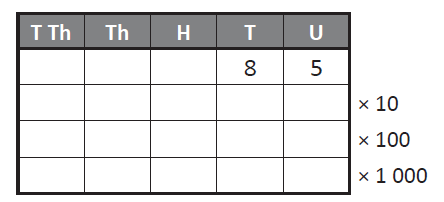
Each day, choose a number and multiply it by 10, 100 and 1000.
The table below is an example of how you could set this out.
Keep going into the 10,000s and beyond to challenge yourself.
What do you notice about how the original number changes when you multiply it by a number that ends in zero?
Describe this using mathematical language.
MY NUMERACY: (40 minutes or daily if you have time)
Learning Intention:
We are working on our personal mathematics goals through My Numeracy
Task:
Log onto My Numeracy on Essential Assessment and work on your Multiplication goals first.
If you have time you can work on other goals in My Numeracy or go onto Sunset maths.
This lesson will be taught during the Webex Essential session on Tuesday.
FACTORS: (40 minutes)
Learning Intention:
We are using our multiplication knowledge to identify and list factors
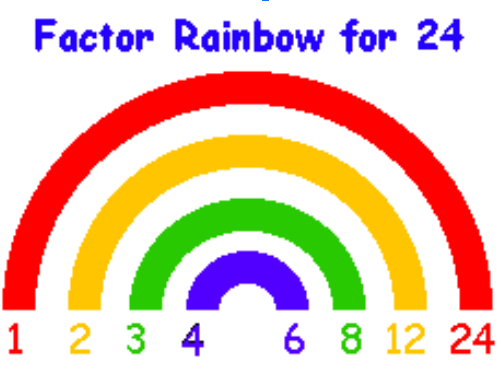
Factors are pairs of numbers that multiply to give another larger number called a multiple.
For example, 3 x 4 = 12, so 3 and 4 are factors and 12 is the multiple.
Furthermore, 2 x 6 = 12, so 2 and 6 are also factors.
Task:
Choose at least 4 of the numbers from the table below and find as many factors as you can for each.

Write the factors you discovered in order and link the pairs to make a ‘Factor Rainbow’ like the one below.
Strategies you might use:
- Use blocks or a group of items such as rice to make arrays to find the answer
- Draw arrays by hand or on the computer
- Use your times table knowledge. If the number appears in a times table then that number is a factor
You may know of other strategies that you could use.
MULTIPLES: (40 minutes)
Learning Intention:
We are identifying and sorting multiples of numbers
A multiple is the result of multiplying one number by another number.
For example, 20 is the result of 4 x 5.
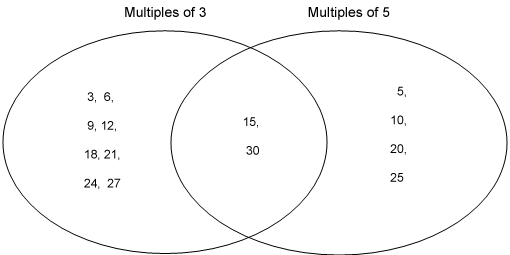
A Venn diagram is a thinking tool to sort data into two or three circles which overlap in the middle.
In the example below:
Numbers that are multiples of 3, but NOT 5, go in the left section.
Numbers that are multiples of 5 but NOT 3, go in the right section.
Numbers that are multiples of both go in the overlapping section in the middle.
Task:
Click here to sort number sets into Venn diagrams as shown in the example above.
If you cannot print the worksheet, complete the activity in your workbook, drawing your own Venn Diagram.
Find something round to trace to keep your diagram neat.
Science
STATES OF MATTER PROJECT: (40 minutes)
This will be reviewed in your Webex Essential sessions on Thursday and Friday.
Learning Intention:
We are demonstrating our understanding of the three main states of matter
Task:
You will use your Science time this week to finish planning an experiment or presentation that demonstrates the properties of one or more states of matter.
When conducting your experiment, you MUST plan responsibly and safely.
Check with your parents before using any heat source, potentially dangerous liquid (e.g. cleaning or cooking products) or sharp or heavy objects.
If you need to review the states of matter, sign into ClickView and watch this video.
You will present or share your experiment during Webex on Thursday and Friday morning this week.
You will have a 2 minute time limit to present, so be prepared.
You may:
- Conduct your experiment live if it is safe to do so and you can do it within the time limit.
- Share a recording of your experiment that you prepared beforehand.
- Share photos of your experiment.
Success Criteria:
I demonstrated the properties of a state of matter in an experiment or presentation
I described materials by observing their properties
I safely planned, prepared, set up and presented an experiment
P.E. / Movement Breaks (40 minutes)
Learning Intentions: We are being active to earn virtual kilometres

14932km!
Good luck Year 5!
Let’s see how active
you can be!
How does it work?
Keep track of how much time you spend being active from Monday to Friday each week
1 minute of any form of exercise = 1km
Keep track of the type of activity you participate in from Monday to Friday each week
e.g. walking, running, skipping, bike riding
Click here to enter your results by 3pm Friday.
Remember to demonstrate the school value of integrity when entering your results.
Every week, the leader board will be updated. You will be able to see how far each year level has travelled.
For example, if you complete a total of 30 minutes of exercise every day from Monday to Friday you will contribute 150 km!
(30 x 5=150).
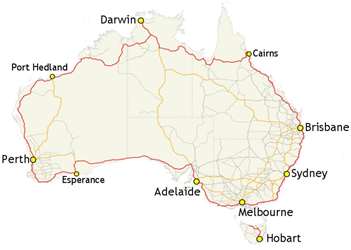
The race will start in Melbourne and head north up the East Coast.
We are following the main highway around Australia which equals 14,932km!
Along the journey there will be ‘bonus’ tasks to earn additional kilometres!
Good luck and remember every kilometre counts!!
Inquiry – Australian History (40 minutes)
Learning Intention:
Use research skills to demonstrate an understanding of the period (1788-1901) using a collection of written, visual and oral pieces
Task:
Research the experiences and impact/s of a person who lived in Australia between 1788 and 1901.
Scenario:
You are an historian with expert skills who has been hired to research and report back on the experiences of a person living in Australia - anytime from the landing of the First Fleet to Federation.
Create a multimodal presentation that will be displayed for others to learn about the important events during that person’s life.
Requirements:
Choose ONE of the following time periods: Colonisation, Gold Rush or Federation.
This will be the time period that you focus on in your project.
Choose an event that you are interested in learning more about from this time period.
Research
Research a person who had an important role in this event. You will need to discover the following:
- Where and when were they born?
- Where (if possible) and when did they die?
- Where did they live and what was their social class? Did this change throughout their life?
- If they migrated to Australia, what was the reason?
- What was their role in society? What major events occurred in their lifetime and what was their part in them?
- What were their hardships?
- What were the positives and negatives throughout their life?
- Describe their living conditions throughout different periods of their life.
Presenting your Understandings
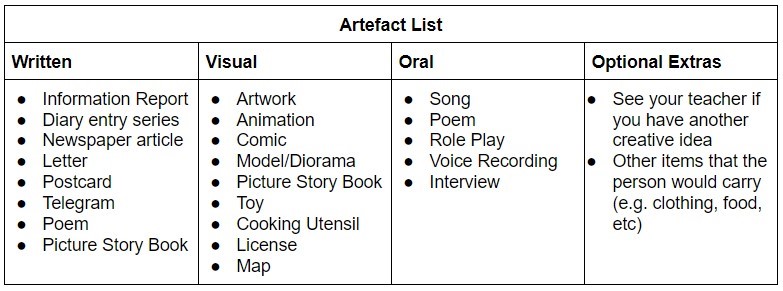
Create a timeline and an artefact from each list (four items in total) in the table below to convey your understanding of the above information.
If you choose an item from one list that is repeated in another, then don’t repeat that artefact choice.
You can also choose to include an artefact created earlier in the term about this time period.
You will be allocated extra time in week 9 to complete your written task.
Extension:
How did your chosen person’s life compare to others?
What can we learn from their life to apply to the future?
Self-Reflection:
MID-TERM REFLECTION: (15 minutes)
We will review this lesson during Webex Essential on Friday.
Learning Intention:
We are reflecting on our progress as Writers
Specialist Classes:
Click here for the Specialist options.
Answers for Week 8
Mathematics:
Factors
The factors for each of the numbers are listed below:
9 – 1, 3, 9
12 – 1, 2, 3, 4, 6, 12
16 – 1, 2, 4, 8, 16
20 – 1, 2, 4, 5, 10, 20
24 – 1, 2, 3, 4, 6, 8, 12, 24
36 – 1, 2, 3, 4, 6, 9, 12, 18, 36
48 - 1, 2, 3, 4, 6, 8, 12, 16, 24, 48
54 - 1,2,3,6,9,18,27,54
100 - 1, 2, 4, 5, 10, 20, 25, 50, 100
50 - 1, 2, 5, 10, 25, 50
60 - 1,2,3,4,5,6,10,12,15,20,30,60
72 - 1,2,3,4,6,8,9,12,18,24,36,72
Multiple Number Patterns
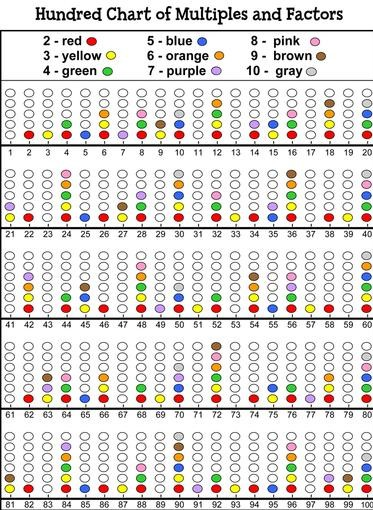
This chart shows which numbers are multiples of the numbers 2 to 9.
Any numbers without any colours are numbers that will help you solve the challenge puzzle.
© Copyright Laburnum Primary School