
Year 1 Learning from Home Week 2 Term 3
Week beginning - 27 July 2020
Below is an EXAMPLE of a weekly timetable that could be used to help plan out weekly learning tasks. Although this is a five day timetable, please plan your week around the days your family uses for Learning from Home. Please remember your Webex sessions as well!
| Monday | Tuesday | Wednesday | Thursday | Friday | |
| Session 1 | Reading Task (Independent reading) | Independent Reading and Reading Task | Independent Reading and Reading Task | Independent Reading and Reading Task | Independent Reading and Reading Task |
| Break | |||||
| Session 2 | Writing Task | Writing Task | Writing Task | Spelling Task | Writing Task |
| Brain break | |||||
| Session 3 | Maths Task | Maths Task | Maths Task | Specialist | Maths Task |
| Lunch | |||||
| Session 4 | Wellbeing Task | Inquiry Task | Inquiry Task | Specialist | Specialist |
Webex Essential Schedule
Below is a list of what we plan to do in our Webex Essential sessions:
Monday: Wellbeing
Tuesday: Writing Task: Acrostic Poem
Wednesday: Reading Task: Noticing questions as you read
Thursday: Spelling
Friday: Maths Task: What are the Chances? Will happen/Won't happen
Wellbeing
Resilience, Rights and Respectful Relationships - 'Stress Management'
Learning Intentions:
We are learning different ways to relax our bodies
Task:
- Try out these exercises to help relax your whole body:
Melting moment -
Close your eyes.
Scrunch up all your muscles so you are as hard as a block of ice. Hold tight.
Now slowly let go.
Scrunch up again.
Now let go.
This time, imagine your block of ice is melting into the floor.
Your muscles are getting softer as you melt.
Let your fingers melt. Let your feet melt. Let your back melt.
Now wiggle your fingers to wake them up. Wiggle your toes to wake them up.
Open your eyes.
How did this exercise make you feel?
Floating Cloud -
Close your eyes.
Picture a fluffy white cloud. It is as gentle and soft as feathers.
Imagine you are lying on this soft and gentle cloud.
It makes your arms relax and feel floaty. It makes your legs relax and feel light and floaty. It makes your back feel soft.
When you are all soft and settled, the cloud is going to slowly lift you up and take you for a ride.
It is going to take you to a really nice place, to your favourite place.
Can you imagine now what you can see in this special place.
Is there something nice there? Is there something fun to do? Is there something peaceful there?
In a moment, your cloud will be bringing you back to your house.
Imagine that it is gently setting you down now.
Wiggle your fingers to show you are back. Wiggle your toes to show you are back.
Open your eyes.
How did this exercise make you feel?
Can you think of any more ways to relax your whole body?
Write the answers to these questions in your workbook.
Draw a picture of the happy place the cloud took you to.
Reading
These tasks need to be completed in your pink lined book with the date written at the top of the page.
Learning Intentions:
We are learning to build our reading stamina by reading independently for 20 minutes every day
We are learning to record questions before we read a book
We are learning to ask and record questions in our workbook, as we are reading
We are learning to keep a log of our daily reading
Tasks:
- It is really important that when we read we are able to concentrate on our book for a long time.
Find a quiet, comfortable place in your house to read a Just Right Book that has been assigned to you on Bug Club or Epic! (including books you may have already read).
This should look just like independent reading at school and you should do it every day.
(20 minutes) - Before you start reading a new book, have a look at the front cover and the title.
What are some questions you have about this book? Write down 2 questions on your sticky notes.
Read the book. Were your questions answered?
Stick your questions into your pink lined book at the end of reading. Make sure you include the date and the title of the book at the top of the page.
(30 minutes) - Complete this task after our Webex Essential session on Wednesday:
Noticing questions as you read:
As you are reading, questions might pop into your head.
Good readers notice these questions and want to find out the answer!
Today, as you start reading, pause when you notice these questions and write them down in your book.
After your teacher has shown you what to do, have a go on your own.
You may choose to repeat this task more than once.
(30 minutes) - Everyday when you read, you are expected to record what you have read, the pages you have read and the date you read in your yellow reading log.
If you don’t have one, you can record this at the back of your pink lined book.
(5 minutes)

Writing
These tasks need to be completed in your pink lined book with the date written at the top of the page.
Learning Intentions:
We are learning to identify the different types of writing that we know (poetry, procedure, word splash, letters, recounts, stories and lists)
We are learning to write an acrostic poem of our name
We are learning to write an acrostic poem about a word of our choice
We are learning to publish one of our poems.
Tasks:
- Free choice writing. You can choose to write an acrostic poem, a procedure, a letter, a recount, a story or a list.
You can do this task more than once!
Don’t forget to create some illustrations to add meaning to your writing.
(30 minutes) - Bring this task to the Webex Essential session on Tuesday to share with your class:
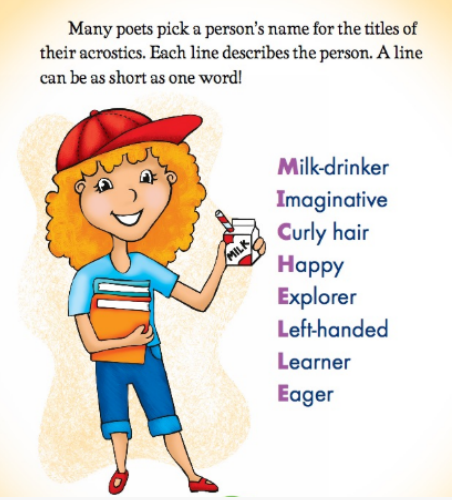
Write an acrostic poem using your name.
Each word used should describe you and your strengths.
Hint: don’t forget to use your adjective chart from last week to help you!
We have included an example for you below.
Don’t forget to draw a picture to match your poem.
Success Criteria (what we are looking for to provide feedback)
I can write my name vertically (straight down) the page in capital letters
I can use interesting adjectives that start with each letter in my name that describe me
I can draw a detailed and colourful picture of myself to match my poem
Please upload a picture of this work to Sentral, with your name on it, through the parent portal by Friday.
(50 minutes)
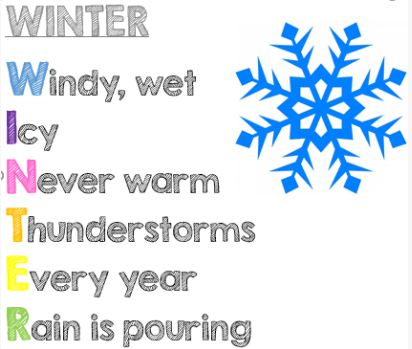
- Now that you have written a few acrostic poems, we would like you to write one about a topic of your choice!
Some ideas for your acrostic poem may be:- animals,
- sport,
- a family member,
- a pet,
- your favourite place,
- your favourite colour,
- your favourite/worst food!
You could do this task more than once. Draw a picture to match your writing.
(50 minutes)
Here is an example about ‘Winter’.
- Choose your favourite acrostic poem that you have completed and publish it onto paper.
You could use any special paper that you have at your house to publish, be creative!
Remember, when we publish, we use our best writing, use lots of colour and draw detailed pictures that match our writing.
We would like you to collect your published poems, so that you can create your very own poetry book!
(50 minutes)
Spelling/Handwriting
This task needs to be completed in your pink lined book with the date written at the top of the page.
Learning Intention:
We are learning to spell high frequency words
Task:
- This task will be completed in Thursday’s Webex Essential session:
The focus word for this session is ‘come’.
Why can this be a tricky word to spell?
Are there any other words you can spell if you know how to spell come?
How many syllables does it have? How many letters does it have?
How can you remember how to spell this word?
(20 minutes)
Maths
These tasks can be completed in your blue scrapbook with the date written at the top of the page.
Learning Intentions:
We are learning to write, say and order numbers
We are learning to write, say and expand numbers to show the value of each digit
We are learning to classify events as will happen and won’t happen
We are learning to identify events that will happen and won’t happen to us
Tasks:
- You will need to use the number cards you cut out last week for this task.
Turn the cards upside down and put them in a neat pile in front of you.
Select the top 2 cards to flip over. What 2 numbers can you make using those 2-digits?
For example, if I picked up a 5 and a 2, I could make the numbers 25 and 52.
Say the numbers aloud and write them down.
Select the next 2 cards and repeat. You should now have 4 numbers written down in your workbook.
Underneath the 4 numbers you have created, rewrite all the numbers in order from smallest to largest.
Repeat this activity until all the cards are turned face up.
Tip: you may want to use your 200s chart to help you with ordering the numbers.
Challenge: If you feel ready after completing this task, you could try it with 3-digit numbers by flipping over 3 cards at a time
(40 minutes) - You will need to use the number cards you cut out last week for this task.
Turn the cards upside down and put them in a neat pile in front of you.
Select the top 2 cards and say the number that they make.
Write the number down in your workbook. Next to it, write the number in words using your neatest bubble writing.
Then draw the number in bundles (tens) and single icy-pole sticks.
Lastly, write the value of all the bundles + the value of the single icy-pole sticks.
An example has been included for you below.
Complete this task until you have run out of cards.
Challenge: If you feel ready after completing this task, you could try it with 3-digit numbers by flipping over 3 cards at a time.
(50 minutes)
Number
Bubble Writing Bundles Ones Expanded 37
Thirty seven 

30 + 7
- Below are some pictures of events that will happen (are certain) or won’t happen (are impossible).
In your books, draw a table with the headings ‘will happen’ and ‘won’t happen’ (see example below) and paste (or draw and write) each event under the correct heading.
Challenge: Add your own ‘will’ and ‘won’t happen’ events to the table.
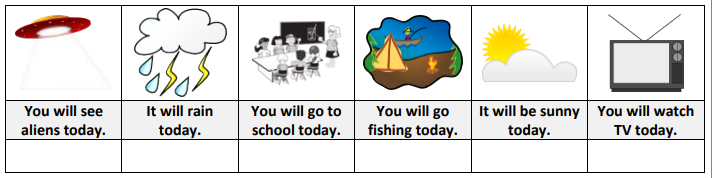
| Will Happen (Certain) | Won’t Happen (Impossible) |
| Miss Walker will eat lunch today | Miss Marshall will join the circus |
- This task will be introduced in Friday’s Webex Essential session:
For this task, you will be creating a page for a class book called ‘What are the Chances?’
On a piece of paper, draw a ‘will happen’ and ‘won’t happen’ table.
Write a sentence about something that will happen (is certain) and something that won’t happen (is impossible) to you this week.
Illustrate your sentences (see example below).
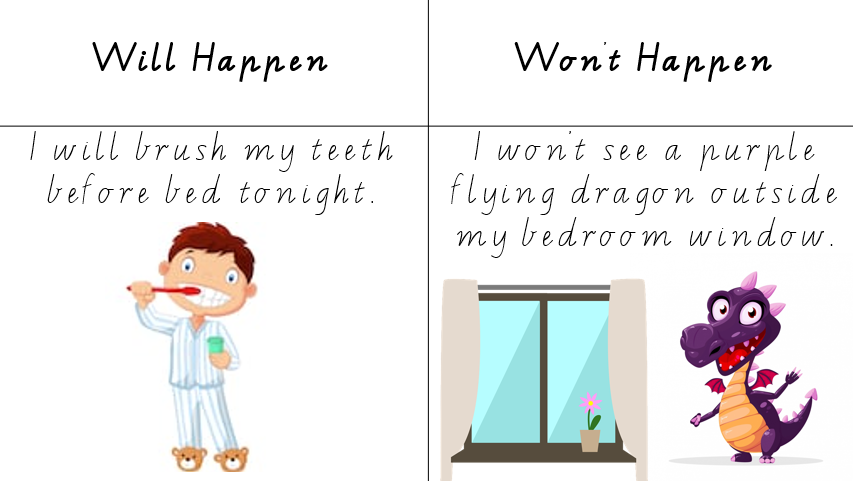
Success Criteria (what we are looking for to provide feedback)
I can draw up a table with the headings ‘will happen’ and ‘won’t happen’
I can identify an event that won’t happen
I can identify an event that will happen
Please upload a picture of this work to Sentral, with your name on it, through the parent portal.
(50 minutes)
P.E./Movement breaks:
Last week our focus was developing our skipping skills.
Hopefully most of you have had some practise with some of the skills you learnt.
This week we are going to continue practising so we get better each week.
Remember to always find a safe space (inside/outside) to practise spinning the rope over your head and jumping over the rope. If you don’t have a skipping rope, you can use a hula hoop, a spare rope or simply jump back and forth over a line on the ground.
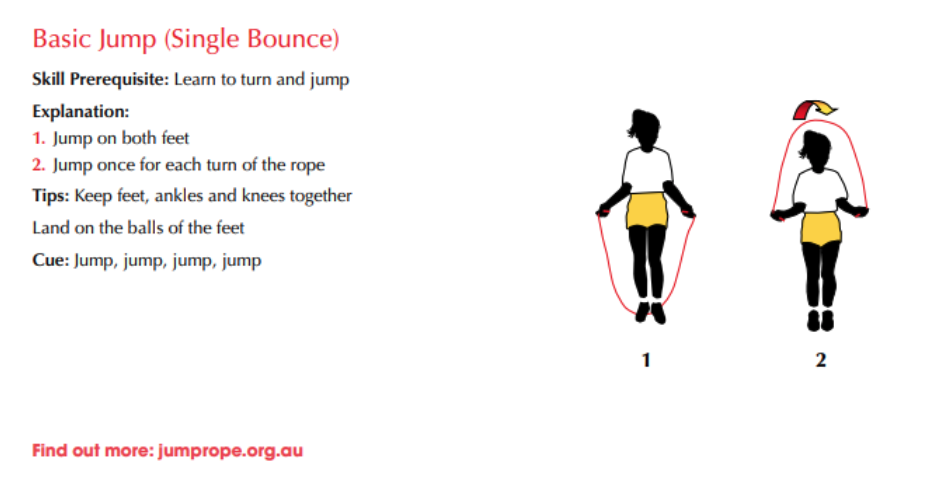
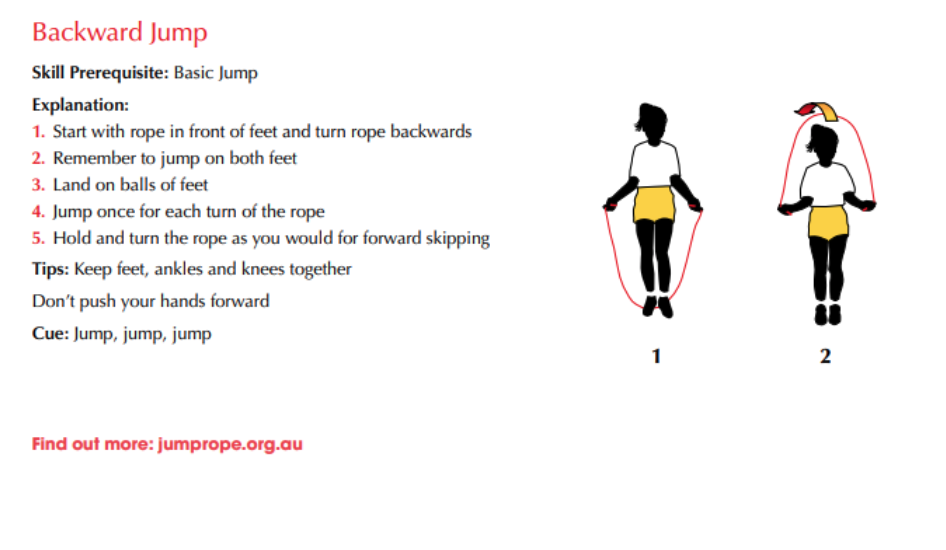
Once you are able to spin the rope over your head, practise forward and backward skipping.
Optional – Take a video or some pictures of you completing some of the skipping challenges and send them via Sentral to either Mr Marikar or Mrs Yue-Lamb.
CHALLENGE 1: Single Bounce
CHALLENGE 2: Backward Jump
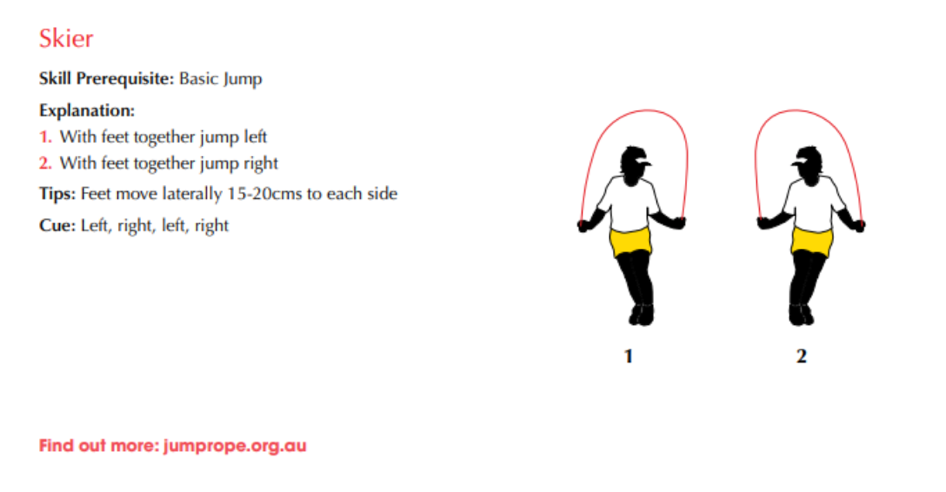
CHALLENGE 3: Skier
Bonus Challenge: First to 100
If you can do 1 skip = 10 Points
If you can do 2 skips in a row = 20 Points
If you can do 3 skips in a row = 30 Points
If you can do more than 5 skips in a row = 50 Points.
Have as many practises as you can. Add up how your points to see if you can get to 100 points. For example, if you do 10 x 1 skips you would get to 100 points, or if you did 5 x 2 skips in a row you would get to 100 points.
Inquiry
These tasks need to be completed in your blue scrapbook with the date written at the top of the page.
Learning Intentions:
We are learning to identify foods and think about where food comes from
We are learning to explore ClickView
Task:
- Draw the table below in your workbook. Label and draw the food in the first column.
In the second column, write where you think the food comes from.
Challenge: Add your favourite foods to the table!
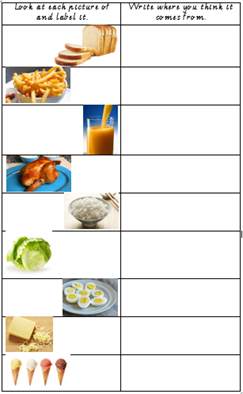
- This week, we are exploring a brand new resource, ClickView.
(Please use your password in the pack that was sent home last term - you will need this to log in to ClickView).
Watch the video ‘Where does it come from?’ which is about where food comes from before it gets to the shops.
After watching the video, check the answers in your table (above). Were you correct?
Self-reflection:
In your book complete the following sentence:
I have shown respect at home this week by __________________________.
I have shown curiosity at home this week by __________________________.
I have shown integrity at home this week by __________________________.
I have shown resilience at home this week by __________________________.
Click here for the Specialist options:
© Copyright Laburnum Primary School