
Year 5 Learning from Home Week 7
Week beginning - Tuesday 26 May 2020
Welcome to Week 7 of Learning from Home!
We are proud of the independence, integrity and perseverance you have all been showing this term.
Did you know that this Tuesday is Sorry Day?
It is a day to reflect on the treatment of Indigenous Australian people in our country’s history.
What does this day mean to you?
Our focus for this week is Contribute!
When we make the effort to contribute during our Webex Meetings, we build understanding through questioning, the discussions we have and the sharing of our viewpoints.
We also interact positively by responding to others’ ideas and giving constructive feedback.
Think about the resources you have at home that contribute to your learning, such as access to the internet, books and magazines.
Your family members are also a resource you can use! They can help you and also contribute to your learning as well.
Reading
Learning Intentions:
We are learning to distinguish between fact and opinion.
We are learning new ways of recording notes effectively.
We are learning to use our notes to write summaries.
Each Week: (60 minutes total over the week)
Read your Just Right Book and record your reading in your Student Diary every day - title, page numbers, genre and time spent reading.
Build your stamina each day.
Shared Class Novel: (20 minutes)
Listen to our class novel on Epic! - ‘The Invention of Hugo Cabret’ by Brian Selznick for 30 minutes.
How much of the novel have you listened to so far?
Distinguish Between Fact and Opinion: (40 minutes) (Answers under Self-Reflection)
Facts are what actually happened and can be proven as true with evidence.
You cannot change a fact.
These can be signalled by numbers, photographs, statistics, verification, records, or eyewitnesses.
e.g. Tuesday follows Monday every week.
Opinions tell us a personal attitude or judgement about something.
Two people can have different opinions on the one topic.
These are usually signalled by words like I think, I believe, probably and should.
e.g. I think Mondays are great, even though Jim disagrees.
- Task 1:
Read the text below and highlight or underline the facts and opinions with two different colours. For example, you might highlight all the facts in orange and all the opinions in green.
Milkshake Mania!
“You can feel the excitement in the air,” said business owner Mary Milkmaid. Today was the grand opening of Mary’s Milk Bar.
“I will be serving the best milkshakes in the world!” declared Mary as she cut the ribbon at the official opening.
Mary makes the milkshakes using 2 scoops of ice cream, 3 shots of syrup and 2 cups of creamy milk. She says that she makes every milkshake with love, and that it is the best milkshake you will ever have.
Travis was the first person to order a milkshake from the new milk bar. He decided to have a chocolate one. “I think chocolate is the best. I’m sure all of Mary’s milkshakes are great though,” he said, as he slurped on his chocolate milkshake.
On the opening day, Mary sold one hundred and eight milkshakes. She declared the day a great success and couldn’t wait to make more milkshakes tomorrow! - Task 2:
“I will be serving the best milkshakes in the world!”
This statement is an opinion. Why do you think it is an opinion? - Task 3: Write a fact and an opinion that you have about milkshakes.
- Challenge: Write an advertisement for Mary’s Milk Bar. Use both facts and opinions in your ad. Write your facts in blue and your opinions in red.
The Hand Summary: (40 minutes)
Read the text ‘Detecting Earthquakes’ on Epic!.
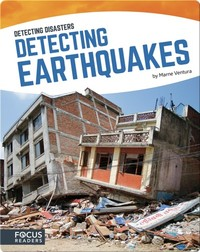
You will record notes from the text that may help you with the inquiry project we are working towards.
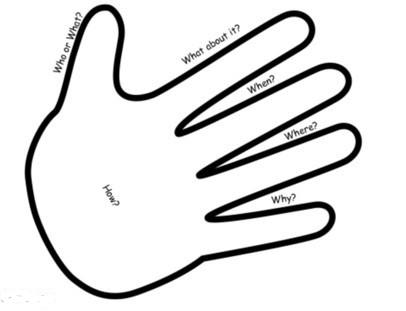
Use the template below to summarise information from the text.
Trace and label your own hand neatly into your workbook to make your template.
Read through each chapter first, then fill in the information.
You will need to complete this task for each new sub-topic in the book to help you with your inquiry project.
Challenge: Complete the quiz on page 30 of ‘Detecting Earthquakes’ in your workbook.
The Slide Summary: (40 minutes)
Read ‘Detecting Tsunamis’ on Epic!.
Once you have read the text, choose a chapter and create a PowerPoint or Google slide summarising it.
An effective slide will only have three or four points on it, otherwise it becomes too crowded and hard to read.
What information from each chapter is important enough to be included in each slide?
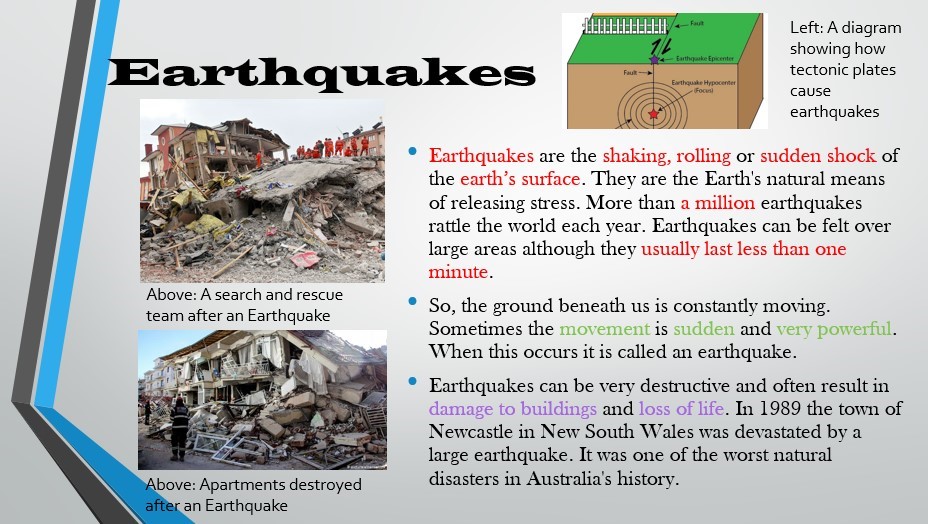
Below is an example of an unclear slide made by Miss Cook.
We can’t read the information and don’t get much information from the images.
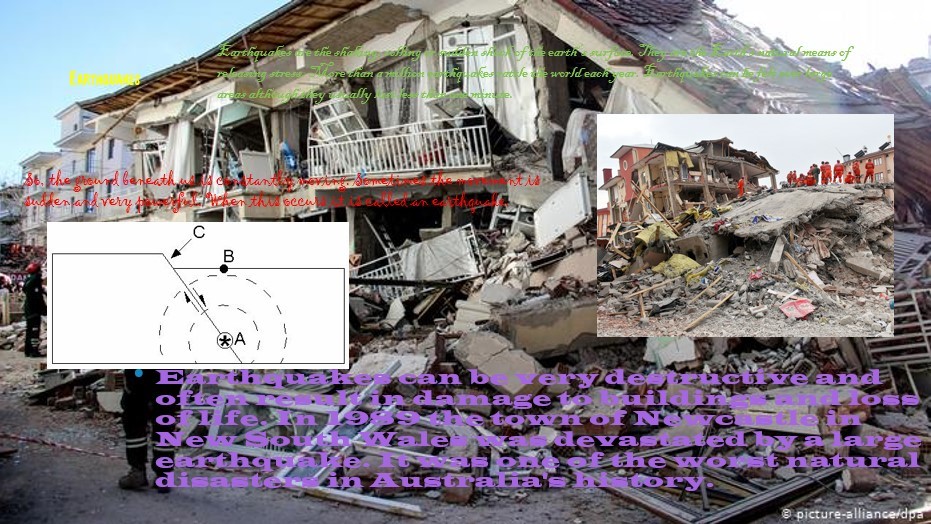
Miss Cook reviewed her work.
Notice now that the information is able to be read easily and we know what the pictures are showing us because of the captions.
The background is simple and the slide is uncluttered.
Try to make your slides more like this one!
Challenge: Complete the quiz on page 30 of ‘Detecting Tsunamis’ in your workbook.
Writing
Learning Intentions:
We are learning to identify different types of information reports.
We are learning to identify the features of an information report.
We are learning to make a research plan before collecting information.
Tasks:
Types of Information Reports: (40 minutes)
An information report can be written in the form of a scientific, technological or social studies report, a newspaper report, a reference text, a brochure, a documentary, a guide book and many more.
Can you think of any others?
Look at this list of information reports.
For each, write who would create it, for what purpose, what it would look like, and who the intended audience would be.
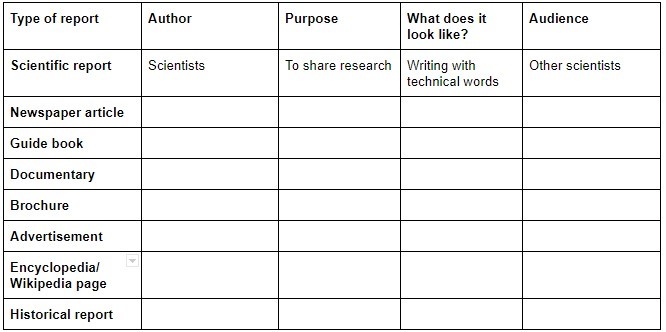
Challenge: List four other types of information reports that aren’t in the table above. Add them to the table.
Features of Information Reports - Introductions: (40 minutes)
Information reports must have strong introductions (also known as classifications) that will do several jobs:
- Define the topic - explain what it is that you will be talking about. It can be one specific thing or a group of things, for example, whales or sea animals.
- Mention what you will learn - Give a brief overview of the information in the report.
- Give the purpose for the writing piece - Why are you writing this? What will it be used for?
- Engage the reader - You need to make the reader want to keep reading.
You can do this with a strong opener, leading questions, or even humour.
You have to think about the audience - are you writing for children, adults, scientists?
Your language will change depending on who is reading your text.
Look at the example below.
Why did the sun go to school? To get brighter, of course! The sun is the most important part of our solar system. All the planets orbit around it, it gives us light and it helps all life on Earth to grow. But have you ever wondered how old the sun is?
Just from this introduction, you should be able to answer the following questions:
- What topic is this piece about?
- What is its purpose?
- Who is the audience?
Write two separate introductions for an information report about the Earth, for two different audiences and reasons - a fun video for students in Year One, and an educational website aimed at adults.
What differences will there be in your word choices?
What strategies would you use to interest them?
Remember, you need to define WHAT the Earth is, and explain WHY you are writing about it.
Challenge: Can you find an excellent example of an information report introduction in a non-fiction text you have been reading? Why is it a great introduction?
Researching for Information Reports: (40 minutes)
Before writing an information report, you need to find something really important - INFORMATION!
There are many ways to research for information, so it is vital to plan ahead so you don’t waste your time.
When choosing a resource, it is important that it is from a reliable and trustworthy source.
If it is a website, check who publishes it.
If it is a company, can you believe their claims?
If it is an individual, are they an expert in the topic?
There are many people and websites that will mislead you, so be careful!
Choose a topic and make a research plan:
- Look up and record the titles of 3 books you could read.
- Write 3 phrases you could enter into a search engine such as Google or Safari. (e.g. If I wanted to know how long sharks can live for, I could enter ‘shark lifespan’, ‘world’s oldest shark’ or ‘how long do sharks live?’)
- List 3 organisations whose websites I could trust.
- Write 3 questions that you would ask an expert.
Spelling
Learning Intention:
We are learning to use possessive nouns to show ownership.
Possessive Nouns: (20 minutes)
A noun is a person, place, thing, or idea.
A possessive noun shows ownership of an object.
An apostrophe (') is a punctuation mark you can use for possessive nouns:
- You add 's for singular possessive nouns (e.g. the cat’s fur)
- Use s' for plural possessive nouns (e.g. the books belonging to the 3 boys = the boys’ books) or
nouns that end in an ‘s’ (e.g. Mr Rodgers’ tape).
Refer to the NASA website to find out characteristics that each planet possesses.
Construct a sentence for each planet demonstrating possessive nouns.
Remember to capitalise the names of the planets and be sure to spell each of them correctly.
E.g. Saturn's rings were first seen through a telescope by Galileo Galilei in 1610.
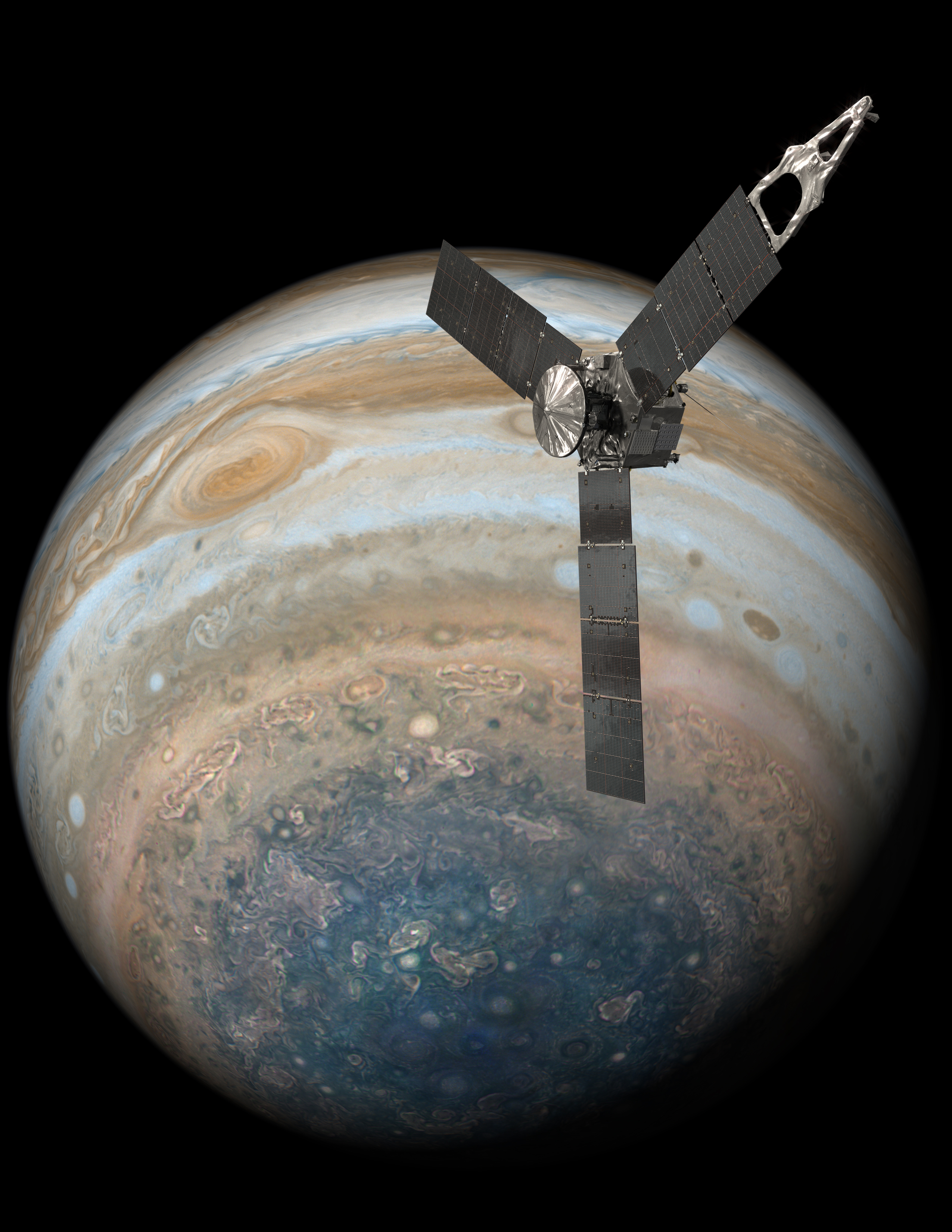
(Dr Dray's Curiosity tip: The NASA link above also leads you to NASA's Eyes.
This App lets you watch what spaceship cameras are filming in real time.
Dr Dray watched Mission Juno approach and film the planet Jupiter in 2019...it was like being there!)
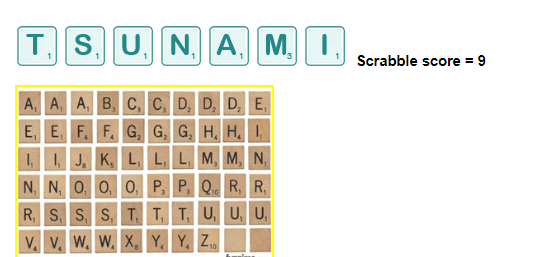
Challenge: Play Scrabble with someone and try to spell the words from our inquiry unit - Natural Disasters.
For example ‘tsunami’ - a violent natural disaster resulting from a destructive sea wave caused by an earthquake or volcanic eruption.
These inquiry-related words will be worth double points and all other words will be normal points (as pictured on each letter tile).
Maths
Learning Intentions:
We are learning to identify the differences between regular and irregular 2 dimensional (2D) shapes.
We are learning to create 2D shapes from triangles.
We are learning about symmetry.
Tasks:
Daily Warm Up - Times tables: (5 minutes) Ongoing Work
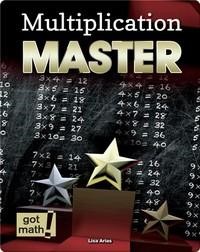
Have a family member test you on the one you were learning last week. If you have mastered it (you can recite them automatically in any order), then choose another times table to practise, otherwise you may need to spend another week learning them. A resource you might like to use on Epic! is Multiplication Master.
Regular versus Irregular 2D Shapes: (40 minutes)
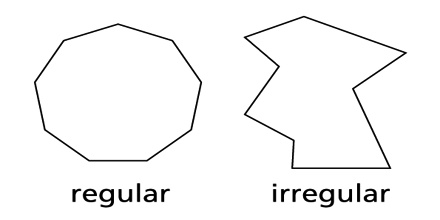
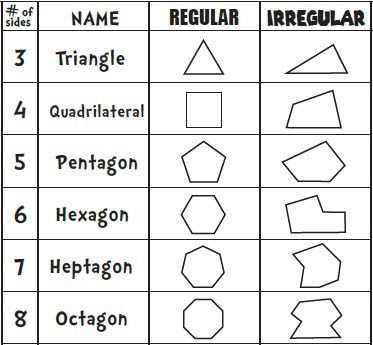
Regular shapes means that all sides and angles in a shape are equal.
Irregular shapes means that not all sides or angles in a shape are the same.
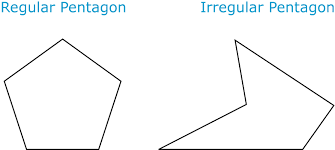
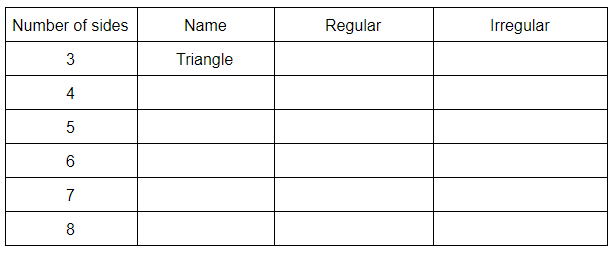
Use colour or scrap paper to cut out an example of a regular and irregular shape for each number of sides shown in the table below.
Stick them into your workbook.
Example: 9 sided shape- Nonagon
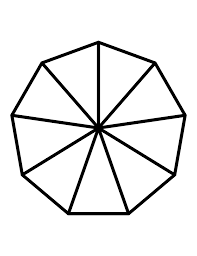
Challenge - Creating 2D Shapes with Triangles:
Your challenge is to create regular 4, 5, 6, 7 and 8 sided shapes from triangles.
How will you arrange the triangles to make the shape?
Will different shapes need different types of triangles?
Find a triangular object to trace, or cut out your own triangles from paper.
For example, this is how a nonagon could be made with triangles.
Symmetry: (40 minutes)
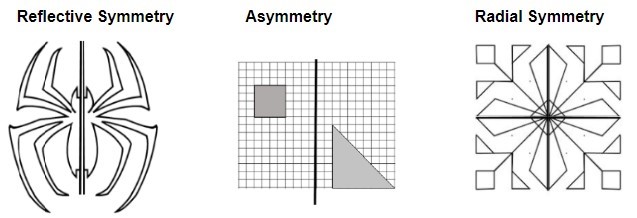
Symmetry is when one part of a shape is the same as another if you flip or turn it.
A mirror image or reflection is an example of symmetry.
Reflection Symmetry - When one half is the exact reflection (a flip) of the other half.
The line that separates the sections that are the same is called the Line of Symmetry.
Same shapes have more than one line of symmetry.
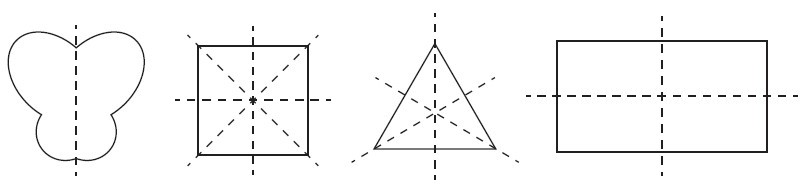
Rotational Symmetry - When the image is rotated around a central point so that it appears 2 or more times.
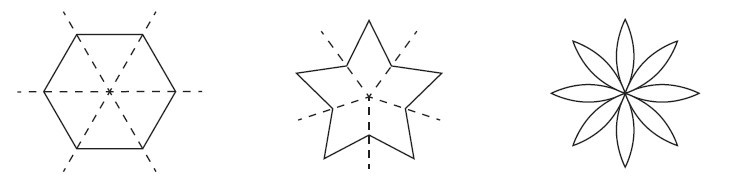
Reflection Symmetry Activity-
Take a piece of paper and fold it in half.
Draw an image that meets the fold line, similar to the examples below. Keep the image big and simple.
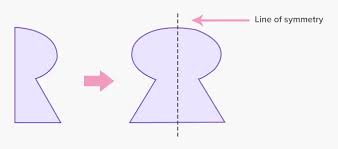
While still folded, cut around your image. Unfold and look at the shape you have made!
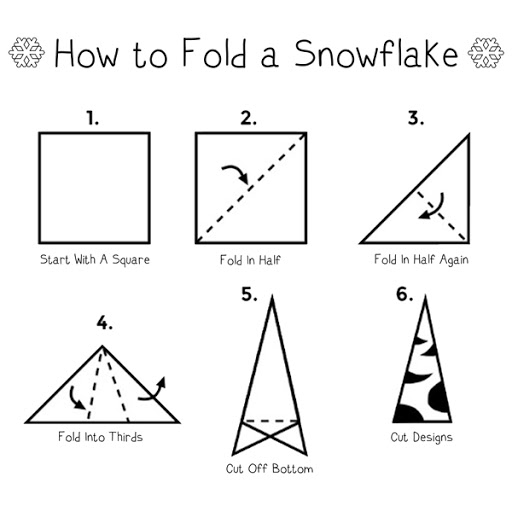
Rotational Symmetry Activity-
Look at the instructions below for how to fold and cut a snowflake.
When you unfold it, look at the example of rotational symmetry you have created.

Challenge: Refer to p.133 Shapes in Maths, Science and Nature on Epic! and create another shape that demonstrates symmetry (e.g. a paper person).
You might like to investigate why plants have radial symmetry and animals have bilateral symmetry.
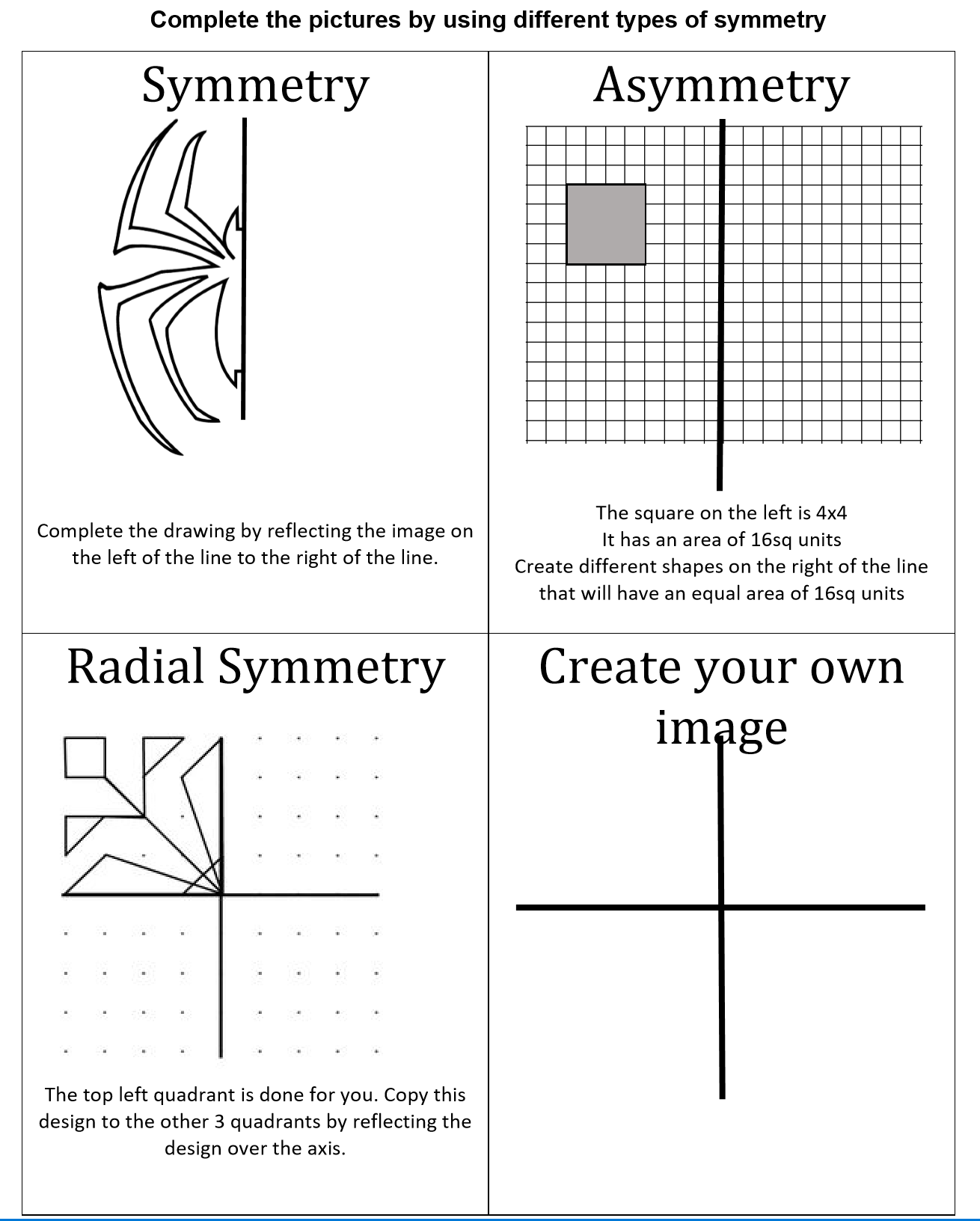
Types of Symmetry: (40 minutes)
When an object has no lines of symmetry, we call it asymmetrical.
Challenge: Go to page 82 in ‘Shapes in Maths, Science and Nature’ in Epic! - ‘Paper Airplane Math’ and complete the activity.
All proper darts are symmetrical, like isosceles triangles; every fold you make on one side of the centre fold you also have to make on the other.
Put this paper airplane to a flight test.
What’s your record for distance travelled and time spent in the air?
Inquiry
Learning Intention:
We are researching facts about Earthquakes and Tsunamis.
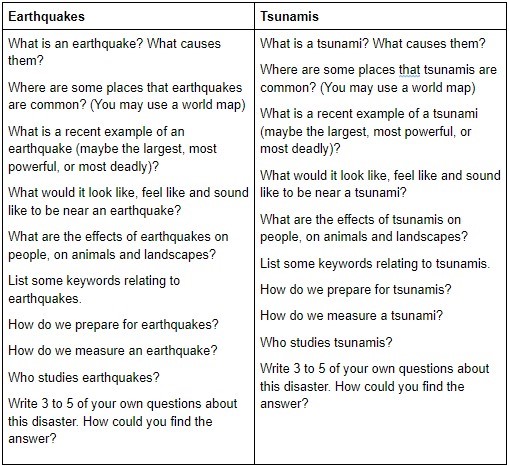
Natural Disaster Investigation- Record your Research: (60 minutes)
Watch this video, ‘Earthquakes: Did You Know’;
read the book “Extreme Earthquakes and Tsunamis’ on Epic!, and
use the Laburnum Primary School Natural Disasters Website
to find answers to the questions below about Earthquakes and Tsunamis.
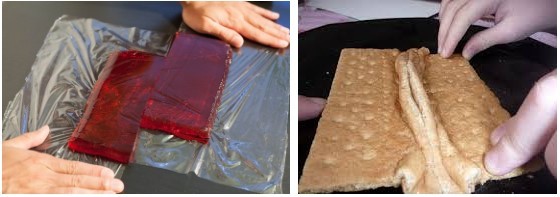
Challenge: Can you find a way to make a model earthquake or tsunami using only items you have at home?
See the pictures below for inspiration.
Science
Learning Intention:
To investigate the features of the planets of our solar system.
Researching the Planets/Moons: (40 minutes)
Since you made your orrery (model of the Earth, Moon and Sun), you have learnt about the Earth’s tilt, phases of the moon and the distance between the planets.
Does this change the way you would have made your orrery?
List 3 changes you would make to your model.
Investigation Task:
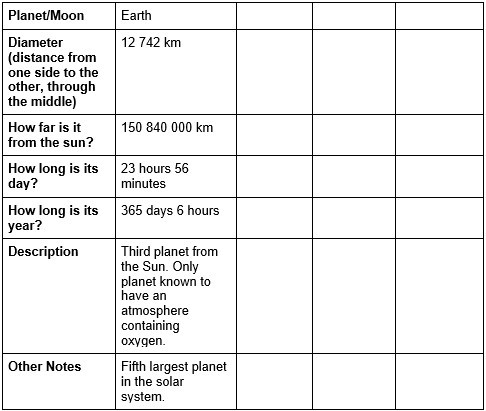
Research 3 Planets or Moons in our Solar System and put the data into the table below.
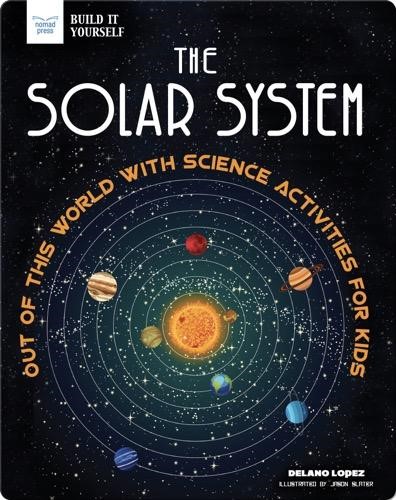
You may wish to read The Solar System on Epic! for some inspiration.
Wellbeing:
Resilience, Rights and Respectful Relationships ‘Problem Solving’
Learning Intention:
We are learning to develop ways to solve a problem.
We are learning to understand the impact of social interaction on a problem.
Task:
Revisit the scenarios from week 6.
Consider who was involved in each scenario and who the problem impacted.
Choose a scenario, or use the scenario you created, to write a short role play.
You need to show the members of the scenario discussing ways to solve the problem and try to show a solution that has a positive outcome for everyone.
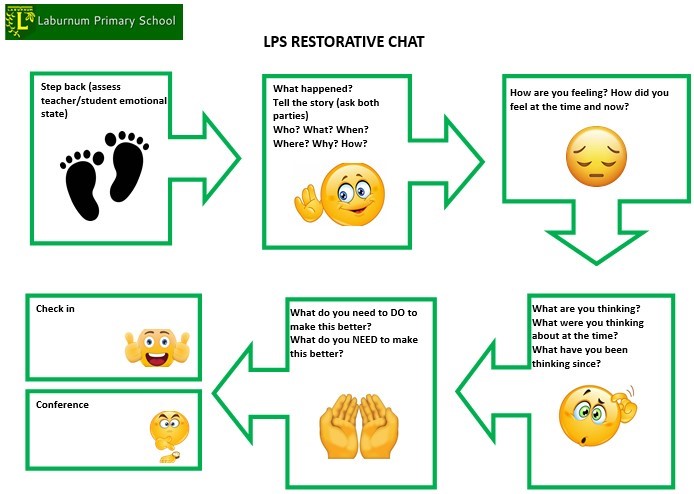
You could also use the prompts on the Restorative Chat card to help you.
Mindfulness Challenge: Choose from the activities below. Have fun!

Self-Reflection:
THRIVE: In your diary, write down three ways you are thriving at home.
Specialist Classes:
Click here for the Specialist options.
Answers for Week 7
Reading
Distinguish Between Fact and Fiction:
Task 1:
Opinions -
“You can feel the excitement in the air”,
“I will be serving the best milkshakes in the world!”,
“She says that it is the best milkshake you will ever have”,
“I think chocolate is the best. I’m sure all of Mary’s milkshakes are great though”,
“She declared the day a great success and couldn’t wait to make more milkshakes tomorrow.”
Facts -
“Today was the grand opening of Mary’s Milk Bar”,
“Mary makes the milkshakes using 2 scoops of ice-cream, 3 shots of syrup and 2 cups of creamy milk.”,
“Travis was the first person to order a milkshake from the new milk bar. He decided to have a chocolate one”,
”He slurped on his chocolate milkshake”,
“On the opening day, Mary sold one hundred and eight milkshakes.”
Task 2:
This statement is an opinion because Mary might think they are the best milkshakes in the world and another person might not like them at all. Everybody’s personal taste is different.
Maths
Regular versus Irregular 2D Shapes:
*Note that your irregular shapes might look different to the ones below. Just make sure they have the correct number of sides.
Types of Symmetry:
*Note that your asymmetrical shape may look different but it must take up the same total area.
© Copyright Laburnum Primary School