
Year 5 Learning from Home Week 6
Week beginning - 18 May 2020
Welcome to Week 6! We hope you had a lovely weekend.
By Wednesday this week we will be halfway through Term 2!
All work should be completed in your workbook or on study paper.
Please write the date, topic and lesson title at the top of each piece of work, so that we can provide relevant feedback when you are able to share it.
Our Focus for this week is Thrive - Physical Wellbeing.
Make sure to look after your health and do some physical activity every day.
How do you like to stay active?
You might go for a walk or bike ride with your family.
You could do one-minute challenges, such as ‘How many star jumps can you do in one minute?’
Make sure you are doing the P.E. activities each day!
We also recommend that you stand up and move several times every hour.
If you have a Garmin, Fitbit, or wristwatch that can set alarms, use it to remind you when it's time to move.
You could also use timer apps on your iPad, electronic device or an alarm clock.
Reading
Learning Intentions:
We are learning to distinguish between fiction and non-fiction texts.
We are learning to summarise non-fiction texts.
We are learning to identify keywords that link to important information.
We are revising the non-fiction text features that organise information.
Each Week: (60 minutes total over the week)
Read your Just Right Book and record your reading in your Student Diary every day - title, page numbers, genre and time spent reading. Build your stamina each day.
Shared Class Novel: (20 minutes)
Listen to our class novel on Epic! - ‘The Invention of Hugo Cabret’ by Brian Selznick. Listen to Part One, Chapter Five - ’Hugo’s Father’ (17.31).
Fiction v Non-Fiction: (40 minutes) (Answers below Self-Reflection)
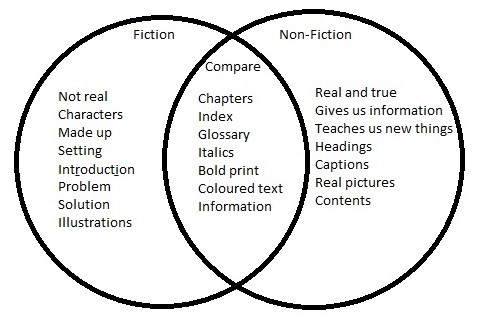
Create a Venn Diagram and list the features of fiction and non-fiction texts.
Remember that the overlap (Compare) is for features that they have in common.

Challenge: Why do authors write the books they write?
What is their intent?
Create a Venn diagram and list reasons why they write fiction or non-fiction books.
Non-Fiction Features: (40 minutes) Go on a non-fiction Scavenger Hunt!
Choose a Non-Fiction book from your ‘book box’.
Draw up the chart below and record an example of each of the features you find, including the page number it was found on. You can use the anchor chart below to help you identify the features in your book.


Challenge: What text features were not included in your non-fiction text?
Can you think of any that are not included in the anchor chart above?
Non-Fiction Key Words: (40 minutes) (Answers below Self-Reflection)
An information report includes key words that signal the main points or important information.
Key words you underline are usually nouns and verbs but not articles (a, an, the) or prepositions (for, in, at etc.).
This is often technical language (jargon), but it could also be explanations or descriptions.
Read this information report and record the words that you believe are the most important.
For each, explain why you believe it is a key word.
Mars: The Red Planet
Mars is the fourth planet from the Sun and is the second smallest planet in our solar system. Mars is sometimes called ‘the Red Planet’ because of its colour. The atmosphere on Mars does not have enough oxygen for us to breathe.
Missions to Mars
It is important to launch a mission to Mars at the right time because Earth and Mars are always moving. Sometimes, Mars is closer to Earth than at other times. Choosing the shortest distance is a good idea because the journey will need less fuel.
Now check your answers to make sure you’re on the right track, then find and record 5 key words from your own Just Right non-fiction text and record/explain them in the same way.
Non-Fiction Summary: (40 minutes)
Choose a Just Right non-fiction text.
While you are reading, highlight some key words.
In your own words summarise what the text is about.
Don’t forget to include the topic, the main idea and details supporting the main idea which might include the 4Ws
(Who, What, When, Where).
Challenge: Find a non-fiction text about Space or a Natural Disaster and summarise it in your own words.
Writing
Learning Intentions:
We are learning to write a procedure.
We are learning to improve the instructions in an existing procedure.
We are learning to use adverbs.
Tasks:
Grammar - ‘How’ Adverbs: (40 minutes)
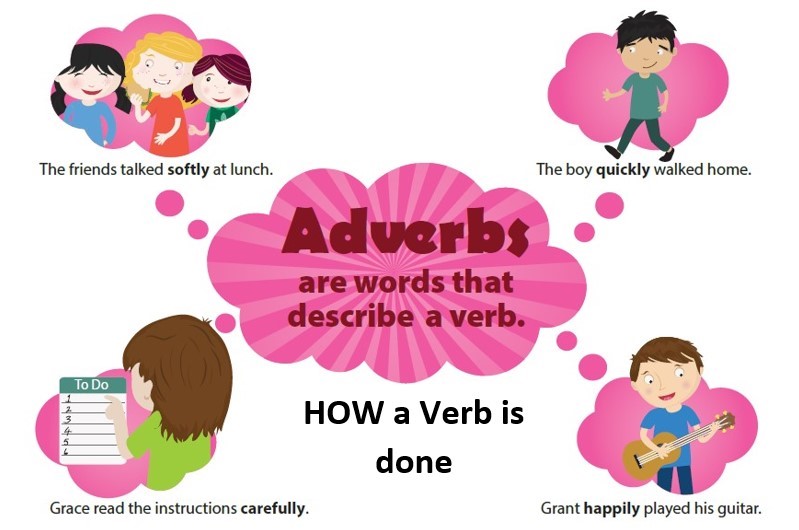
Task 1: Sentences are improved with the use of adverbs.
Adverbs are words that you use to describe how you perform an action. Therefore, they describe the verb.
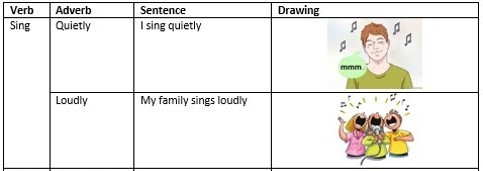
Copy the table from the example in the image below.
For each of the following verbs and adverbs combine both into a sentence,
then draw how the action would look: ride safely, ride confidently, dance gracefully, dance enthusiastically, walk slowly, walk quickly.
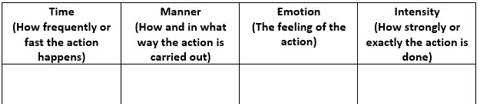
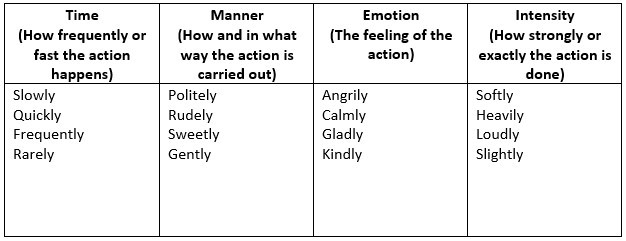
Task 2: There are different categories of adverbs. For example, some describe the timing of an action (quickly, slowly), whilst others describe the manner (gently, rudely).
Categorise each of the following verbs under the correct column using the table below: angrily, rarely, slightly, calmly, softly, slowly, politely, rudely, sweetly, gladly, heavily, quickly, kindly, gently, loudly, frequently.
(Answers under Self-Reflection)
Challenge: Is there anything you notice about the spelling of adverbs?
Do they have a common spelling pattern? Add some of your own adverb examples to each table.
Improve a Procedure: (40 minutes)
Below is a procedure written by Mr Rodgers. (To be honest, it’s not very clear!).
Rewrite it with more detail, stronger verbs and descriptive adverbs.
Refer to last week’s example, ‘How to Wash Your Dog,’ for ideas about features to include or improve.
How to make a sandwich
Aim: To make something for lunch.
You will need:
Bread
Butter
Stuff to go in
A knife
Steps:
- Get your stuff out on the bench
- Put butter on the bread
- Add anything else
- Eat it
Tip: If you liked it make another
Challenge: Try writing your procedure again with a different audience in mind.
Could you write the same procedure for a Prep student as well as an adult?
What would you need to change in the procedure?
Write a Procedure: (40 minutes)
Think of a physical activity that you would like to teach someone else to do at home e.g. dance moves, a sports skill, a game, etc.
Write a clear and effective procedure using all the elements we have covered so far to help someone else to learn how to succeed at this activity.
Challenge: Make a video of yourself demonstrating your procedure. Talk to the audience as if it is your own video channel!
Feedback on Your Procedure: (40 minutes)
For this activity you will need to work with a family member.
Choose one of the procedures you have written, read over it and see if you need to make any changes.
Now, read your procedure to your family member and have them follow your instructions.
If possible, while you are giving instructions, video record your procedure.
Once completed have a look at your recording and discuss what you did really well and areas you could improve on.
Challenge: Revise your procedure and redo your instructions with a different family member.
Compare the similarities and differences. Don’t forget to record if possible.
Spelling
Learning Intention:
We are learning to create adverbs by adding suffixes to adjectives.
Tasks: Choose 10 adjectives to change into adverbs.
You can do this by adding -ly. For example, something can be quick (adjective), and you can eat quickly (adverb).
Words that end in ‘l’ will become ‘double l’ words. e.g. successful will become successfully.
Find 5 words that will have double l when you add the -ly suffix.
Challenge: Take one of the above adverbs and act it out.
Get up and walk into the room in a manner that shows the adverb.
Have family members guess which adverb it is and then take a turn themselves.
Maths
Learning Intentions:
We are learning to identify the features of 2-dimensional shapes.
We are learning to create tessellating patterns.
Tasks: (Answers under self-reflection)
Daily Warm up- Times tables: (5 minutes)
Ongoing Work Have a family member test you on the times table you were learning last week.
If you have mastered it (you can recite them automatically in any order), then choose another times table to practise, otherwise you may need to spend another week learning them.
A resource you might like to explore is this ABC education site - Multiplying.
Identifying Regular 2D Shapes: (40 minutes)
It’s important to know the features and terminology to name 2-dimensional (2D) shapes.
A regular shape is a 2D shape where all angles and sides measure the same.
An irregular shape is a shape which has sides and angles of any length and size.
The poster below shows the English and Spanish names for some regular 2D shapes.
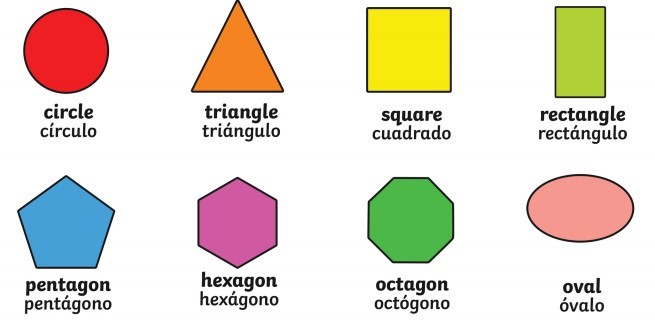
Task 1: How many of each of the above shapes can you find around your house?
Keep a tally to track your progress. Which shapes are most common around your home?
Task 2: Create a table as shown below.
For each of the eight 3D shapes in the above activity, count their vertices and edges and record them in the table.
One has been done for you as an example.

Follow a Procedure to Make a Tessellation: (40 minutes)
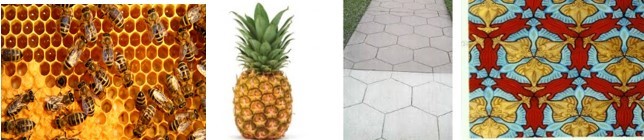
A tessellation is an arrangement of regular or irregular shapes closely fitted together in a repeated pattern without gaps or overlapping. Examples you might see in the real world are tiles in a courtyard, plant cells, beehives, bricks in buildings or patterns in wallpaper, rugs or fabric.
Task: Follow the procedure below to create a Tessellation.
Materials: square piece of paper (a small sticky note works well), scissors, tape, pencil, larger piece of paper (background), coloured pencils or textas.
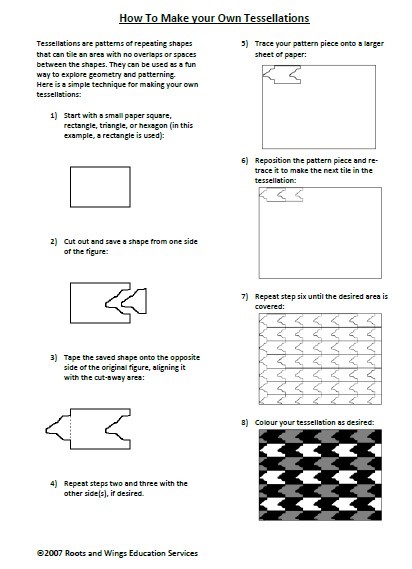
Challenge: Investigate how to move your shape in different ways to create various patterns
e.g. if you flip your paper over, or slide it across, does it create a different look?
You can also practise on Icy slides, flips and turns.
Tiling Tessellations: (40 minutes)
Look at the pictures below of a real-life use of tessellation at Miss Cook’s house! (Dr Dray thinks this is a magnificent tessellation design...wow)
The lady who made this pattern used maths to work out the number of tiles she needed in each shape to fill the area, and which shapes she could tessellate to make a pattern. A lot of planning and resilience went into decorating this floor space.

Task: Choose a part of the room to ‘redecorate’ - wall, floor, desk, etc.
You may need to measure or estimate this area so that you know how many tiles you will need to cover it.
Draw a plan of your tessellation design, including the colours and sizes of tiles that you use.
You can choose to use regular and/or irregular shapes.
Remember to use your resilience, as it might take a few tries to get it to work.
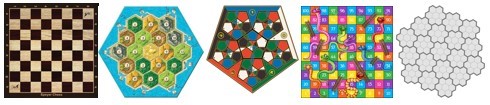
Challenge: Can you make a board game, such as chess, that uses tessellation in a pathway?
The examples below may inspire you.
Write a direction on each tile/space that instructs the player to get up and move! Play the game with a family member.
Essential Assessment: (40 minutes)
Task 1: Sunset Maths (15 minutes)
This helps you to build your number fluency skills.
Log into Essential Assessment and select the ‘game controller’ icon to access Sunset Maths.
Task 2: My Numeracy (25 minutes)
This is aligned to your personal learning goals.
Log into Essential Assessment.
Select Measurement and Geometry.
Select General All.
Select My Numeracy.
You should now see your Learning Goals. Start working on your goals in Measurement and Geometry.
If you have finished those and feel confident, you can choose new goals to work on.
Spend 10 minutes each day working on these skills in My Numeracy.
If you have completed all your My Numeracy tasks for Measurement and Geometry, then you can complete tasks from either Number and Algebra or Statistics and Probability.
Challenge: Watch mathXplosion: ‘It’s a Bird! It’s a Fish! It’s a Metamorphosis!’ on Epic!
Can you create your own tricky tessellation?
Inquiry - Volcanoes
Learning Intentions:
We are learning to investigate volcanoes as a natural disaster.
We are learning to research for the purpose of answering questions.
We are recording notes in preparation for an Inquiry project.
Natural Disaster Investigation- Record your Research: (60 minutes)
Over the next three weeks you will be investigating different types of natural disasters.
You will keep notes from your own investigations, as well as the information your classmates share on Webex.
We are working towards a final project on Natural Disasters, which this information will help you complete.
This week we will focus on volcanoes!
Try and find the answers to the questions below, recording your responses in your workbook.
Use this website to research and record information-
Laburnum Senior School Inquiry: Natural Disasters
You may also want to read ‘Why do Volcanoes take so long to erupt?’ on Kidsnews.
Volcano Questions:
- What causes volcanoes?
- What types of volcanoes are there? Draw a picture of each type of volcano.
- Where are there active volcanoes? (Draw or print a map to mark out the locations). Hint: What is the Ring of Fire?
- What is a real life occurrence of a volcanic eruption?
- What would it look like, feel like and sound like to be near a volcanic eruption?
- Who studies volcanoes?
- How do people detect and prepare for volcanic eruptions?
- Apart from the lava what other dangers are there when a volcano erupts?
- What are the effects of volcanoes on people, on animals and landscapes?
- List some keywords relating to volcanoes.
- Write 3 to 5 of your own questions about this disaster. How could you find the answer?
Challenge: Make your own volcano!
Follow this procedure to make your own volcano in your backyard.
Be sure to check with your parents (you'll need an adult to help you) and be responsible when setting up, conducting the experiment and cleaning up afterwards.
How to make a Volcano
Materials:
10 ml of dish soap
100 ml of cold water
400 ml of white vinegar
Food colouring
Baking soda slurry (fill a cup about ½ with baking soda, then fill the rest of the way with water)
Empty bottle (or create your own paper-mâché model of a volcano!)
Instructions:
- Combine the vinegar, water, dish soap and 2 drops of food colouring into the empty bottle.
- Use a spoon to mix the baking soda slurry until it is all a liquid.
- Eruption time! … Pour the baking soda slurry into the soda bottle quickly and step back!
How it Works:
A chemical reaction between vinegar and baking soda creates a gas called carbon dioxide. Carbon dioxide is the same type of gas used to make the carbonation in sodas.
What happens if you shake up a soda? The gas particles have so much energy they expand to fill the container. There is not enough room for the expanded gas so it leaves through the bottle opening very quickly, causing an eruption!
Extra Experiments:
- Does the amount of vinegar change the eruption?
- Does the amount of water change the eruption?
- Does the amount of baking soda change the eruption?
Science (40 minutes)
Learning Intention:
Create a vocabulary poster about the solar system. Write 10-12 terms, definitions and pictures.
Look at the example below to guide you.
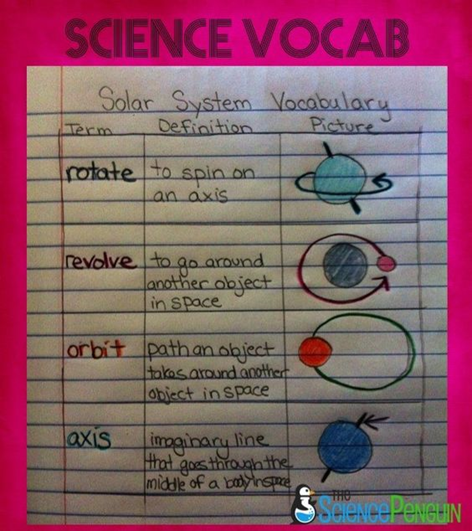
You may wish to read The Solar System on Epic! for some vocabulary inspiration!
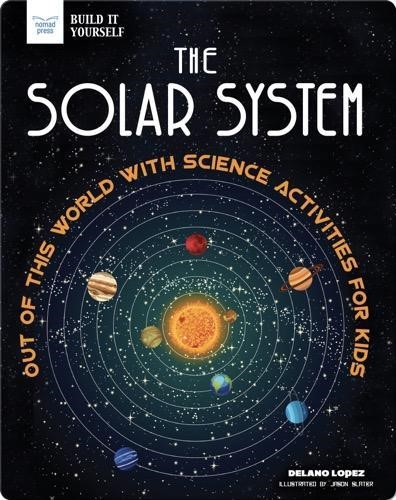
Challenge: There are many space terms that are beyond the solar system. You add to your vocabulary with some extra cosmic terms (e.g. black hole, quasar, nebula).
Wellbeing
Resilience, Rights and Respectful Relationships ‘Positive Coping’
Learning Intentions:
To identify the problem in a scenario.
To brainstorm possible solutions to the problems and determine the best option.
Task: Look at the scenarios below.
In each scenario, identify what you think the problem is.
Can you think of a range of possible solutions for each problem?
Write your own problem for scenario number 6. This could be a problem you have encountered at school or home.
What were some possible solutions for this problem?

Bring a hat you love or wear something funny for the beginning of Friday’s Webex meeting!
Self-Reflection
Thrive - Physical Wellbeing: Record in your diary how you were physically active each day, and for how long.
Specialist Classes:
Click here for the Specialist options.
Answers for Week 6
Reading Answers
Fiction v Non-Fiction
Non-Fiction Key Words
Mars: The Red Planet
Mars is the fourth planet from the Sun and is the second smallest planet in our solar system.
Mars is sometimes called ‘the Red Planet’ because of its colour.
The atmosphere on Mars does not have enough oxygen for us to breathe.
Missions to Mars
It is important to launch a mission to Mars at the right time because Earth and Mars are always moving.
Sometimes, Mars is closer to Earth than at other times.
Choosing the shortest distance is a good idea because the journey will need less fuel.
Reasons
Fourth planet - tells us the location of the planet
Second smallest - informs us about the size of the planet
Red Planet - tells us what the planet looks like
Atmosphere...does not have enough oxygen - tells us about the liveability
Launch a mission - the intent of the paragraph is to inform us about this topic
Shortest distance...less fuel - tells us how best to complete the mission and why
Writing Answers
Grammar - Simple Adverbs
Maths Answers
Identifying Regular 2D Shapes

© Copyright Laburnum Primary School