
Year 3 Learning from Home Week 6
Week beginning - 18 May 2020
Welcome to Week 6 of Learning from Home.
Organisational Skills:
- Complete the following tasks in your homework book.
- Try to complete one task from each section per day.
- Whilst completing tasks in your homework book, please make sure you always write the heading and date your work.
- Please ensure you use neat handing when completing a task.
- Do not use a new page for every task, just underline the task once completed and start a new task underneath.
- Please write neatly using a grey lead pencil.
Reading
Learning Intentions:
We are building our reading stamina.
We are learning to understand what an inference is.
We are learning how to infer when reading.
Tasks:
Just a quick reminder about the Premier’s Reading Challenge:
Participate in the Premier’s Reading Challenge by logging in and registering. You will need your parents to assist you, as you need to use their email address in order to receive your password.
Click on Challenge Application and then click on ‘Home Based Reader’ tab.
You will need to use your parents’ email address for remote access from home.
Fill in all the information needed to receive your login details.
You cannot log in on the School/Student tab because you are learning from home.
- Each day read a JRB (Just Right Book) for at least 30 minutes to build your reading stamina.
*Remember to log your reading in your homework book*.
In your reading log record the date, title, author, genre and rating.
(30 minutes) - Look at this party invitation for Sam’s birthday party.
Answer the questions below in full sentences in your homework book using both the written and picture clues from the text to make some inferences.
(45 minutes)
** For example: Sam’s favourite colour is red because Sam’s name is written in red on the invitation.
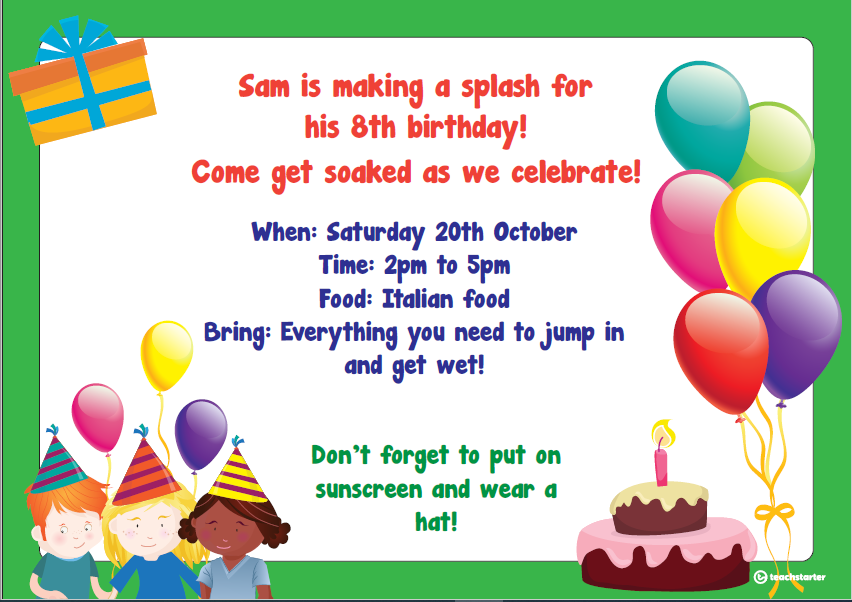
What type of party is Sam having? How do you know?
What food might Sam be serving at the party? Can you think of any specific foods they might have?
What is the season when the party takes place?
How long is the party going to last?
What time of the day is the party?
Why do you think the party is ending at 5pm?
Why do you have to wear sunscreen and a hat?
Which country do you think this party is taking place in? Why?
What is Sam’s favourite flavour of cake?
Is Sam a boy or a girl? How do you know? - Read the two short stories ‘Haunted’ and ‘The Exam’ and answer the questions.
(15 minutes)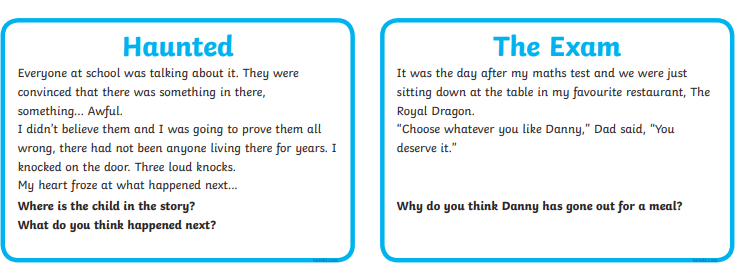
- Click here to listen to ‘My Uncle’s Donkey’. Don’t forget to press ‘cc’ on the bottom right toolbar next to the speaker /volume symbol, once the video has started, to see the words for the story.
Answer the questions below as full sentences in your homework book:
How do you think Uncle feels about the donkey?
How do you know?
How would you describe the donkey’s inside character traits? Give reasons by using evidence from the text.
(30 minutes)
Shared Class novel:
- Click here and read Chapter 4 of Out of Time Book 2: Lost on the Titanic.
In your homework book, answer the following questions using full sentences.
Give evidence from the text to support your answers:
Why were the children stared at by the other passengers?
What did the girl find funny about the children. How do you know?
How do you know the girl comes from a family without much money?
How do you know the waiter didn't believe the children were from first class?
(45 minutes)
Writing
Learning Intentions:
We are learning to structure a narrative piece of writing.
We are learning to write a sizzling start.
Tasks:
- Click here to read The Three Little Pigs on Epic!
Below is an example of a completed ‘Story Mountain Planner’ graphic organiser on the Three Little Pigs.
This is a tool that can help us plan our narrative writing.
Have a look at the way that we have completed the planner, by retelling the beginning, build up, problem, resolution and ending of the story (similar to the way we have retold stories in previous weeks).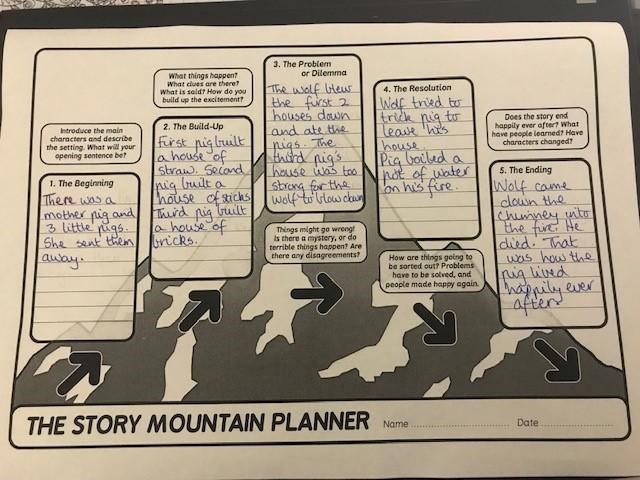
- Please click here to read Goldilocks and The Three Bears on Epic!
Using the story planner linked below, and the example shown above, complete the Story Mountain Planner on the story Goldilocks and the Three Bears.
Click here to open a blank Story Mountain Planner.
You may choose to print out the planner above or draw your own and complete it in your homework book.
(1 hour) - Read the following information giving some interesting or ‘sizzling’ ways to start a narrative (story).
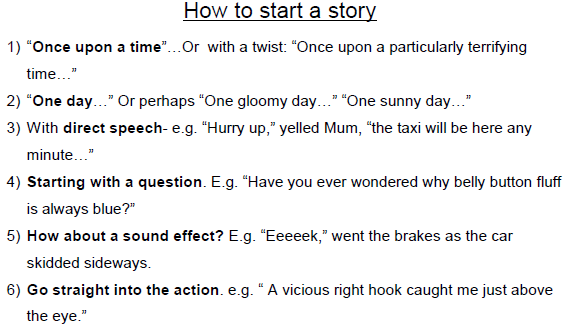
In your homework book, use two of the above ‘sizzling starts’ to write two different story starters by changing the following sentence - this is the sentence you need to make ‘sizzle’:
“Once there was a boy called George.”
(45 minutes)
Handwriting:
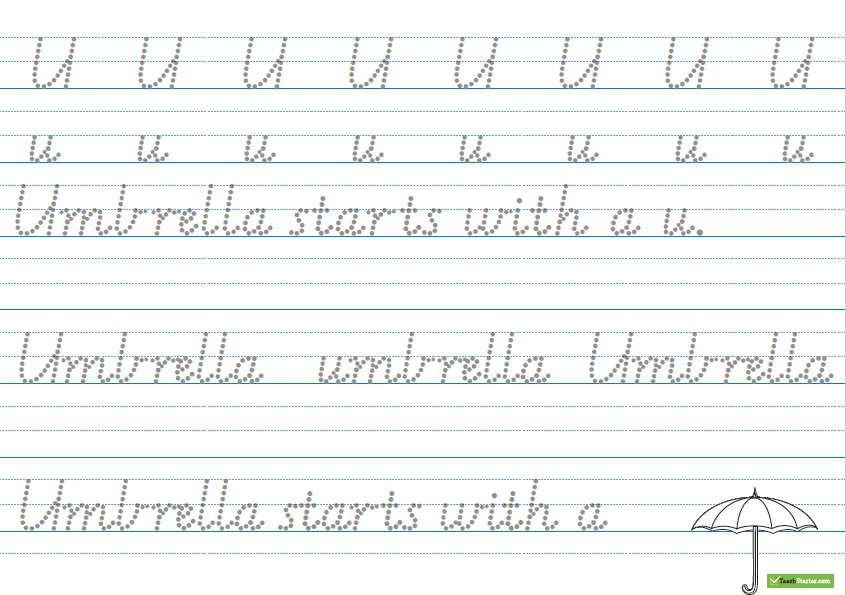
- Practise writing the letter U by copying the examples below into your homework book.
If you need additional practice, print out the copy below.
(30 minutes)
Spelling
Learning Intention:
We are learning to spell common homophones correctly.
Tasks:
- here/hear, there/their, witch/which, to/two, through/threw, where/wear.
For each word write the meaning, for example:
The word ‘I’ means me.
The word ‘eye’ is what people and animals use to see with.
Then place each of the above homophones into sentences.
As a challenge, can you write a sentence containing both pairs of homophones.
For example, ‘I walked through the ship and the Captain stared at me with his eye.’
(30 minutes)
Maths
Learning Intentions:
We are learning to complete tasks in My Numeracy.
We are learning to use the jump strategy to solve addition equations.
We are learning to tell the time to 5 minute intervals.
Tasks:
- My Numeracy: Log in to Essential Assessment and complete your My Numeracy tasks. The tasks assigned are skills you need to develop based on your assessments, so do your best!
(45 minutes) - Jump Strategy
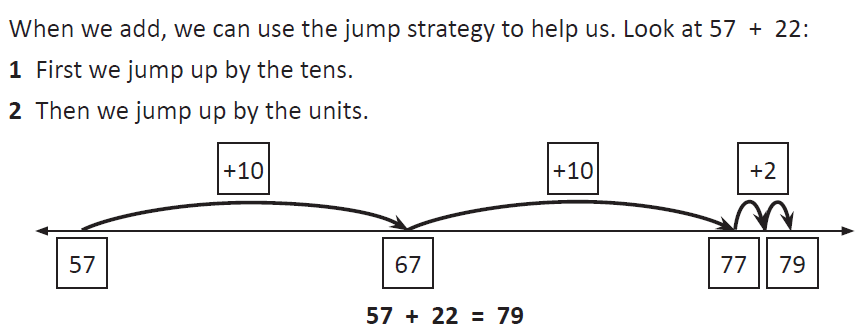
Using the above strategy complete the following equations in your homework book.
- 67 + 45 =
- 95 + 14 =
- 75 + 18 =
- 13 + 23=
- 42 + 32=
- 33 + 78=
- 12 + 46=
Challenge:
Write at least 10 of your own equations.
Show your working out using the jump strategy on number lines.
(45 minutes)
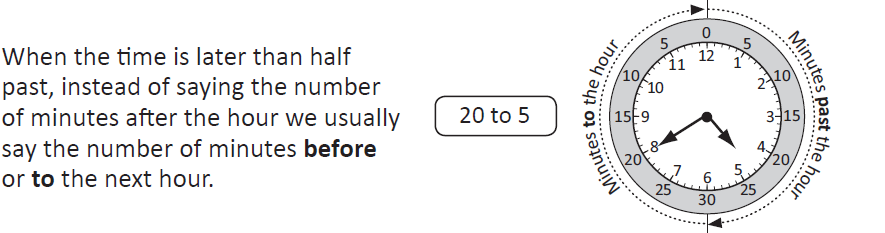
- Look at the example below to see an explanation on telling time to 5 minute intervals.
Click here to access the Time Tools activity!
Match each clock by clicking and dragging the digital clock to the matching analogue clock.
Once you have completed this, press the START button in the bottom right-hand corner.
Explore changing the analogue time to 5 minute intervals by clicking on the + and - buttons.
Click on the ‘Tell me more’ tab at the top and read through the activity instructions for information about time.
For example, you can divide the clock face into 4 sections.
Then move onto 1 minute intervals.
Go to the ‘Time Challenge’ tab.
You will need to change the digital clock to match the master analogue clock by clicking on the + and - symbols.
Adjust the time so the analogue and digital clocks tell the same time.
(45 minutes)
Challenge: Click the ‘Time Match’ tab and then click on a tile to view the time.
You then have to choose another tile to turn over. Try to find all the matching pairs.
Inquiry
Learning Intention:
We are learning to identify the climate and vegetation of the temperate zone of Australia.
Tasks:
- Click here to open a Presentation about Temperate Climate Zones.
Using the images (slides 4 - 7), complete the five senses activity about the temperate zone - an example of a five senses grid is found within the presentation on slide 3.
Use your imagination about what may be heard and what you may taste.
Once you have done this, read through the rest of the presentation.When you have read the rest of the information, think of any WONDERINGS or QUESTIONS you have.
A WONDERING is anything which you found interesting or made you think.
A QUESTION is something which you want to learn more about.
(30 minutes) - Challenge: Making a Triorama
Use the important information that you wrote in your homework book to create a triorama of either a plant or animal from one of the three climate zones we have learnt about (Tropical - week 4, Arid - week 5 or Temperate - week 6).
You can click here to see the instructions for making it.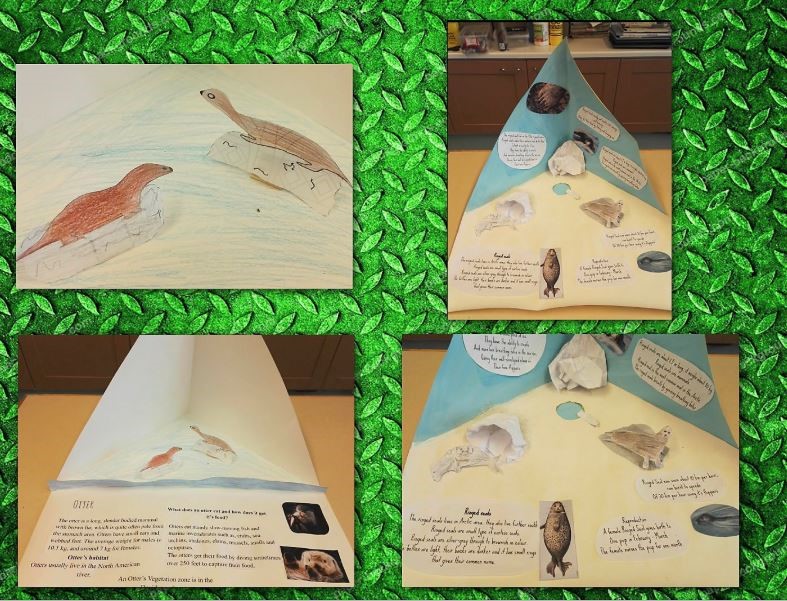
Above are some examples of what the trioramas should look like when they are finished.
(45 minutes)
Wellbeing
Resilience, Rights and Respectful Relationships ‘Positive Coping’
Learning Intentions:
We are learning to describe factors that contribute to positive relationships.
We are learning helpful communication skills.
We are learning to identify characteristics of cooperative behaviour.
When working within a group in our classrooms, or even working with our family members at home during this learning from home time, it is important to cooperate with those around us. This could mean:
Taking turns
Sharing
Letting everyone offer an idea
Tasks:
Try this game with your family:
Make a circle and then pass a ball of string around so that each person has to hold on to it. Pass around several times. Now try to untangle the string!
Play a card game of your choice, with members of your family.
Write a reflection about what you noticed.
How does communication help when playing these games?
How can you use the skill of communication to help in other areas of your life?
Click here for the Specialist program.
© Copyright Laburnum Primary School