
Year 6 Learning from Home Week 4
Week beginning – 4 May 2020
This week we will be focussing on: WELLBEING AND PHYSICAL BREAKS
As we are now starting Week 4 of our Learning from Home program, we thought it would be helpful to focus on our personal health and wellbeing.
Some things to consider:
- Ensure you have a water bottle with you during your learning time, just like at school.
- Have regular breaks to give your eyes a break from the screen. Breaking at least twice per hour would be a good idea.
- Consider preparing some healthy snacks to have near you whilst you are working, for example, cut up fruit or vegetable snacks.
- Build some exercise into your day. This could be a walk, a bike ride or shooting some hoops. A bit of sunshine will help as well!
- Schedule in the other things you enjoy. This might be your music practice, playing games, craft or reading for enjoyment. Don’t forget to stay in contact with family and friends!
- Try to make sure you have a regular sleep routine. Recommended amount of sleep for your age group is 10-12 hours per night.
HOME LEARNING REMINDERS:
- Ensure you include a TITLE and DATE before beginning any new tasks, not using a new page for each new task.
- Your setting out and handwriting need to be NEAT and CLEAR.
- Use the times provided as a guide to how long to spend on each task.
- At the beginning of the week, read through all of the tasks, then use your Organisational Timetable as a guide to self-manage these, including necessary breaks.
- Remember to complete your self-reflection at the end of the week.
These tasks need to be completed this week:
- You need to include 30 minutes a day in your Organisational Timetable for MOVEMENT breaks.
See ‘Specialists’ link towards the end to access ideas from P.E. - You need to include 30 minutes a day in your Organisational Timetable for WELLBEING/MINDFULNESS breaks.
- You may choose to listen to some relaxing music, meditate or try one of the following activities:
We have listed some podcasts below you might like to use during mindfulness breaks this week.
Please investigate these by clicking on the image, which directly links to the resource.
There will be a task related to this in week 5.
Reading
Learning Intentions:
To explore how reading fluency improves reading skills
To monitor reading fluency, focusing on pausing and phrasing
To identify and explore the features of non-fiction texts
Tasks:
Task 1: Daily Independent Reading with Tracks of your Thinking - You should be reading for at least
30 minutes a day, plus tracks of your thinking
Continue with your own independent reading.
This could include texts selected from Epic, books, magazines, newspapers etc. you have at home, or other online library sources.
Remember to detail what you are reading in your Reading Log and leave tracks of your thinking. For example, questions, wonderings, predictions, inferences, connections or visualisations.
*We are interested to see what you have been reading over the past 4 weeks.
At the end of this week, you need to take a photo or scan your Reading Log.
Ask a parent or carer to send it to your teacher as an attachment via the Sentral Parent Portal (Teacher Mailbox)*
Task 2: Developing Reading Fluency - This task should take about 30 minutes to complete
When we read aloud, it is important to pay attention to our reading fluency.
Fluency is made up of a range of skills.
This week, we will focus on two of these skills:
- Pausing (using punctuation to guide the voice, e.g. Short breath at a comma, longer pause at ending punctuation, such as a full stop or question mark.)
- Phrasing (reading words together in meaningful groups, i.e. they are marked with short breaths or pauses).
Consider your own reading.
How would you rate your reading fluency in these two areas?
Rate yourself out of five and give reasons.
Read aloud to someone in your home and ask for feedback about these two areas of fluency.
Does the feedback match your own assessment of your reading?
Rule up a table like the one below to record your comments and a comment from a reading buddy (e.g. Mum).
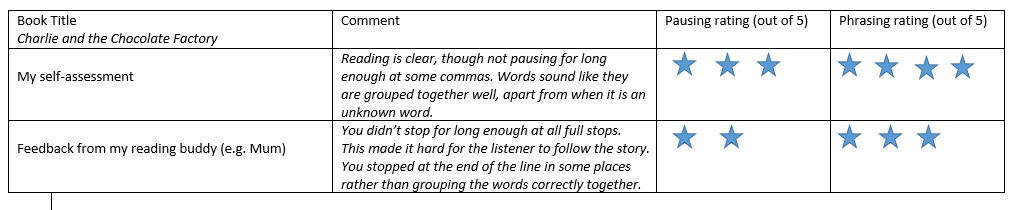
These are areas of fluency for you to work on this week.
Use the feedback and your own self-assessment to make improvements in these areas.
Even if you think you are really good at these areas of fluency, you can still practise!
Perhaps try a more challenging text. See what happens when you try to read fluently.
Task 3: Identifying Reading Fluency - This task should take about 15 minutes to complete each day over 3 days.
Choose a story from Story Box Library to listen to. Log-in details: Username: lpsstories Password: lps1
Reflect on the effectiveness of pausing and phrasing by the reader.
What did you notice?
Could the reader improve their pausing and phrasing in any way?
Did you know that you can add closed captions so that you can see the words on the screen as they’re read by following these steps:
-click ‘play’ on your story selected. You will see a toolbar open up that spreads along the bottom of the screen.
-click the button ‘CC’ until it is activated (blue).
-now listen to the story being read and see the words appear at the bottom of the screen.
Listen to a different story each day (over 3 days) and write down your observations of the reader's pausing and phrasing.
Continue to practise your own fluency goal daily.
At the end of the week, make a comment about how your pausing and phrasing skills have developed.
Task 4: Identifying features of non-fiction texts - This task should take about 30 minutes to complete
Choose 3 books from Epic which are non-fiction and from an area that interests you (e.g. basketball).
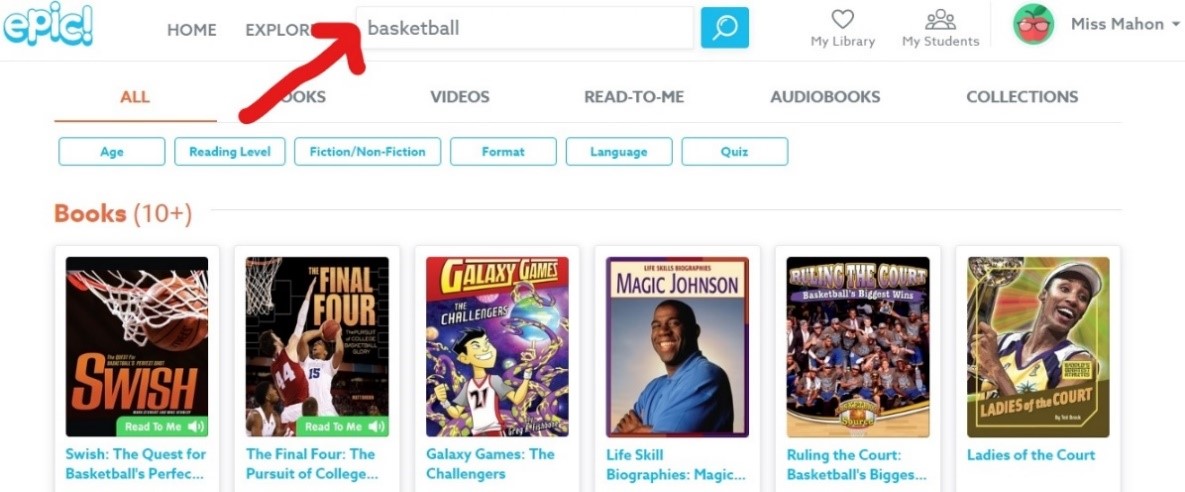
Read through the books and record the different unique features that you notice about the non-fiction texts.
For example, how is the information organised?
Are there pictures?
How do they help you understand the topic?
How do you find specific information?
Rule up a table like the one below to show your learning.
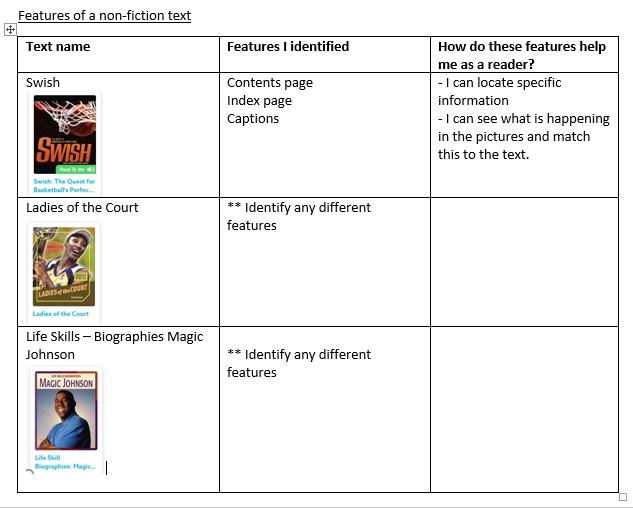
Task 5: Non-fiction text features checklist - This task should take about 15 minutes to complete.
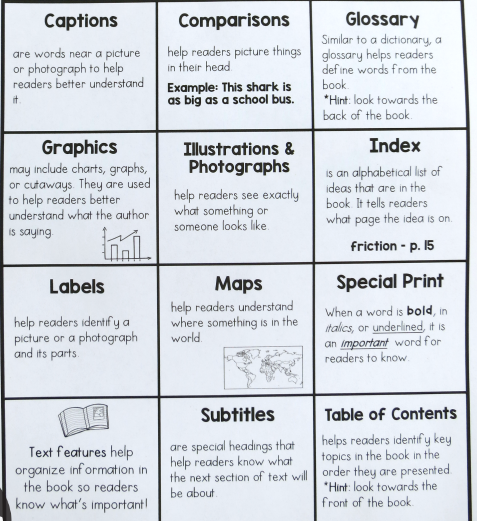
Now check the anchor chart below.
Did you find all of the features listed?
Were there different features in your books?
Write a short reflection about your learning.
Task 6: Audiobooks - This task should take about 15 minutes to complete
Follow the link to Audible by clicking here.
You do not need an account or email to access via our link.
Investigate the books which are available.
There will be further tasks related to using an audiobook in week 5.
Writing
Learning Intentions:
To demonstrate the effective use of adjectives when describing a character.
To identify and explore the features of an information report.
Tasks:
Task 1: Using Adjectives - This task should take about 45 minutes to complete
Use the words from the ‘fabulous adjectives’ chart below (or use your own!), to describe a character from a book or movie in as much detail as possible, so that someone in your house will be able to try and guess the character.
How good is your description?
Reread your work, does it make sense?
Try it out on someone in your family.
How did you go?
Write a brief reflection.
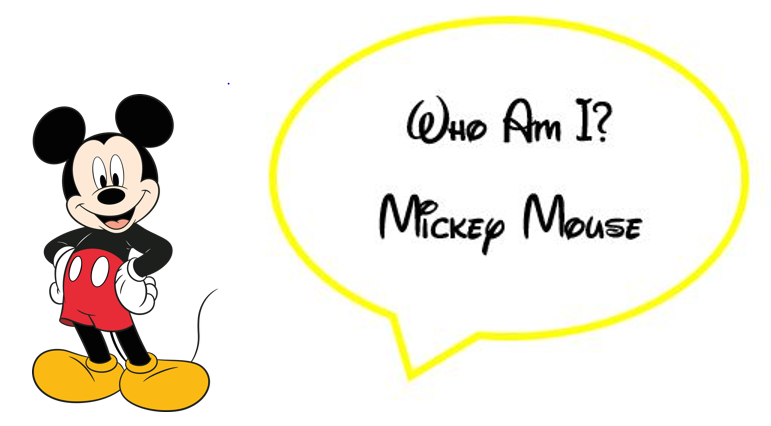
Try this one: Who am I? I have big, round, black ears and wear huge, bright, yellow shoes. I am jolly and easy going.
I have a squeaky voice and a dazzling girlfriend who wears a red bow.
*Scroll to the very end of this week’s Learning From Home tasks to see if you were right!*

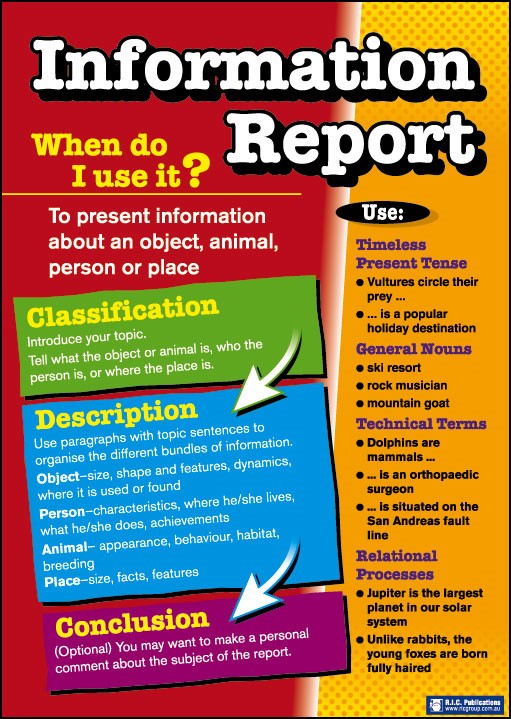
What is an Information Report?
An information report is written to describe factual information on a particular topic or theme.
Information reports can be about animals, places, people, sports, companies etc.
The structure includes:
- An introduction, which classifies the topic of the report.
- Descriptive information about various aspects of the topic, which is organised into paragraphs, with or without subheadings.
- A conclusion that can include your opinion.
The skills required to write an information report are researching, surveying, taking notes, summarising and interviewing.
Read the ‘Information Report’ poster below for more information.
Task 2: Planning an Information Report - This task should take about 30 minutes to complete
Choose a topic you are interested in to write about.
Challenge yourself by investigating a new topic.
You may like to browse Epic to explore a range of possibilities.
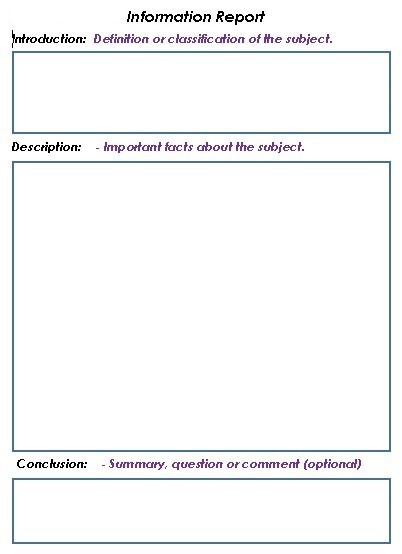
Using the template below as a guide, create a plan in your home learning book.
Spelling
Learning Intentions:
To identify prefixes
To understand that prefixes can change the meaning of base words when added
Definition:
A prefix is a group of letters placed before a root or base word. For example, the word ‘unhappy’ consists of the prefix ‘un’ (which means ‘not’) combined with the base word ‘happy’. The word ‘unhappy’ means ‘not happy’.
Tasks:
Task 1: Matching - This task should take about 30 minutes to complete.
Below are 11 prefixes and meanings:
Prefixes: sub-, over-, post-, mid-, inter-, under-, in-, un-, anti-, trans-, tri-
Meanings: later, too or in excess of, three, below or down, between, middle, not, against, across, under
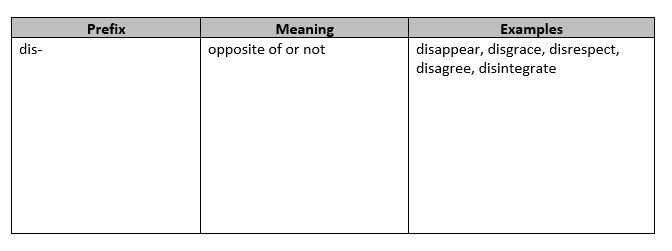
Rule a table with three columns and label each column with titles ‘Prefix’, ‘Meaning’ and ‘Examples’ (see below)
Record the matching prefix and meanings from above, then brainstorm at least 5 examples of each. For example, ‘dis‘ means ‘opposite of or not’. disappear, disgrace, disrespect, etc.
Task 2: Playing with Prefixes - This task should take about 30 minutes to complete.
How many ‘real’ words can you make by adding different prefixes to the following 10 base words?
cover, happy, accept, friend, success, pack, teach, open, part, joy
Record your responses in your home learning book. Don’t forget to tally up how many words you came up with altogether.
Write 3 separate sentences, each using any 2 or 3 of your brainstormed prefixes.
Make sure each sentence makes sense by rereading each one.
Challenge activity (optional)
Fun with Prefixes: How many ‘made up’ words (e.g. antifriend J) can you make using the 10 base words from above?
Record your responses in your home learning book. Don’t forget to tally up how many words you came up with altogether.
Write 3 separate sentences, each using any 2 or 3 of your brainstormed ‘made up’ words to create crazy sentences.
Try reading these to someone at home.
Did they think they were funny or crazy?
Maths: Number and Algebra
Learning Intention:
To build automatic response of the four processes.
To develop concepts in Number and Algebra.
Tasks:
Task 1: Sunset Maths - This task should take 5 minutes to complete each day
Each day this week, begin your Maths work with 5 minutes of ‘Sunset Maths’. This helps you to build your number fluency skills.
Log into Essential Assessment and select the ‘game controller’ icon to access Sunset Maths.
Task 2: My Numeracy - This task should take 10 minutes to complete each day
Log into Essential Assessment.
Select Measurement and Geometry.
Select General All.
Select My Numeracy.
You should now see your Learning Goals. Start working on you goals in Measurement and Geometry.
If you have finished those and feel confident you can choose new goals to work on.
Spend 10 minutes each day working on these skills in My Numeracy.
You can continue to work on goals from Number and Algebra at any time.
Task 3: Making Equations - This task should take about 15 minutes, completed 3 times this week
(45 minutes in total)
You will need a deck of cards; include the Jokers but take out all the other picture cards (Kings, Queens and Jacks).
All cards are worth their face value (9 is worth 9, 3 is worth 3 etc.) and the Aces are worth 1.
The Joker can represent any number from 1 to 10 (this is called a wild card).
If you don’t have a deck of cards, you could make some number cards up using some scrap paper.
Deal six cards face up (numbers showing) in front of you.
You will use these six cards to try and make your Target Number.
The Target Number is the next card you deal (the 7th card). For example:

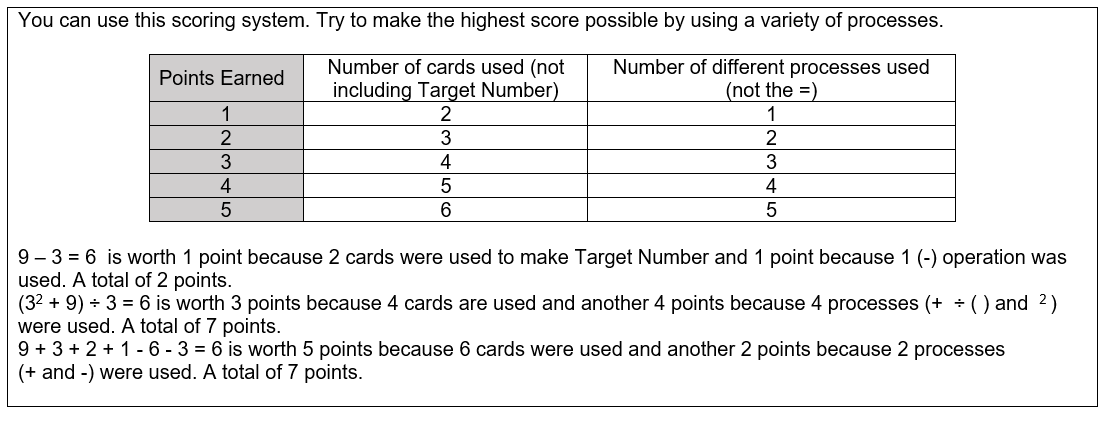
Record as many equations as you can, using combinations of your six cards, to reach the Target Number. You may use any operation, brackets, negative numbers, decimals, fractions, etc.
Use a timer and allow 3 minutes to complete as many equations as you can.
Optional Challenge:
Play another few rounds, recording your equations as you go.
If you have someone to play against, you could compete to see who earns the most points/makes the most equations.
Maths: Measurement and Geometry
Learning Intentions:
To identify and use the correct operations when converting measurements
To understand that units of measurement relate to each other in a base ten system for metric units
Mass and Weight are explained: Click here
Diameter is explained: Click here
Task 4: Cans in your Cupboard - This task should take about 30 minutes to complete.
Look in your kitchen cupboard.
What measurement is used on cans of food?
Find 5 different sized cans and order them by mass.
Compare their mass by holding 2 different cans in your hands at the same time. Look at their height and diameter. Order the 5 cans by height. Order them by diameter.
Draw 3 different cans, labelling all the measurements you can find for them.
Write about what you have discovered.
Maths: Measurement and Geometry
Learning Intentions:
To identify and use the correct operations when converting millimetres, centimetres, metres, kilometres, milligrams, grams, kilograms, tonnes, millilitres, litres, kilolitres and megalitres.
To understand that units of measure relate to each other in a base ten system for metric units.
Task 5: A year of soft-drink cans - This task should take about 60 minutes to complete.
Did You Know? A typical household of four uses about 750 aluminium soft-drink cans every year.
(assume for this activity that all the cans contain 375 millilitres, are 12.5 centimetres high, and have a diameter of 6 centimetres).
(If 750 cans is too many for you to work with, choose a smaller number of cans. For example, this could be as small as 2 cans, 10 cans, 50 cans or 100 cans. Work with a just right number for you.)
Record your responses using the most appropriate unit of measurement, e.g. mm, cm, m, km, etc.
- If all the cans were put end to end, how far would they stretch?
- How could you find the mass of an empty 375 millilitre can?
- If an empty can weighs aproximately 18 grams, what is the mass of 750 empty cans?
- How much liquid would be inside 750 full cans?
Optional Challenge 1: Can you convert your answers to alternative units of measurement?
Optional Challenge 2: How many cans do you think Laburnum Primary School families use? How far would they stretch? How much would it weigh? How much liquid would this be?
Wellbeing:
Resilience, Rights and Respectful Relationships ‘Positive Coping’
Learning Intention:
To share positive coping strategies with those around us.
Tasks:
Task 1: Create a positive coping profile for yourself - This task should take about 20 minutes to complete.
Think about the situations where you might feel worried, scared, anxious, stressed etc. and consider how the five categories from the activity last week could help (Energetic, Self-calming, Social, Shifting your Attention, Getting Organised).
Have you noticed that your use of positive coping strategies has changed since you have been learning from home?
You could write, draw, paint or create a comic strip to show your response.
Show this to a family member and ask them for further suggestions and to make a comment on your ideas.
Task 2: Create an Accomplishment Jar - This task should take about 30 minutes to complete initially and then you will add to the jar each day.
Achieving goals and accomplishing our objectives helps us to grow and build on our success.
We should celebrate our achievements, no matter how big or small.
Feeling positive about our achievements will have a positive impact on our mood and feeling of wellbeing.
To complete this task, you will need a jar or box and some small slips of paper.
Decorate and personalise the jar or box to reflect your personality!
Each day, try to add at least 5 slips to the jar or box.
You should write down the thing you accomplished and how it made you feel.
For example:
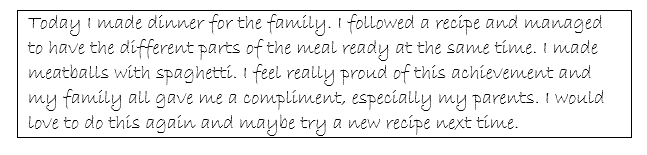
At the end of the week, read back through the slips in your Accomplishment Jar. Well done. Give yourself a high 5!
Task 3: Challenge yourself - This task should take about 30 minutes to complete.
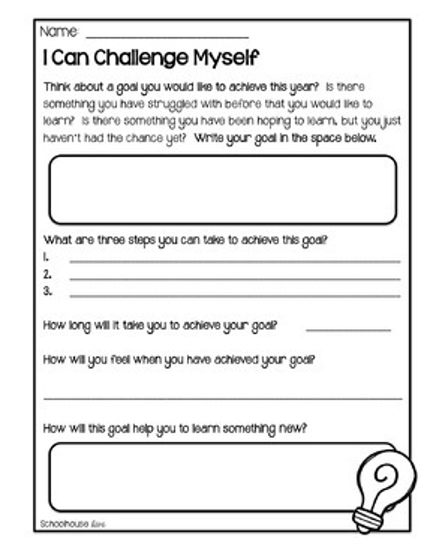
See the image below and consider a goal you would like to work on whilst Learning from Home.
How can you use a growth mindset to work towards meeting this goal?
Think back to our work early in term 1 about the Learning Pit. Positive self-talk, positive coping strategies and the school value of ‘Resilience’ are all going to be helpful when working towards a goal.
Present your goal, including the steps you will take to work towards it, in a creative way in your home learning book.
Inquiry:
Learning Intention:
To investigate the impact of bushfires
Tasks:
Task 1: The Impact of Bushfires - This task should take about 45 minutes to complete.
Climate and environmental features make parts of Australia very prone to bushfires.
Click here to read about some of the most serious bushfires in Australia from the last 100 years.
Develop a table to record your learning about each of the fires listed. See below for an example:
|
Name and date of the fire |
Location |
Impact on land, including flora and fauna |
Lives lost |
Other interesting information |
Ongoing impact of this fire |
Task 2: Further Reading - This task should take about 30 minutes to complete.
Read the following book in Epic about Forest Fires.

What connections can you make between fires in Australia and the information in this text? Record your thinking.
Watch this clip from BTN about fires in NSW.
How do the fires impact the community?
Science
Learning Intention:
To analyse numerical and factual information
To describe and discuss the use of the Richter and modified Mercalli scale to measure earthquakes
Tasks:
Task 1: Earthquake Impact - This task should take about 20 minutes to complete.
Read this book to learn a little more about Earthquakes: Exploring Earthquakes. Seismologists at Work in Epic
Now read the following eyewitness account about the Newcastle Earthquake in NSW, Australia, 1989.
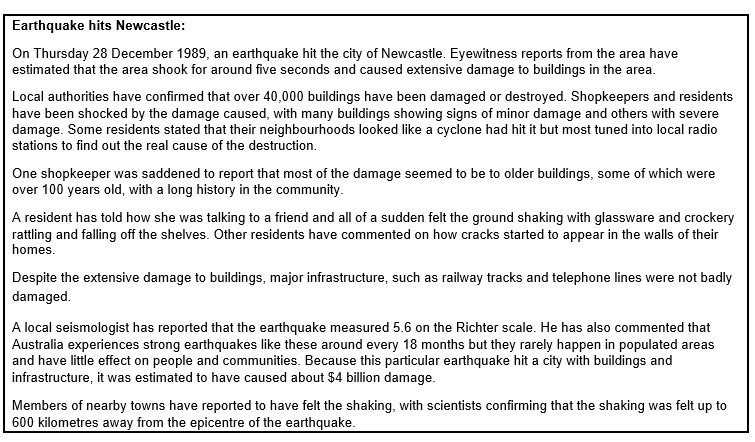
In your home learning book, answer these questions:
- What happened?
- When did it happen?
- Where did it happen?
- Who did it affect?
- Why did so much damage happen?
Task 2: Measuring Earthquakes - This task should take about 20 minutes to complete.
The Modified Mercalli scale is used to measure the intensity of, or destruction caused by, an earthquake.
The Descriptors are ordered using roman numerals (1-12), starting with the weakest earthquake and progressing to the strongest.
In the table below, the Descriptors are in the correct order but the Effects have been muddled up.
In your home learning book match the Effect to the Descriptor. E.g. I. Instrumental = J (or print it out and match with lines)
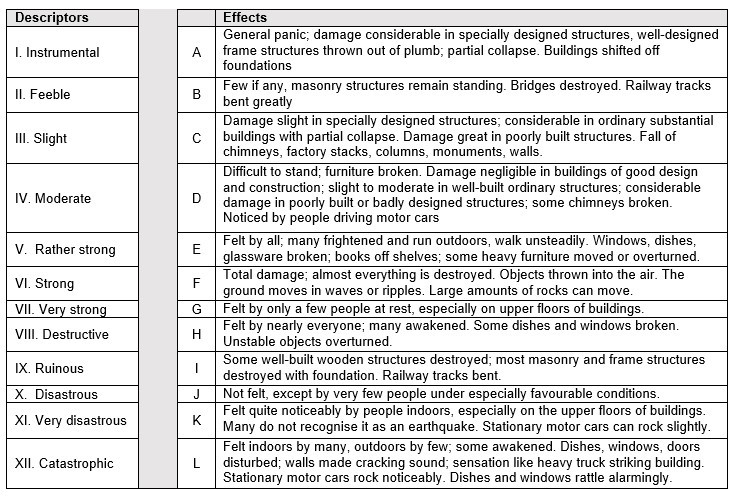
How did you go with matching the Descriptors with the Effects? Check your answers here
Task 3: Mercalli Scale – This task should take about 20 minutes to complete
In your Home Learning Book, complete responses to the following questions in full sentences.
- Use the Eyewitness Account about the Newcastle earthquake to determine where it would be rated on the Modified Mercalli scale. Why?
- Watch the start (1minute 10second) of the BTN episode from 2011 about New Zealand earthquakes here.
Where would these earthquakes rate on the Modified Mercalli scale? Why? - Why was the Richter scale developed when the Modified Mercalli scale already measured earthquakes?
- Watch the rest of the BTN episode and write down any new knowledge you’ve found out.
Reflection: What are you wondering about earthquakes?
What would you like to find more about?
Write down any questions you have.
Click here for the Specialist options.
Self-Reflection:
Pointss you may like to consider:
- How did I organise my time this week?
- Was I successful in completing the allocated tasks?
- Which tasks did I particularly feel proud of achieving?
- Challenges I had along the way
- What I could do more effectively next time?
(This task should take about 20 minutes to complete)
© Copyright Laburnum Primary School