
Year 5 Learning from Home Week 4
Week beginning - Monday 4th May 2020
Welcome to Week 4!
It was lovely to speak to you on Webex last week about how your learning is going so far.
This week, each task will take about 40 minutes and should be completed in your workbook or on study paper.
Our focus for this week is Resilience - We can do it!
Try to solve problems with different thinking.
If you find something challenging then use some strategies to help you to bounce back; for example, walk away for 5 minutes then come back to it, move on to the next activity then come back when you are ready, or write down your questions to ask an adult when they are available.
Remember, you can ask your parents to help you send a message to your teacher’s Sentral mailbox.
Reading
Learning Intentions:
We are learning to create our own digital book box using Epic!
We are learning to retell the main events in fiction books.
We are learning to find keywords in non-fiction books.
Each Week - Continue to independently complete a total of 60 minutes of Just Right Reading over the week.
Record your reading in your Student Diary every day: title, page numbers, genre and time spent reading.
Try to build your stamina (how long you can read for without taking a break) each day.
If you choose to use Epic! click on the blue mailbox at the top right-hand side of the page and this takes you into all your assigned books.
You can listen to a book being read to you, as well as practising reading this aloud for fluency.
Tasks:
Set Up Your Epic Book Box: (40 minutes)
Log on to Epic.
To set up your online book box (‘favourites library’), firstly browse the site and find at least 6 books you can add to your ‘My Library’ list.
You can do this by clicking the ‘Explore’ tab top right.
You need to find at least 3 fiction texts and 3 non-fiction texts.
Most books should be Just Right (at your reading level) but choose some easy and some challenging books for variety as well.
If you do not have access to Epic online, set up a book box with a variety of texts you have at home.
This could include the newspaper, cookbooks or other texts that interest you.
(This task should take about 20 minutes to complete).
Spend the remainder of the lesson reading a Just Right book.
Step 1: Open a Just Right Book and click on the heart in the top left-hand corner of the page.

Step 2: Click on “My Library” at the top of your page.
Scroll down to find the books that you have added to your virtual book box (‘favourite books’).
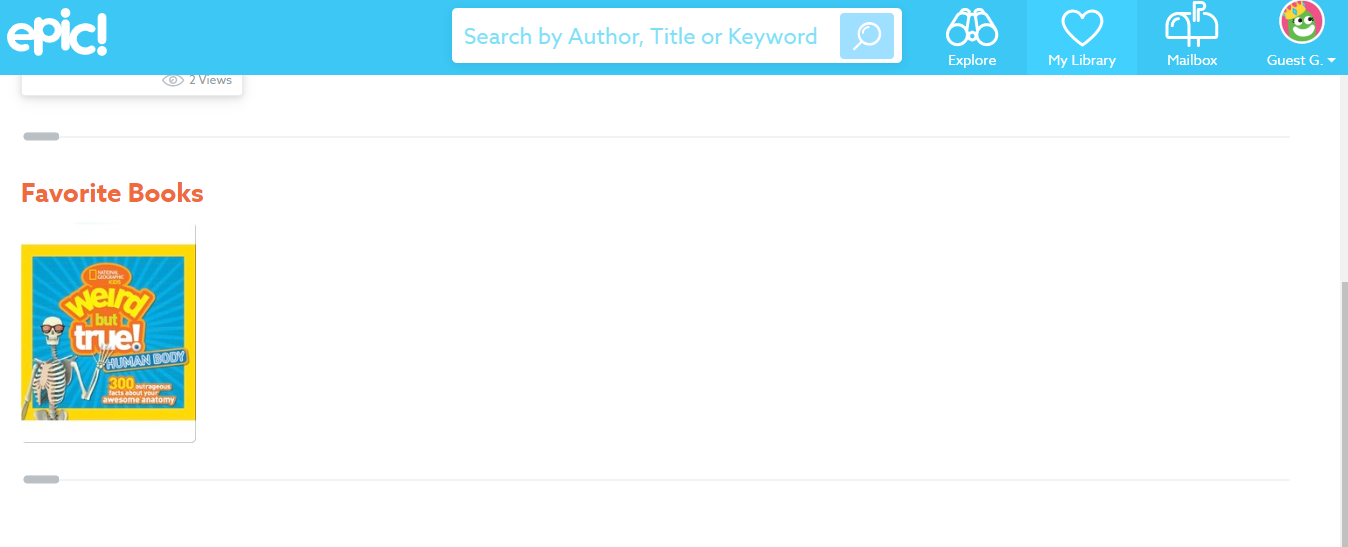
Challenge: What are your thoughts on Epic?
Write a short reflection detailing your thoughts in your workbook.
Retelling a fiction narrative: (40 minutes)
Information: ‘Retelling’ is a reading strategy that helps us to monitor our understanding of a text.
When retelling, we need to decide what the most important information in the text is.
We do not add anything, such as inferences, judgements or opinion.
We just state what the text told us.
We can use the Story Retell Rope strategy below to guide our retells.
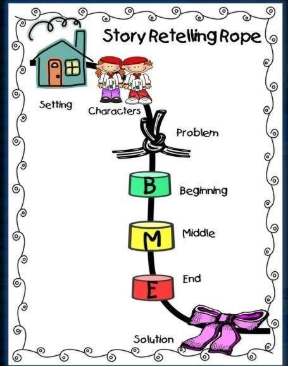
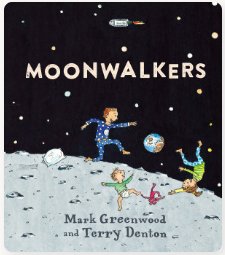
Access the Storybox Library video ‘Moonwalkers’ by Mark Greenwood and Terry Denton.
After the video, write a retell including the key points of the text in order.
You must include the setting, characters, problem, beginning, middle, end and solution.
Retelling a Fiction Narrative: (40 minutes)
Read a Just Right Book of your own.
This could be a book that has been assigned to you by your teacher on Epic! or a book from your own digital book box.
Write a retell including the key points of the text.
Remember to follow the Story Retell Rope.
Retelling a Non-fiction Text: (40 minutes)
Open the text ‘12 Incredible Facts about the Moon Landing’ on Epic!
(Tip: Search for the book title in the bar at the top of the web page).
Read pages 12 to 17.
Record what you consider the most important information from each page.
You may use the text features, such as headings, images, captions, and sidebars to help you navigate the important information.
For each piece of information, explain why you think it is important.
Shared Class novel: (10 minutes)
We will continue to share our class novel on Epic! ‘The Inventions of Hugo Cabret’ by Brian Selznick
(remember, the chapter audio book has been assigned to you).
Listen to Part One, Chapter Two (5:10) and Part One, Chapter Three (3:54).
Stop and Buzz (share your thoughts) with a family member about how you visualise the main character.
Writing
Learning Intentions:
We are learning to interview by asking questions, listening to answers and recording important information
We are identifying different types of writing
We are learning to make origami
Natural Disaster Interview Questions: (40 minutes)
Natural disasters have an effect on everybody who experiences or hears about them.
Find a family member or friend who has gone through a natural disaster, or heard about one on the news and conduct an interview using the questions below.
Please be considerate when interviewing your family member.
If they experienced a traumatic disaster first-hand, they may still be upset by the event.
Check with your parents if it is appropriate to interview your chosen family member first.
Make sure to take notes when conducting the interview.
Afterwards, write a summary of their answer for each question.
Your formatting should be similar to this Kids News Article.
- What type of disaster did you experience or hear about?
- When and where did this disaster occur?
- What did people do to prepare for the disaster?
- What steps did people take during the disaster to protect themselves or their home/s?
- What was the experience like after the disaster?
- What did people learn from this experience?
- How did people feel during this experience?
- What advice would you give to someone who were to encounter this situation?
Challenge: Write two of your own questions to add further detail to your interview.
What else are you interested in learning about this natural disaster?
Mother’s Day/Special Person Interview: (40 minutes)
Sunday 10th May is Mother’s Day.
How much do you know about your mum/step-mum/special person?
Write down at least 10 questions that you would like to ask them e.g.
“Where did you grow up?”
“What was a funny thing that you did as a child?”
“What’s one of your earliest memories?”
“What is the most trouble you’ve gotten into and why?”
“What did you want to do when you grew up?”
Conduct your interview (either in person, over the phone, or online) and record the answers in your book.
You will need these for the next activity.
Challenge: Ask the same questions to your grandmother, or another member of your family who knows your mum/step-mum/special person, and see what they say.
You might need to conduct this interview over the telephone or online.
Are their responses similar or different?
Origami Poem/Card: (40 minutes)
Materials: 2 pieces of large square paper (all four sides should be the same length), 1 piece of small square paper, a ruler, a pencil, textas or pencils, and RESILIENCE.
Follow the visual steps below to make an origami card to give to the person you interviewed in the task above.
Write a letter in your card.
Include some of the details you learned in your interview to personalise your letter.
You could also create an acronym (see Spelling task) to include in your Mother’s/Special Person’s Day Pop Up Card.
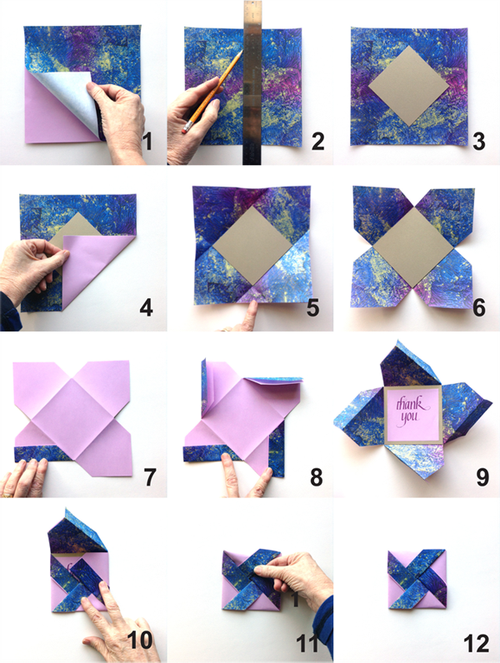
Challenge: If you know how to make another type of origami, then make some more fun paper shapes to give to your mum/step-mum/special person as a gift.
Be Resilient. If it doesn’t work the first time, try again!
Personal Choice Writing: (40 minutes)
You can choose to write a comic, letter, narrative, diary entry, a recount or another type of writing that interests you.
Make sure your work is neat and you edit your work when you have finished.
Spelling
Learning Intention:
We are learning to use acronyms and abbreviations
We are learning to create acrostic poems
Tasks:
Acronyms and Abbreviations: (30 minutes)
An acronym is a word whose letters are the first letters of other words e.g. QANTAS = Queensland and Northern Territory Aerial Services, NASA = National Aeronautics and Space Administration.
Abbreviations are short forms of words.
They take only some letters from the word or phrase e.g. etc.= et cetera (French for ‘and so on’), Apt = Apartment,
Approx = Approximately, Jan = January.
Acronyms and abbreviations are great to use in casual communication, such as emails and texts.
As a general rule, don’t use full stops after any abbreviations, contractions or acronyms and close up space between letters.
Using the list of acronyms and abbreviations below, complete the following tasks in your workbook:
SA, NSW, Vic, WA, Tas, Au, cm, LOL, mm, kg, Ave, USA, Blvd, St, RIP, Dr, PM (not time), Mr, adj, ASAP, PS, TBH, ATM, VIP, Hrs, Ms, ie, est.
- In a table, organise the list based on whether they are acronyms or abbreviations.
- For each of the acronyms and abbreviations, write the meaning in your book.
- Now is your chance to make funny acronyms of your own!
e.g. SALT - Same As Last Time, TMB - Too Many Birthdays.
Create six of your own.
Feel free to use one of these in your card to make your mum/step-mum/special person smile.
Challenge: Can you think of any abbreviations we didn’t include in the list above?
Create an Acrostic Poem: (30 minutes)
Information: An acrostic poem is a type of poetry where the first letter of a series of words spell out a word or phrase.
We can use this as a memory aid for challenging spelling words.
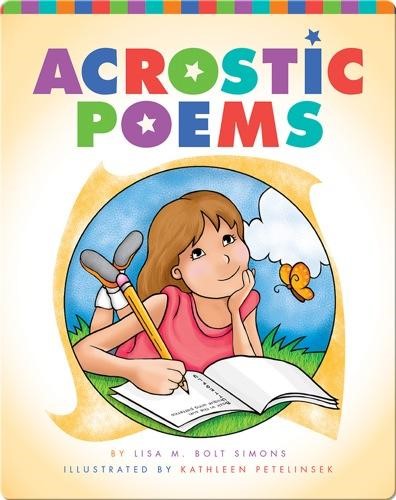
Task: View Acrostic Poems on Epic!
Create your own Acrostic Poem from the examples given in the book.
Below is another example using the word EARTH.
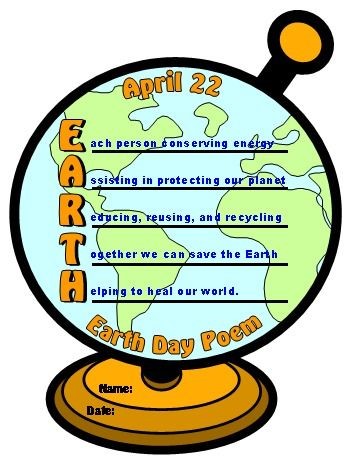
Each person conserving energy
Assisting in protecting our planet
Reducing, reusing and recycling
Together we can save the Earth
Helping to heal our world
Challenge: Take the quiz at the end of the Epic! book on Acrostic Poems
Maths
Learning Intention
We are learning to practise our times tables
We are learning to identify and use 24-hour time
We are learning to convert time using 12- and 24-hour time
We are practising our maths skills using Essential Assessment
Tasks:
Daily Warm up - Times Tables: (5 minutes) Ongoing Work
How did you go practising your times table last week?
Have a family member test you on the one you were learning.
If you have mastered it (you can recite them automatically in any order), then choose another times table to practise, otherwise you may need to spend another week learning the same tables as last week.
Information: Have you seen time written as 17:00 or 20:00?
That's an example of time measured in 24-hour time.
In 12-hour time this would be 5:00pm and 8:00pm.
So why do we have 12-hour and 24-hour time?
12-hour time is used when reading analogue clocks. Most clocks only have twelve hours marked on them. The hour hand will complete two revolutions in a day. So, we would read the same hour twice a day (e.g. 8:00am in the morning and 8:00pm in the afternoon).
24-hour time shows the actual number of hours and minutes that have passed since midnight.
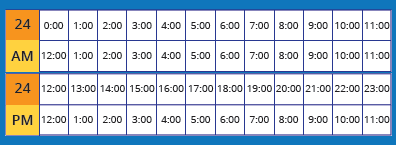
In Image 1, at midday (12:00 pm), a 12-hour clock goes into its second rotation, then continues to 1:00 pm.
A 24-hour clock keeps counting the hours that have passed since midnight.
At 1:00pm, 13 hours have passed since midnight, so we write the 24-hour time as 13:00.
You do not need to write pm.
We know that it is in the afternoon because the number is bigger than 12.
Image 1: Conversion Table for 12- and 24-hour time
Late Again!: (40 minutes) (Answers to questions are found at the bottom of the page, under self-reflection)
Watch the video Late Again! from the ABC Education website that explains how to calculate 24-hour time.
As you view, write and answer these questions in your workbook:
- The host says his train leaves at 15:35. What time is that in 12 hour time?
- What are the two commonly used time systems?
- What time system is used in health, transport and the military? Why is that system used?
- In 12-hour time what do the letters 'am' and 'pm' mean?
- What time is it at 6:00 and 22:00?
Now write and convert these times into 24-hour:
6) 5:00am 7) 5:00pm 8) 7:30pm 9) 9:15pm 10) five past eleven at night
11) 20 past 1 in the afternoon 12) midday 13) midnight
Finally, write and convert these times into 12-hour:
14) 23:45 15) 14:45 16) 09:00 17) 18:15 18) 17:49 19) 11:15 20) 22:50
Challenge: Notice that midnight is 0:00 in 24-hour time.
Why is this?
Describe this in a sentence.
24-Hour Timetables: (40 minutes)
Rewrite your daily learning timetable in 24-hour time.
Or
Europe uses 24-hour time.
Write a holiday plan for one day in Paris, London or any other European city.
What would you want to do or see in your chosen city? For example, in Paris you would want to see the Eiffel Tower, eat a croissant and visit the Louvre. What will you do at each time? How long will it take?
Challenge: It is 225 minutes until midnight.
What time is it on a 12-hour and 24-hour digital clock?
Elapsed Time Mountain Strategy: (40 minutes)
You will create a timeline with mountains, hills, and rocks. Fill in the times used as you go.

Example: I need to add 1 hour and 23 minutes to 2:35pm.
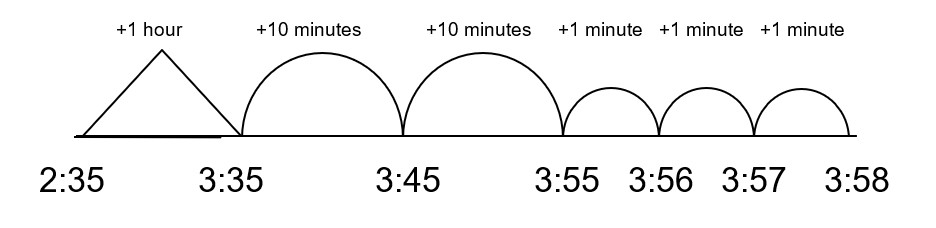
So by adding the hour first, then the ten minutes and lastly the single minutes, we find the final time.
Problem 1: Dr Dray was dropped off at the cinema at 4:40pm and her mum picked her up at 7:37pm.
How long was Dr Dray at the cinema?
Draw a timeline listing your start time at the left-hand side and your end-time at the right-hand side.
4:40pm 7:37pm
Problem 2: Ms Braden started her Assistant Principal homework at 3:45pm and she worked for 2 hours and 37 minutes.
What time did she finish her work?
Make your line with the start time at the left, and leave the end time blank.
Work left to right adding on mountains, hills, and rocks until you have used all of the 2 hours and 37 minutes.
When finished, check that you have moved the required time.
The end time will be the final jump.
Problem 3: Mrs Verbi finished repairing her shower at 7:29pm.
She began 3 hours and 45 minutes earlier.
What time did Mrs Verbi begin the job?
Make your line with the end time on the right and leave the start time blank.
Work right to left adding mountains, hills, and rocks until you have used all of the 3 hours and 45 minutes.
When finished, check that you have moved the required time.
The start time will be your final jump.
Challenge: Look at a television guide and choose your favourite shows to watch.
What time are they, using 24-hour time?
Add 12-hour clock face drawings.
AND/OR
Write a short help guide to using a bus timetable.
The aim is to help commuters understand what 24-hour time means.
What information would you include to help people from misreading the timetable?
Add 12-hour clock face drawings.
My Numeracy: (Time to complete, this task will vary from student to student)
We will be checking your progress on My Numeracy this week.
Log in to Essential Assessment.
If you have not completed any of your assigned pre-tests then this is your first priority.
Once complete, choose one area to start working on your My Numeracy Goals.
If you are completing an assessment, you must complete these under test conditions, which means:
No assistance from anyone, no distractions, use a pencil and paper to work out answers and no calculators.
You will be expected to demonstrate our school value of ‘integrity’ when completing this task.
Inquiry
Learning Intention:
To investigate the Natural Disasters that affect our country
Australian Natural Disasters: (30 minutes)
What natural disasters affect Australia?
Which do not?
Make a list in your workbook, and list a real example of at least one.
Two examples are the Queensland floods and the Victorian Black Friday Bushfires.
Challenge: Why does Australia not have any active volcanoes or serious earthquakes?
Explain why in your workbook; you may need to include diagrams!
Science
Learning Intention:
To investigate the phases of the moon
Information: The moon is in orbit (rotation) around the Earth.
It takes roughly 29 days to make a full orbit.
This is where the word ‘month’ comes from, as the calendar used to be based on the moon’s orbit around Earth, rather than the Earth’s rotation of the sun.
We can see the moon because it reflects the sun’s light, but this reflection changes throughout the month.
We call this a ‘phase’.
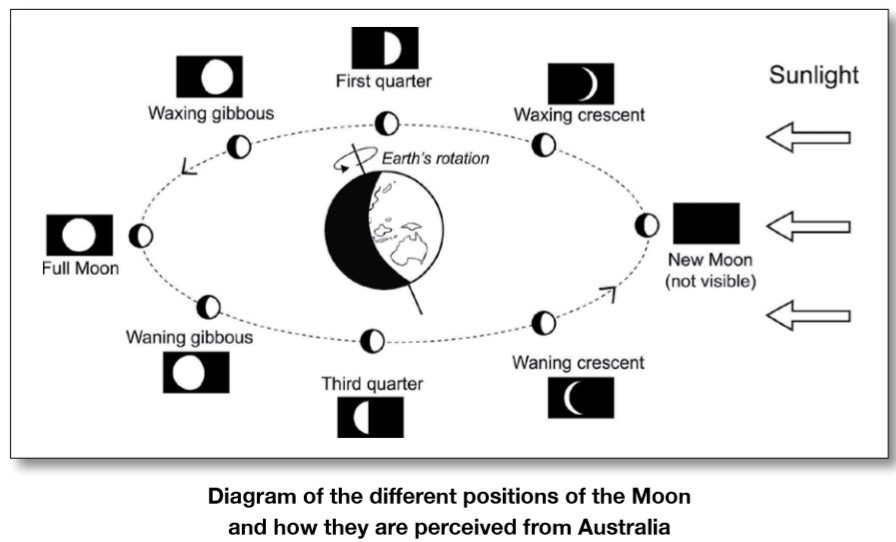
Chart the changes in the moon’s phase: (40 minutes)
Create your own flow chart of the phases of the moon, in your own way.
You could draw a diagram similar to above.
You could create a model using paper, orbs or LEGO.
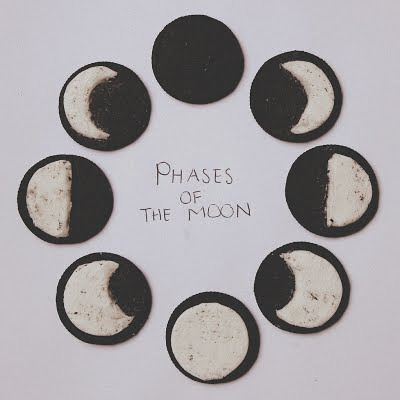
You could even use food such as cheese and crackers or cream biscuits, like in the picture below!
Label the stages of the phase with the terms in the diagram. (e.g. waning gibbous).
Challenge: In a dark room, or in your backyard at night, use a torch and a ball (basketball, tennis ball, etc.) to copy the phases of the moon.
Can you figure out a way to model an eclipse?
Wellbeing:
Resilience, Rights and Respectful Relationships ‘Positive Coping’
Learning Intention: We are learning positive coping strategies
Task: Create a ‘positive coping’ profile for yourself.
Think about situations you have been in (or might be in) where you felt worried, scared, anxious, stressed etc. and draw yourself and label the coping strategies that you used that helped.
Write five significant people that you could call on to assist you in difficult situations while you are learning from home.
Show this to a family member. Ask them for further suggestions and to make a comment on your ideas.
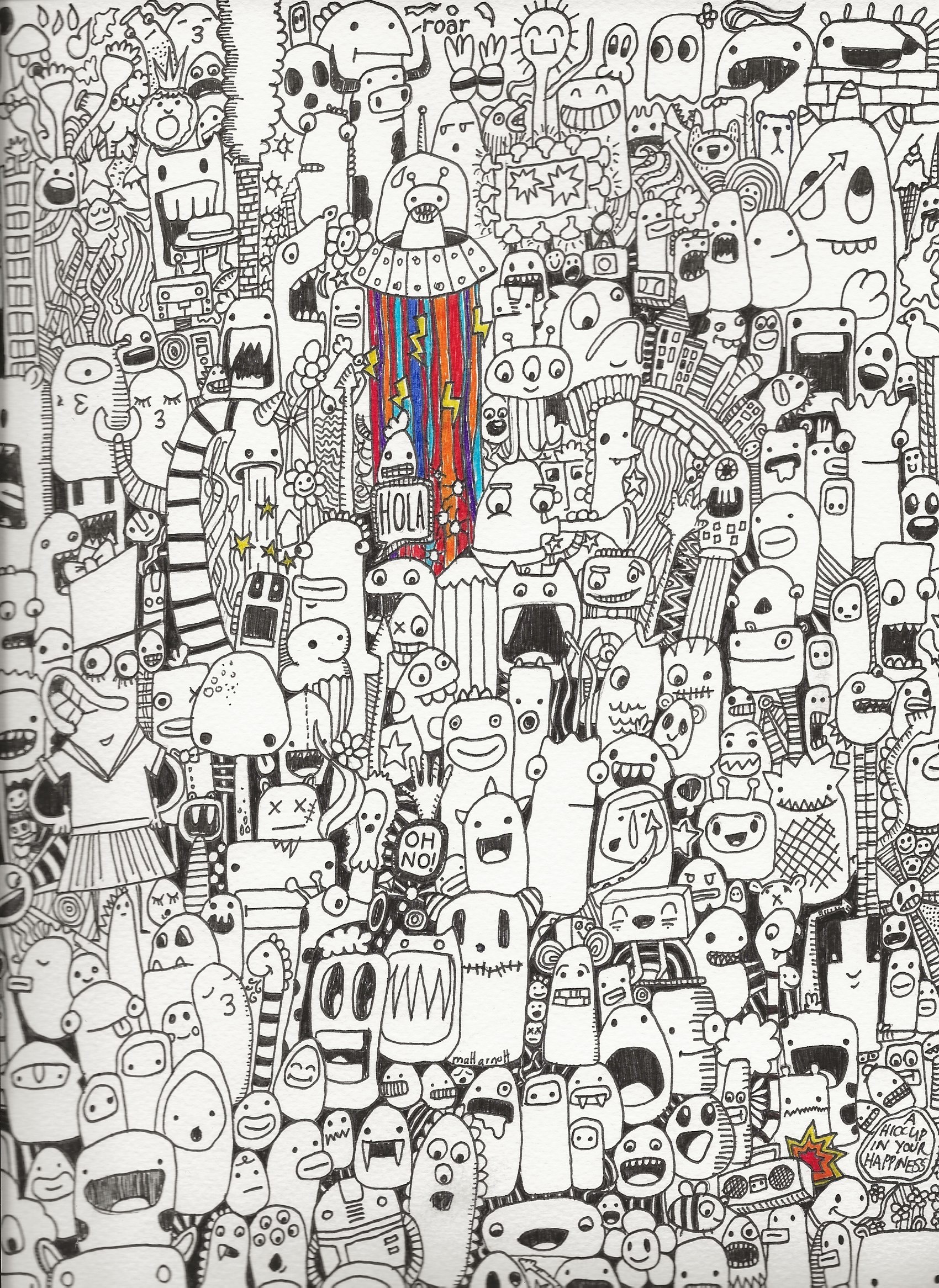
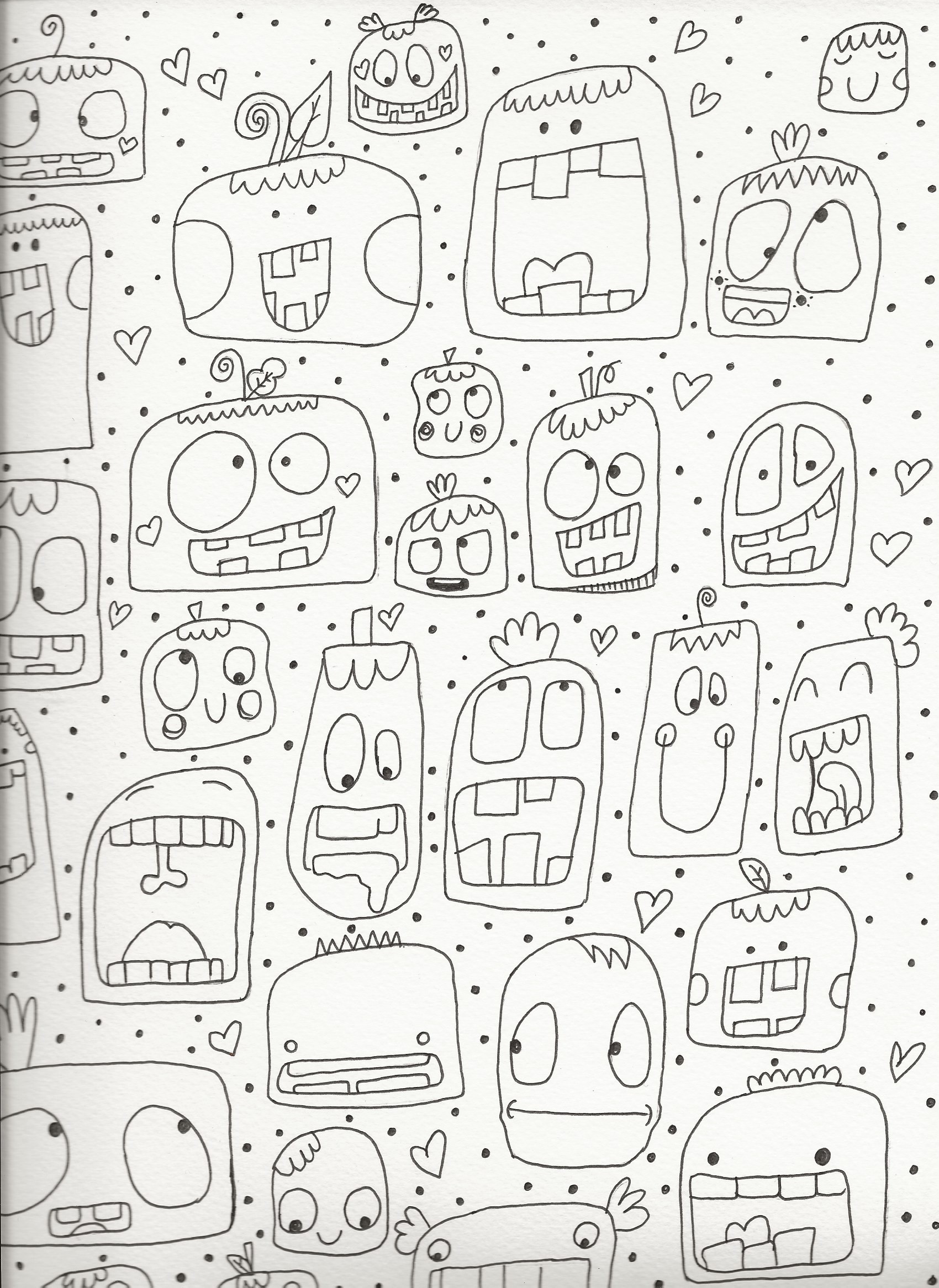
Mindful Colouring: Research suggests that mindful colouring, as with meditation and art therapy, can provide numerous benefits for all ages.
It can also provide a much-needed break and the chance to relax and refocus.
The colouring sheets below were made by our own Mr Arnott! Wow.
You can save and print them out to colour.
Specialist Classes:
Click here for the Specialist options:
Self-reflection:
Write in your school diary about how you were resilient this week.
Answers for Week 4
SPELLING
Acronyms and Abbreviations:
1.
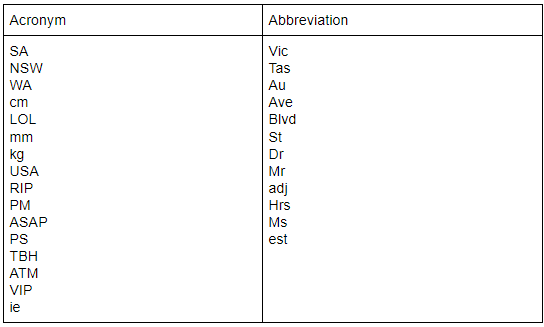
- SA - South Australia, NSW - New South Wales, Vic - Victoria, WA - Western Australia, Tas - Tasmania, Au - Australia or the element Gold (on the periodic table), cm - centimetre, LOL - laugh out loud, mm - millimetre, kg - kilogram, Ave - avenue, USA - United States of America, Blvd - boulevard, St - Street, RIP - Rest in Peace, Dr - doctor, PM (not time)- Prime Minister, Mr- Mister, adj- adjective, ASAP- As Soon As Possible, PS- post scriptum, TBH - To Be Honest, ATM - At The Moment or Automatic Teller Machine, VIP - Very Important Person, Hrs - Hours, Ms - Mistress, ie - ‘id est’ (Latin for ‘that is’), est.- established
MATHS
‘Late Again’ Answers
- The host says his train leaves at 15:35. What time is that? 3:35 pm
- What are the two commonly used time systems? 12-hour and 24-hour
- What time system is used in health, transport and the military? Why is that system used? 24-hour time. It is used to avoid confusion between am and pm.
- In 12-hour time what do the letters 'am' and 'pm' mean? am - Ante Meridiem pm - Post Meridiem
- What time is it at 6:00pm and 22:00? 6:00pm - 18:00, 22:00 - 10:00pm
Convert these times into 24-hour:
- 5:00am = 5:00
- 5:00pm = 17:00
- 7:30pm = 19:30
- 9:15pm = 21:15
- five past eleven at night = 23:05
- 20 past 1 in the afternoon = 13:20
- midday = 12:00
- midnight = 00:00
Convert these times into 12-hour:
- 23:45 = 11:45 pm
- 14:45 = 2:45 pm
- 09:00 = 9:00 am
- 18:15 = 6:15 pm
- 17:49 = 5:49pm
- 11:15 = 11:15am
- 22:50 = 10:50pm
Elapsed Time Answers
Problem 1
1 hour + 1 hour = 2 hours
10 min. + 10 min. + 10 min. + 10 min. + 10 min. + 5 min. + 1 min. + 1 min. = 57 minutes
2 hours 57 minutes
Problem 2

6:22pm
Problem 3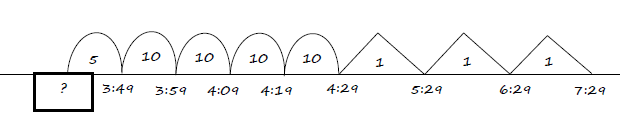
3:54pm
© Copyright Laburnum Primary School