
Year 4 Learning from Home Week 3
Week beginning - 27 April 2020
Book Expectations
These activities need to be completed in your lined homework book OR scrap book. Sticky notes should be kept in your lined homework book under the title of the book you have read. For each learning task you must include the following:
- Date
- Title underlined (Subject/Week, e.g. Reading Week 2)
- Joined handwriting that should be neat and correct line spacing used
Reading
Learning Intentions:
We understand the difference between what we already know about a topic and what new information is.
We are finding important information in a non-fiction book.
We are reading with expression (also known as intonation).
We are sharing our experience of reading from home.
Tasks:
- Ensure you are reading a Just Right book independently for at least 30 minutes each day. Remember to record these books in your reading log.
- Use a ruler to draw a table with two columns in your lined homework book. At the top of each column, write the headings ‘What I already know’ and ‘New information’. Soon you will read a book about haiku poems. Before you read this book, think about what you already know about haiku poems and fill in the first column ‘What I already know’. Click here to go to the Get Epic website and log in using your class code. Your teacher has assigned you a book called ‘Read, Recite and Write Haiku’. While you are reading this book, write any new information into the second column. (20-30 minutes)
- Re-read the book, ‘Read, Recite and Write Haiku’. While you are reading this book again, write five important facts about haiku poems in your lined homework book. It might help to imagine that you are explaining what a haiku poem is to someone who knows absolutely nothing about poetry. You will need to think about what information is most important, not just interesting. Optional: Try telling someone at home your five important facts to see if they understand what a haiku poem is. (20-30 minutes)
- Read aloud a book of your choice to someone at home (e.g. family members, your pet, a favourite toy). Concentrate on noticing how you change the volume of your voice to match what is being said in the book. For example, you might lower your voice to a whisper if a character is sneaking into the kitchen to steal a cookie, or your voice might be louder if someone is shouting because they are angry. (10-20 minutes)
- In your lined homework book, write a letter to your teacher to share your thoughts about your reading while learning from home. You could include the titles of books you have enjoyed reading, what has been challenging, a goal you have set for yourself and what books you want to read next. You could also tell your teacher what you think of some of the new websites we are using for reading, like Get Epic! (10-20 minutes)
Writing
Learning Intentions:
We are revising the structure of haiku poems.
We are writing for enjoyment.
We are editing our writing to check for capital letters, spelling and punctuation.
Tasks:
- Quick write: In your scrapbook, create a brainstorm of topics that you could use to write your own haiku poem. Once you have written down your topics, make a list of interesting words that match each topic. For example, for the topic ‘Lion’ you might brainstorm words like Africa, mane, ferocious, roar and hunter. (10-20 minutes)
- A haiku poem is a Japanese poem. They are usually about nature and do not rhyme. Each line has a certain number of syllables. Below you will see the steps to write a haiku. We have separated the syllables by using a slash (/).
Title: Turtle
Line 1: 5 syllables - Glides/ through/ the/ wa/ter/.
Line 2: 7 syllables- Swim/ming/ calm/ly/ and/ a/ware/.
Line 3: 5 syllables- Harm/less/ and/ gen/tle/
Choose some topics from your brainstorm (quick write) and write your own Haiku poems in your lined homework book (10-20 minutes)
Here are some other examples:
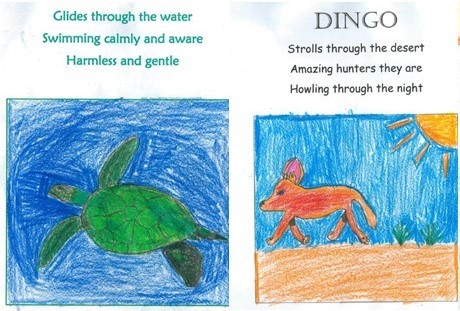
- Choose your favourite haiku poem that you have written this week. In your scrapbook create a final copy using beautiful handwriting and then illustrate like the examples above. Optional: You can illustrate more than one of your poems if you like! You could even create a book of your poems, like the poetry anthologies that we created in class last term! (20-30 minutes)
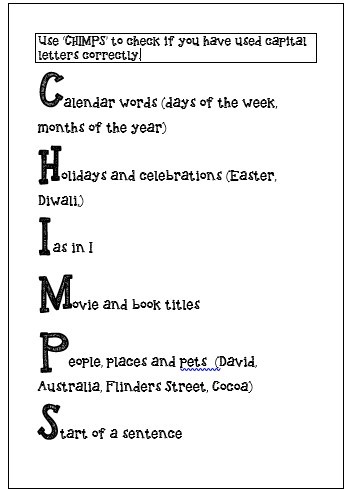
- Free choice writing: Choose a genre of writing that you would like to do today. For example; recount, narrative, poetry, letters, procedure, plays. Remember to include interesting adjectives and edit your writing to make sure you have correct capital letters (CHIMPS), punctuation and spelling. You can choose to complete your free choice writing in your scrapbook OR lined homework book. (40-50 minutes)
Spelling
Learning Intention:
We are investigating how words can be changed to create word families.
Task:
- Here are the words that we used last week in spelling:
vegetation
species
organism
environment
sustainability
adaptation
This week we have been looking at syllables in words when writing a haiku. Look at these words carefully. Say each word aloud. Can you hear each syllable? Try clapping once for each syllable. Write each word in your lined homework book and show the syllables using a slash (/). Make sure each syllable has a vowel. The first one has been done for you – veg/e/ta/tion/. (10-20 minutes)
Maths
Learning Intentions:
We are identifying and extending the repeating part of patterns.
We are creating repeating patterns.
We are using a key to interpret a simple map.
Tasks:
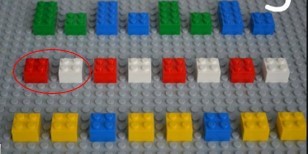
- Collect some materials from around the house. You could use anything, such as forks, blocks, lego, pencils, playing cards, or toys, as long as you have asked for permission first. With these items, your task is to make a repeating pattern. Below are three different repeating patterns that have been made with lego. The repeating part of the second lego pattern (red and white) has been circled for you. After you have created some patterns using your collection of materials, draw these patterns in your scrapbook and circle the repeating part of each pattern. Challenge: Look at the third lego pattern (blue and yellow). Can you work out what colour the 27th block will be? (30 minutes)
- Congratulations, Agent 3456. You’ve just captured a secret coded message from the Number Series Spy Network. But, as usual, there are some numbers missing. Your job, Agent 3456, is to crack the code to find the missing number in each pattern. You will need to copy each number pattern into your lined homework book, along with the next three missing numbers. Now, get cracking! Hint: Look to see if there is a repeating pattern. E.g. 95, 90, 85, 80, 75 - In that example the repeating pattern is zero, five, zero, five in the ones column. Challenge: Can you explain the repeating pattern for each problem? (10-20 minutes)
Challenge: Click here to access a range of challenging problems. You can use resources at home to help solve these; attempt as many as you can.
- In your lined homework book, create at least ten skip counting number patterns of your own. You could skip count by 2s, 3s, 4s, 5s, 6s, 7s and so on. Try starting at numbers other than zero. See if you notice any repeating patterns forming. Hint: Sometimes you need to continue the pattern for a while until you can see if there is any repeating part. Here is an example of skip counting by 6s starting at the number 36 - 36, 42, 48, 54, 60, 66, 72…. (10-20 minutes)
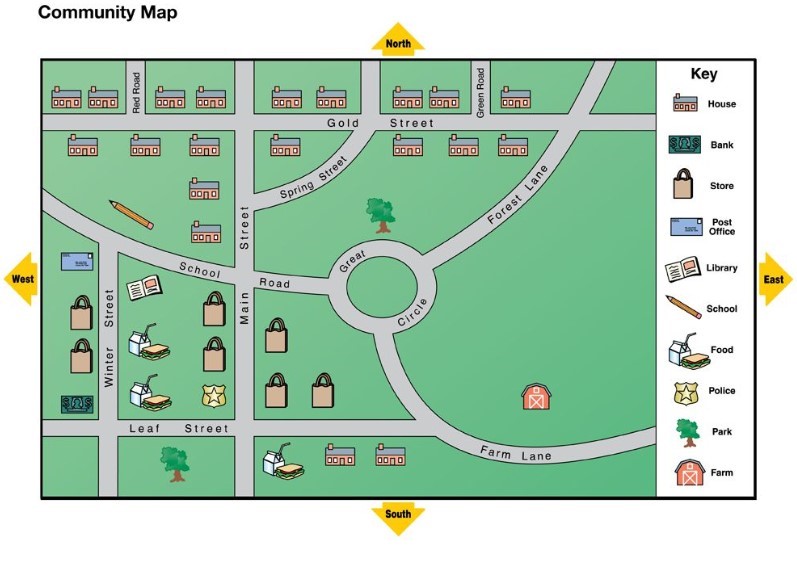
- In your lined homework book, use the map and legend (key) below to answer the following questions: (20 minutes)
- Name two streets that have many houses.
- What does the paper bag symbol mean?
- This community has one bank. Find the bank on the map and describe its location.
- Find the post office. Where is it located and what symbol is used to represent it?
- Find the police station. What type of buildings is it located between?
- What direction would you travel to get from the post office to the farm?
- How many schools are there in this community?
- How many places could you buy food from on Winter Street?
Inquiry
Learning Intentions:
We are exploring how living things, including plants and animals, have life cycles.
Task:
- Click here to go to the Get Epic website and log in using your class code. Click on your name and then go to the search bar at the top of the page and type in: life cycle. You will see many different books about life cycles pop up on the page. Your task is to choose just one book to read about a particular plant or animal. After reading your book, decide on a creative way to represent this plant or animals lifecycle. You could create a poster, diorama, Power Point, a model, or any other creative way you could think of. Use your imagination! It is also important to understand that this project could take you two to three days to complete, spending around 30 minutes each day on it. (Spread over 2 - 3 days)
Wellbeing
Resilience, Rights and Respectful Relationships ‘Positive Coping’
Learning Intentions:
We are working cooperatively and energetically.
We are exploring different ways to practise mindfulness.
Tasks:
- Find a board or card game you can play with a family member. How will you decide who goes first and what the order of players should be? What other things do you need to agree on before starting your game? Try to play your game with a positive and energetic attitude. Practise making positive comments to your partner, congratulating them on the game and thanking them for playing with you. Was this a positive experience? Reflect on what you got out of the game with these things in mind (30-40 minutes).
- Rainbow walk: Quietly walk around your house and find one item that is orange, pink, blue, yellow, purple, green and red (5-10 minutes).
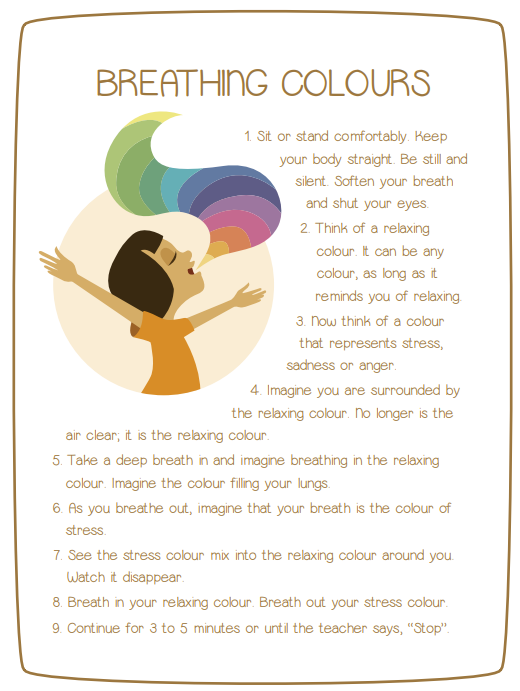
- Breathing colours: If you can, get someone to read the instructions below to you (5-10 minutes).
- Practise a mindful activity of your choice, e.g. colouring, finger knitting, origami, drawing, belly breathing. Optional: If you have an app such as Smiling Mind or Headspace, you may like to do this instead. [Reminder: your parents can find these Apps on the LFH for Parents page, if you ask them nicely!] (10-20 minutes).
Click here for the Specialist options.
Self-reflection: At the end of the week have a think about your learning.
Did you think you tried your best?
Write 2-3 sentences in your lined homework book about your learning.
What tasks did you enjoy?
Were there any challenges that you came across while learning from home?
Please remember to save your work and bring it to school when you return. We can't wait to see your Learning from Home work.
© Copyright Laburnum Primary School